In this article
- What Is the 2027 Medicare Conversion Factor?
- 2027 vs 2026 Medicare Conversion Factor
- Why the 2027 Medicare Conversion Factor Went Down
- How to Calculate Your 2027 Medicare Payment: 6 Steps
- G2211 Becomes Modifier B1 (and B2 for ACOs)
- Other 2027 Physician Fee Schedule Changes Billers Must Know
- What the 2027 Rule Means for Our Specialties
- Texas Note: Commercial Contracts Tied to Medicare
- Common Mistakes and Denials After the January Update
- Your January 1 Checklist
- Key Takeaways
- FAQs
- Get Ready for the 2027 Medicare Conversion Factor Now
- Sources
The 2027 Medicare conversion factor is $32.63 for most clinicians, and that means Medicare pays less for almost every service you bill starting January 1, 2027. The cut doesn’t stop at Medicare. Many commercial and Medicare Advantage contracts pay a percentage of the Medicare fee schedule, so they can drop too. And G2211, the add-on code many primary care practices rely on, is being replaced by a modifier. If your team isn’t ready, January claims will be underpaid or denied.
This guide explains the new rates, why they went down, how to calculate your own 2027 payments and what to change before January 1.
Quick Answer
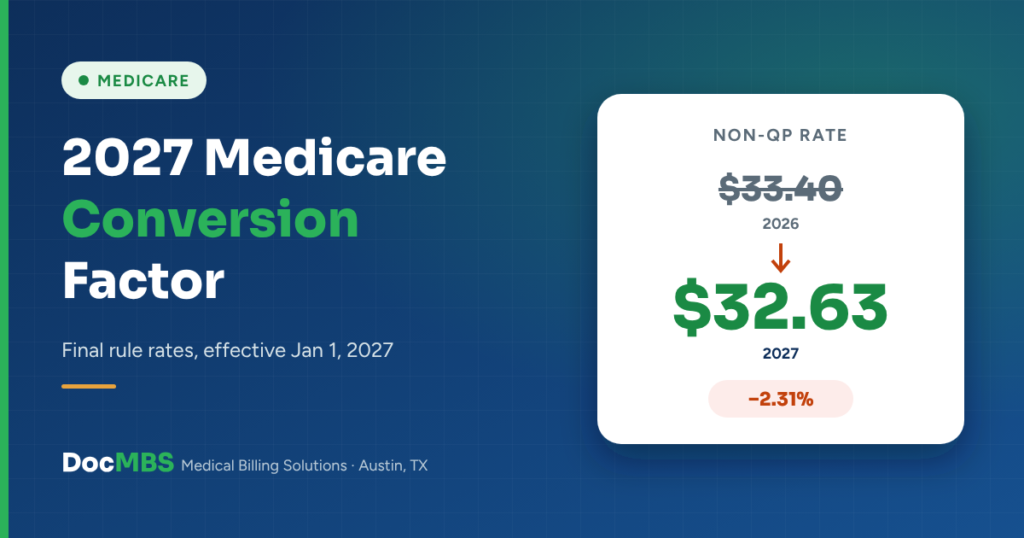
The 2027 Medicare conversion factor is $32.63 for clinicians who are not qualifying APM participants (−2.31% from $33.40) and $32.95 for qualifying APM participants (−1.83% from $33.57). The rates take effect January 1, 2027. Add-on code G2211 becomes modifier B1.
Table of Contents
- What Is the 2027 Medicare Conversion Factor?
- 2027 vs 2026 Medicare Conversion Factor
- Why the 2027 Medicare Conversion Factor Went Down
- How to Calculate Your 2027 Medicare Payment: 6 Steps
- G2211 Becomes Modifier B1 (and B2 for ACOs)
- Other 2027 Physician Fee Schedule Changes Billers Must Know
- What the 2027 Rule Means for Our Specialties
- Texas Note: Commercial Contracts Tied to Medicare
- Common Mistakes and Denials After the January Update
- Your January 1 Checklist
- Key Takeaways
- FAQs
- Sources
What Is the 2027 Medicare Conversion Factor?
The conversion factor is the dollar amount Medicare uses to turn relative value units (RVUs) into a payment. Every service on the Medicare Physician Fee Schedule (PFS) has RVUs for physician work, practice expense and malpractice. Medicare adjusts each one for your location with a geographic practice cost index (GPCI), adds them up and multiplies by the conversion factor.
The formula:
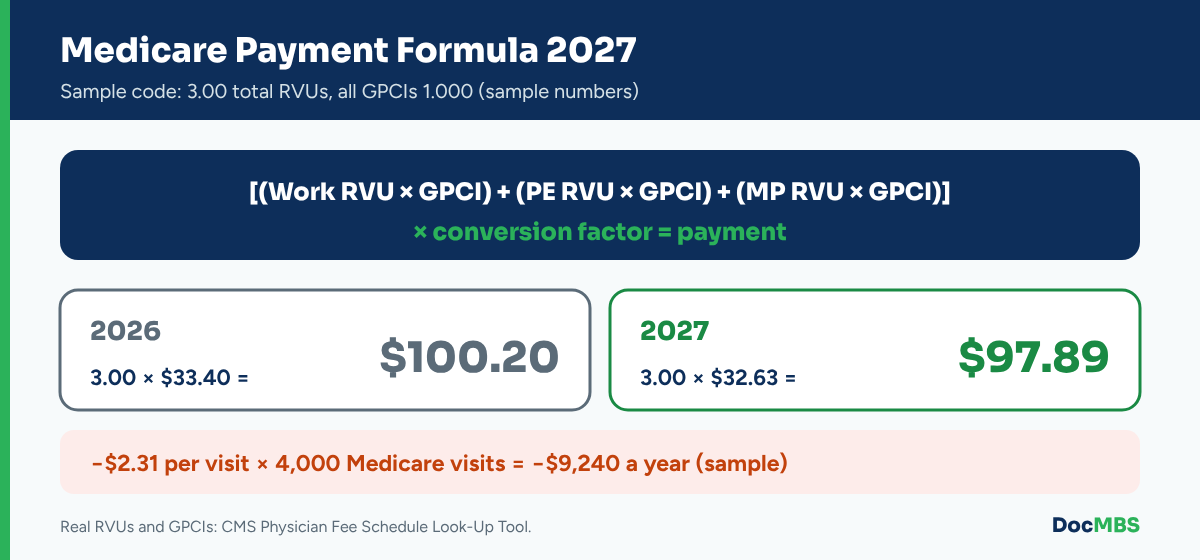
Payment = [(Work RVU × Work GPCI) + (PE RVU × PE GPCI) + (MP RVU × MP GPCI)] × conversion factor
CMS published the 2027 Medicare conversion factor in the CY 2027 Physician Fee Schedule final rule, released November 4, 2026. Since 2026, Medicare uses two conversion factors: one for qualifying APM participants (QPs) in Advanced Alternative Payment Models, and one for everyone else (non-QPs). Most independent practices use the non-QP rate.
2027 vs 2026 Medicare Conversion Factor
Here’s how the 2027 Medicare conversion factor compares with 2026, from the CMS fact sheet for the final rule.
| Type | 2026 | 2027 final | Change ($) | Change (%) |
|---|---|---|---|---|
| Non-qualifying APM participants (most practices) | $33.40 | $32.63 | −$0.77 | −2.31% |
| Qualifying APM participants (QPs) | $33.57 | $32.95 | −$0.62 | −1.83% |
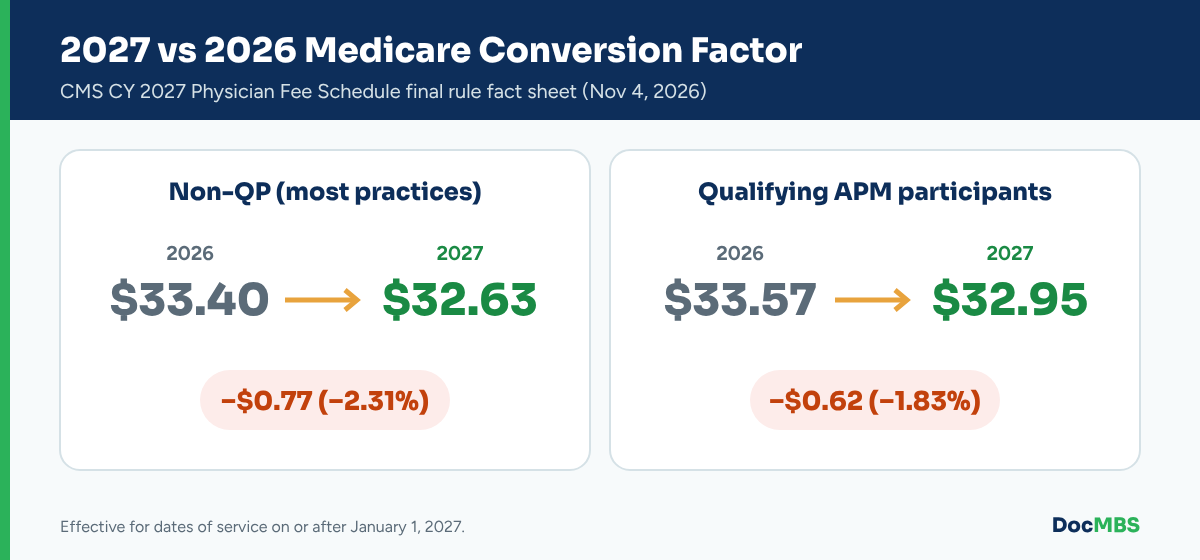
The final cut is larger than CMS proposed in July. The proposed rule projected about −1.68% for non-QPs and −1.19% for QPs. [VERIFY: proposed rule percentages — CY 2027 PFS proposed rule fact sheet] CMS rounds these figures to two decimals in the fact sheet; the exact four-decimal 2027 Medicare conversion factor is in the final rule tables. [VERIFY: exact 4-decimal conversion factors and anesthesia conversion factor — CY 2027 PFS final rule / Federal Register]
Watch Out: The rates apply by date of service. A visit on December 31, 2026 is paid at 2026 rates, even if you bill it in January. Don’t reprice old claims with the new fee schedule.
Why the 2027 Medicare Conversion Factor Went Down
The CMS fact sheet lists three parts to the change:
- Statutory update: +0.75% for QPs and +0.25% for non-QPs, as set by law.
- Work RVU adjustment: an estimated −0.12% to offset changes in work RVUs for some services (budget neutrality).
- End of the one-year boost: Public Law 119-21 gave a one-time 2.50% increase for CY 2026 only. That boost ends, so the 2027 Medicare conversion factor drops by 2.50% compared with 2026.
Put together, the small statutory increase can’t make up for losing the 2.50% boost, so the 2027 Medicare conversion factor goes down. Congress sometimes acts on physician payment late in the year, so check for updates before January 1. [VERIFY: any new legislation changing the CY 2027 conversion factor before January 1, 2027]
How to Calculate Your 2027 Medicare Payment: 6 Steps
- Pick the CPT or HCPCS code you want to price with the 2027 Medicare conversion factor.
- Get the 2027 RVUs from the CMS Physician Fee Schedule Look-Up Tool or the final rule’s Addendum B.
- Find your locality’s GPCIs (work, practice expense, malpractice) for 2027.
- Apply the formula: multiply each RVU by its GPCI, add them, then multiply by the 2027 Medicare conversion factor ($32.63 or $32.95).
- Use the right setting: facility or non-facility practice expense RVUs, based on the place of service.
- Compare with 2026 so you know the per-visit change and can update your expected payments.
Worked Example (Sample Numbers)
The numbers below are samples to show the math. Real RVUs come from the CMS Look-Up Tool. [VERIFY: actual 2027 RVUs for your codes — CMS PFS Look-Up Tool]
| Step | 2026 | 2027 |
|---|---|---|
| Total RVUs (sample code, all GPCIs = 1.000) | 3.00 | 3.00 |
| × Conversion factor (non-QP) | $33.40 | $32.63 |
| = Medicare allowed amount per visit | $100.20 | $97.89 |
| Change per visit | −$2.31 | |
| × 4,000 Medicare visits a year (sample) | −$9,240 a year | |
If the RVUs for your code also changed under the 2027 Medicare conversion factor rule, the difference will be larger or smaller. That’s why you check each high-volume code, not just the conversion factor.
Is your 2027 fee schedule ready?
On January 1, every Medicare payment drops, G2211 stops paying and contracts tied to Medicare may follow. Our revenue cycle management services update your rates and catch Medicare underpayments.
G2211 Becomes Modifier B1 (and B2 for ACOs)
The biggest coding change in the 2027 rule: add-on code G2211 for visit complexity is replaced by a modifier on the office/outpatient E/M code itself.
| 2026 | 2027 | |
|---|---|---|
| How it’s reported | Separate add-on code G2211 | Modifier B1 (or B2) on the E/M code |
| Payment effect | Separate fee for G2211 | B1: +16% of the E/M payment · B2: +32% |
| Who uses it | Practitioners with ongoing, longitudinal care | B1: same situations as G2211 · B2: practitioners in a Shared Savings Program ACO or a LEAD Model participant |
| Applies to | Office/outpatient E/M visits | Office/outpatient E/M visits, at every level |
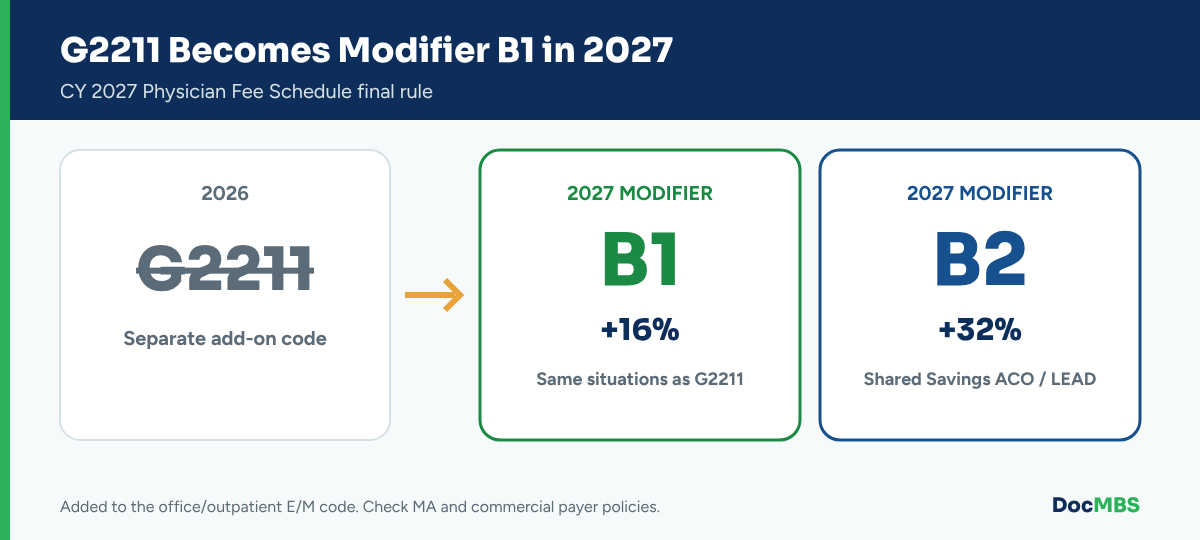
CMS says B2 is voluntary and can be billed for all beneficiaries the practitioner serves, not only those assigned to the ACO. Check eligibility at the TIN and NPI level before you use it. The rule that the add-on can’t be billed with an E/M carrying modifier 25 (except with an AWV, vaccine administration or a Part B preventive service) appears to carry forward. [VERIFY: B1/B2 claim edits, including modifier 25 — CMS MLN article or MAC guidance when released]
Watch Out: Medicare Advantage and commercial plans that adopted G2211 may not recognize B1 or B2 on January 1. Check each payer’s policy before you change your billing rules for everyone.
Other 2027 Physician Fee Schedule Changes Billers Must Know
- Same-day E/M + 0-day global procedure: when a separately identifiable office/outpatient E/M is done on the same day as a 0-day global procedure, the highest-paid service is paid at 100% and the others at 80%. CMS dropped the proposal to include 10- and 90-day globals.
- Practice expense: the indirect practice cost index is phased out over two years and replaced by a “PE stabilizer.”
- RPM and RTM: RTM is limited to established patients. Both need a separately reportable initiating visit. The rule that only practice-employed staff can furnish these services is delayed to January 1, 2029.
- Advance care planning: new codes G0572 and G0573 cover ACP done by clinical staff under direct supervision. CPT 99497 and 99498 are for the billing practitioner’s own time.
- Behavioral health: psychotherapy codes are in the final year of their four-year transition; tobacco cessation and SBIRT were added to that final year, and Collaborative Care Model work RVUs go up.
What the 2027 Rule Means for Our Specialties
Mental and behavioral health: the 2027 Medicare conversion factor hits therapy practices directly. Psychotherapy codes such as 90834 and 90837 are paid with the new rate, plus the final-year transition. Recheck your rates for your most-billed codes. See our guides to CPT code 90837 and 90834 vs 90837.
FQHCs and RHCs: these clinics are paid under their own systems, not the conversion factor. The rule waives the in-person requirement for mental health visits through December 31, 2027 and extends payment for non-behavioral-health telecommunication visits through the same date. See our FQHC PPS rate guide and FQHC telehealth billing guide.
SNF and home health: skilled nursing facility and home health agency payments use their own prospective payment systems (PDPM and PDGM), not the physician conversion factor. Physicians who visit those patients are still paid under the PFS.
Texas Note: Commercial Contracts Tied to Medicare
When you plan for the 2027 Medicare conversion factor, look past Medicare. Many Texas commercial and Medicare Advantage contracts pay a percentage of the Medicare fee schedule. When the 2027 Medicare conversion factor drops, those payments can drop too. Check each contract for:
- Which year’s Medicare fee schedule it uses (current year, or a fixed year such as 2026)
- When the payer updates its rates (January 1 or later)
- Whether there’s a floor that protects you from Medicare cuts
Your GPCIs also matter. Texas has several Medicare payment localities, including Austin, with their own GPCIs. [VERIFY: 2027 GPCIs for the Austin locality — CY 2027 PFS final rule, Addendum E] If you need help reviewing Texas payer contracts, our Austin medical billing team can compare them with the 2027 rates.
Common Mistakes and Denials After the January Update
These are the mistakes we expect to see most once the 2027 Medicare conversion factor takes effect. For a wider plan, see how to reduce claim denials.
| Mistake | Likely result | How to fix it |
|---|---|---|
| Billing G2211 for dates of service after January 1, 2027 | Line denied [VERIFY: expected CARC, e.g. CO-4, CO-16 or CO-181] | Remove G2211 and add modifier B1 (or B2 if eligible) to the E/M code. |
| Posting payments against the 2026 fee schedule | Underpayments missed, or CO-45 adjustments that look wrong | Load the 2027 rates before the first January ERA arrives. |
| Wrong place of service | Paid at the facility rate (CO-45) | Check the place of service on every claim; office visits use POS 11. |
| Same-day E/M without modifier 25 | CO-4 or CO-97 | Add modifier 25 when the E/M is separately identifiable, and expect the 80% rule on 0-day globals. |
| RPM/RTM without an initiating visit | Denial [VERIFY: expected CARC] | Bill a separately reportable initiating visit when monitoring starts. |
| Claim filed more than 12 months after the date of service | CO-29 | See our Medicare timely filing limit guide. |
Your January 1 Checklist
- Load the 2027 Medicare conversion factor and RVUs into your billing system.
- Update your charge master so no charge falls below the new allowed amounts for other payers.
- Remove G2211 from charge capture and train providers and coders on modifier B1 (and B2 if eligible).
- Review every contract tied to the Medicare fee schedule.
- Watch the first January ERAs closely for underpayments and new denials.
Key Takeaways
- The 2027 Medicare conversion factor is $32.63 for non-QPs (−2.31%) and $32.95 for QPs (−1.83%).
- The new rates apply to dates of service from January 1, 2027.
- The cut comes mainly from the end of the one-year 2.50% boost for 2026.
- G2211 becomes modifier B1 (+16%); ACO practitioners can use B2 (+32%).
- Same-day E/M + 0-day global: 100% / 80% payment.
- Check every commercial contract tied to Medicare rates.
FAQs
What is the 2027 Medicare conversion factor?
The 2027 Medicare conversion factor is $32.63 for clinicians who are not qualifying APM participants and $32.95 for qualifying APM participants, according to the CMS fact sheet for the CY 2027 Physician Fee Schedule final rule. Medicare multiplies it by a service’s geographically adjusted RVUs to set the payment.
How much is Medicare cutting physician pay in 2027?
The conversion factor drops 2.31% for most clinicians (from $33.40 to $32.63) and 1.83% for qualifying APM participants (from $33.57 to $32.95). Under the 2027 Medicare conversion factor, your actual change per service also depends on RVU changes for each code, so some services may drop more or less.
What is the difference between the QP and non-QP conversion factor?
Qualifying APM participants (QPs) are clinicians who meet thresholds in an Advanced Alternative Payment Model. By law they get a slightly higher statutory update (+0.75% vs +0.25%), so their 2027 conversion factor is $32.95 instead of $32.63. Most independent practices use the non-QP rate.
How do I calculate a Medicare payment with the conversion factor?
Multiply each RVU (work, practice expense, malpractice) by its GPCI for your locality, add the three results, and multiply the total by the conversion factor. For example, a sample code with 3.00 total RVUs and GPCIs of 1.000 pays $97.89 at the 2027 non-QP rate.
Is G2211 going away in 2027?
Yes, as a separate code for Medicare. Starting January 1, 2027, the visit complexity add-on is reported as modifier B1 on the office/outpatient E/M code, which adds 16% to the E/M payment. Medicare Advantage and commercial payers may follow their own timelines.
What is modifier B1 and modifier B2?
Modifier B1 replaces G2211 and increases the office/outpatient E/M payment by 16% at every level. Modifier B2 is for practitioners in a Shared Savings Program ACO or a LEAD Model participant and increases the E/M payment by 32%. B2 is voluntary.
When does the 2027 Medicare fee schedule take effect?
The CY 2027 Physician Fee Schedule applies to services furnished on or after January 1, 2027. Services with dates of service in 2026 are still paid at 2026 rates, even if you submit the claim in January 2027. Your MAC posts its 2027 fee schedule files for each locality.
Get Ready for the 2027 Medicare Conversion Factor Now
The 2027 Medicare conversion factor cuts most physician payments by 2.31%, and the G2211 change will trip up claims that aren’t updated in time. Load the new rates, retrain on modifier B1, and check every contract tied to Medicare before January 1. Our revenue cycle management team updates your fee schedule and checks every Medicare payment against the 2027 rates. Book a free billing review.
This article is for education only. Confirm current rates and billing rules with CMS and your Medicare Administrative Contractor before you bill.
Sources
- CMS: Calendar Year (CY) 2027 Medicare Physician Fee Schedule Final Rule fact sheet (November 4, 2026)
- CMS: CY 2026 Medicare Physician Fee Schedule Final Rule fact sheet (CMS-1832-F)
- CMS: Physician Fee Schedule Look-Up Tool
- Federal Register: CY 2027 Physician Fee Schedule final rule (CMS-1848-F) [VERIFY: Federal Register document number and publication date]
Last updated: November 2026.
Need help with medical billing? End-to-end medical billing for US practices: charge entry, claim submission, payment posting, denial follow-up and reporting.