In this article
- 90834 vs 90837: The Short Answer
- The Psychotherapy Time Rule Explained
- Which Code Should You Bill? 5 Simple Rules
- 90834 vs 90837 Reimbursement: What the Difference Costs You
- Why Payers Audit 90837 (and How to Stay Safe)
- Telehealth Rules for 90834 and 90837
- Prescribers: 90833, 90836 and 90838 Add-On Codes
- 90834 vs 90837 in FQHCs and Behavioral Health Programs
- Common 90834 vs 90837 Mistakes and Denials
- Texas Note
- Key Takeaways
- FAQs
- Choose Between 90834 vs 90837 With Confidence
- Sources
90834 vs 90837 is the choice therapists make after almost every session, and getting it wrong costs money either way. Bill a 55-minute session as 90834 and you leave about $53 on the table with Medicare. Bill 90837 on nearly every session without solid time notes and you invite an audit.
This guide covers the 90834 vs 90837 decision in plain terms: the time rule, the 2026 Medicare rates from CMS, what the difference costs over a year, and how to document so either code holds up.
Quick Answer
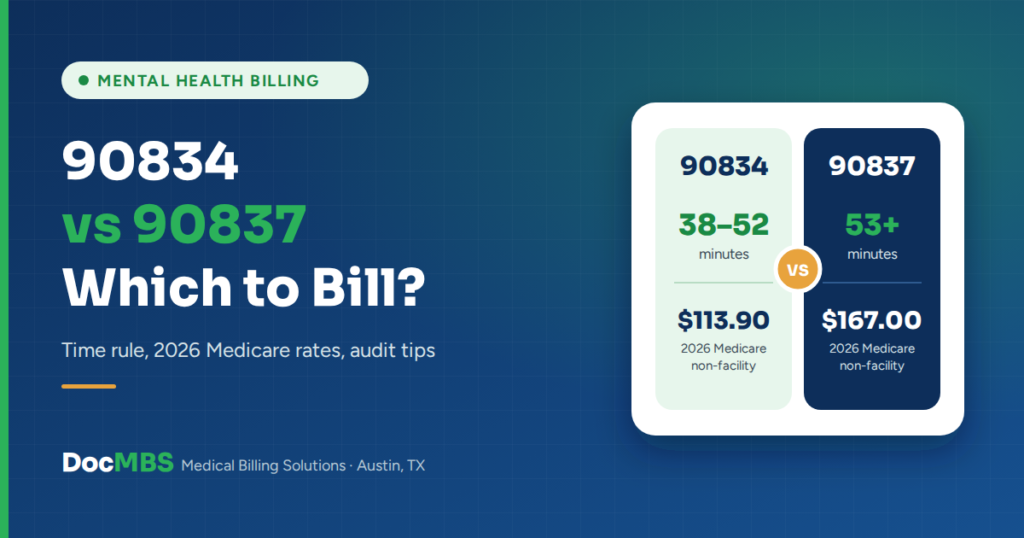
In the 90834 vs 90837 choice, time decides the code. Bill 90834 for 38–52 minutes of psychotherapy and 90837 for 53 minutes or more, based on documented face-to-face time. In 2026, Medicare’s national non-facility rate is $113.90 for 90834 and $167.00 for 90837. 90837 pays more, so payers review it more.
Table of Contents
- 90834 vs 90837: The Short Answer
- The Psychotherapy Time Rule Explained
- Which Code Should You Bill? 5 Simple Rules
- 90834 vs 90837 Reimbursement: What the Difference Costs You
- Why Payers Audit 90837 (and How to Stay Safe)
- Telehealth Rules for 90834 and 90837
- Prescribers: 90833, 90836 and 90838 Add-On Codes
- 90834 vs 90837 in FQHCs and Behavioral Health Programs
- Common 90834 vs 90837 Mistakes and Denials
- Texas Note
- Key Takeaways
- FAQs
- Sources
90834 vs 90837: The Short Answer
Both codes describe individual psychotherapy with the patient and/or a family member. The only real difference in 90834 vs 90837 is how long the session lasted. Everything else, from who can bill to where it can happen, is mostly the same.
| Feature | 90834 | 90837 |
|---|---|---|
| Psychotherapy time | 38–52 minutes | 53 minutes or more |
| Typical session | “45-minute” session | “60-minute” session |
| 2026 Medicare rate, non-facility (national) | $113.90 | $167.00 |
| 2026 Medicare rate, facility (national) | $91.85 | $135.27 |
| Audit risk | Lower | Higher, especially when billed on most sessions |
| Medicare telehealth | Yes | Yes |
| Add-on version with an E/M visit | 90836 | 90838 |
Rates: CMS 2026 National Physician Fee Schedule Relative Value File × 2026 conversion factor $33.4009 (90834: 3.41 non-facility / 2.75 facility RVUs; 90837: 5.00 / 4.05). National amounts before your locality’s GPCI adjustment. Check your locality in the CMS Physician Fee Schedule Look-Up Tool.
The Psychotherapy Time Rule Explained
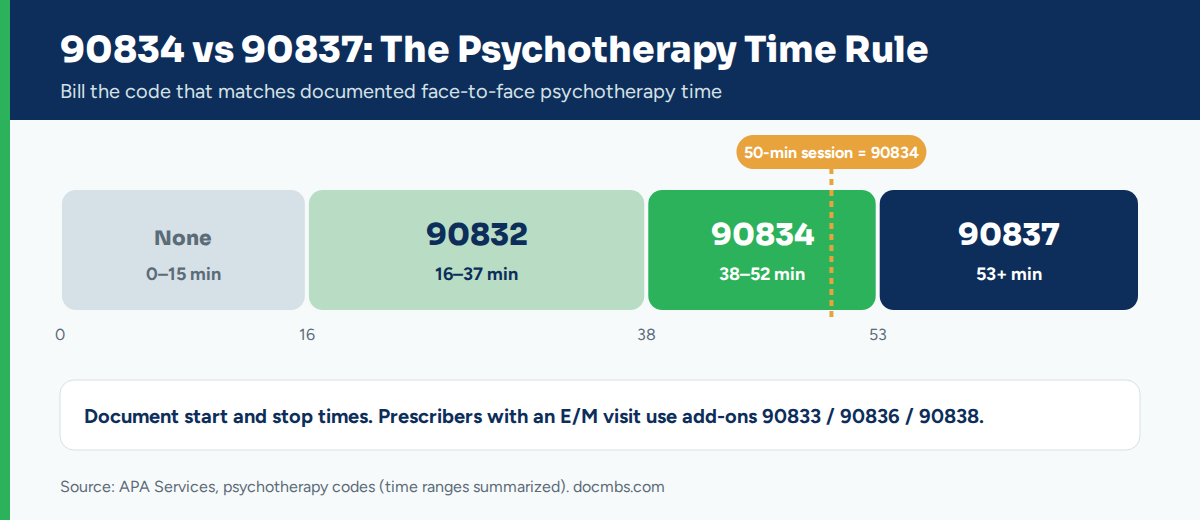
CPT psychotherapy codes follow a time rule. You report the code whose time range your actual face-to-face psychotherapy time falls into, as published by APA Services:
| Documented psychotherapy time | Code to bill | Called |
|---|---|---|
| 0–15 minutes | No psychotherapy code | Not reportable as psychotherapy |
| 16–37 minutes | 90832 | 30-minute code |
| 38–52 minutes | 90834 | 45-minute code |
| 53 minutes or more | 90837 | 60-minute code |
Source: APA Services, psychotherapy codes for psychologists. Time ranges summarized, not quoted from CPT.
What counts as time:
- Face-to-face psychotherapy with the patient, and/or a family member when the patient is present for all or part of the session.
- Not counted: scheduling, writing notes after the session, phone calls with other providers, or time spent on a separate billable service.
- Document start and stop times (for example, 2:02–2:57 pm). A note that only says “60 minutes” is weaker in an audit.
Watch Out: A “50-minute hour” is 90834, not 90837. Under the time rule, 50 minutes falls in the 38–52 range. To bill 90837, the documented psychotherapy time must reach 53 minutes.
Which Code Should You Bill? 5 Simple Rules
- Bill what the clock says. Check the documented start and stop times. 38–52 minutes is 90834; 53 or more is 90837. Don’t round up.
- Don’t schedule to the code. If your sessions are booked as 50 minutes, they are 90834 sessions. If clinically needed, book 60-minute sessions and document why.
- Show medical necessity for longer sessions. Payers want to see why a patient needs 53+ minutes: severity, crisis, trauma work or the treatment plan.
- Use the add-on if you also did an E/M visit. Prescribers bill the E/M code plus 90833, 90836 or 90838, not 90834 or 90837 alone.
- Check the payer’s rules. Some commercial and Medicaid plans limit 90837 or require prior authorization for it. Read the policy before you bill it often.
Underbilling 50-minute sessions or worried about 90837 audits?
DocMBS checks session times against the codes you bill, flags notes that won’t hold up in a review and keeps your 90834 vs 90837 mix clean for every payer.
See our mental health billing services for full support with psychotherapy codes, telehealth and payer audits.
90834 vs 90837 Reimbursement: What the Difference Costs You
The 2026 Medicare national non-facility rates put the 90834 vs 90837 gap at $53.10 per session ($167.00 − $113.90). That’s the full allowed amount: Medicare pays 80% after the deductible, and the patient pays 20%.
Who gets the full rate: psychologists and physicians are paid 100% of the fee schedule amount. Clinical social workers are paid 75% of the physician fee schedule amount, and marriage and family therapists and mental health counselors are paid 75% of the amount paid to clinical psychologists (CMS MFT and MHC guidance). For those clinicians, 90834 is $85.43 and 90837 is $125.25 (non-facility, national).
Worked Example: 53-Minute Sessions Billed as 90834
A psychologist sees Medicare patients in an office. Their sessions run 53–55 minutes, with times documented, but the practice bills them all as 90834. The weekly session count and weeks per year below are sample numbers for the math.
| Step | Psychologist (100%) | LCSW / LMFT / LMHC (75%) |
|---|---|---|
| Allowed for 90837 | $167.00 | $125.25 |
| Allowed for 90834 | $113.90 | $85.43 |
| Lost per session | $53.10 | $39.82 |
| × 25 sessions a week (sample) | $1,327.50 per week | $995.50 per week |
| × 48 working weeks (sample) | $63,720 per year | $47,784 per year |
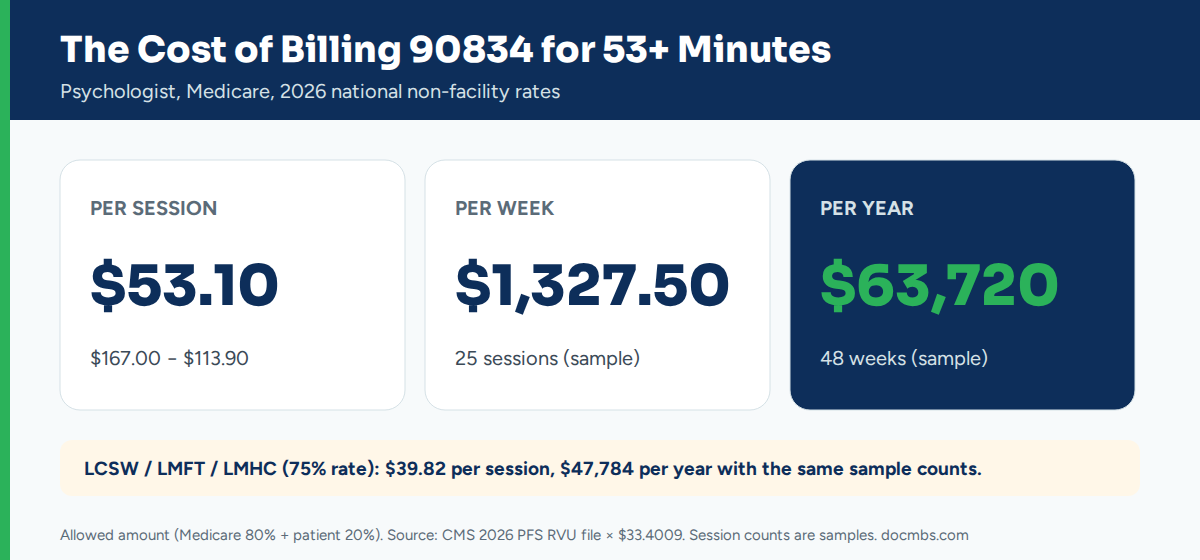
That’s the allowed amount lost, split between Medicare (80%) and patient coinsurance (20%). It happens with zero denials, which is why it often goes unnoticed. On the therapy claims we review, sessions that ran 53+ minutes but were coded 90834 “to be safe” are one of the most common underbilling patterns.
Pro Tip: The fix is not “bill 90837 more.” The fix is “bill what you documented.” If a session ran 54 minutes and the note shows it, 90837 is correct. If it ran 50, 90834 is correct.
Why Payers Audit 90837 (and How to Stay Safe)
Because 90837 pays more, payers watch practices that bill it on most sessions. A provider whose 90834 vs 90837 mix is far above their peers is more likely to get a records request or a pre-payment review.
Documentation checklist for every psychotherapy note:
- Start and stop times (or total psychotherapy minutes)
- Who was present (patient, family member)
- Diagnosis and current symptoms that support medical necessity
- Link to the treatment plan and its goals
- What was done in the session (interventions) and the patient’s response
- For 90837: why this session needed 53+ minutes
For the full 90837 guide, including documentation and who can bill, see our post on CPT code 90837.
Telehealth Rules for 90834 and 90837
Both codes can be billed for Medicare telehealth. According to HHS’s telehealth policy page:
- Medicare patients can permanently receive behavioral and mental health telehealth in their home, and audio-only delivery is permanent for these services.
- The in-person visit requirement (within six months before telehealth, then yearly) is waived through December 31, 2027.
- Use the place of service your payer requires: POS 10 (patient at home) or POS 02 (other location). Add modifier 95 for real-time audio-video where the payer wants it, and 93 for audio-only.
Commercial and Medicaid plans set their own telehealth rules, so check each plan’s policy.
Prescribers: 90833, 90836 and 90838 Add-On Codes
Psychiatrists, psychiatric NPs and other prescribers often do medication management and psychotherapy in the same visit. In that case, don’t bill 90834 or 90837. Bill the E/M code plus a psychotherapy add-on:
- 90833 with E/M: the 30-minute add-on (16–37 minutes)
- 90836 with E/M: the 45-minute add-on (38–52 minutes)
- 90838 with E/M: the 60-minute add-on (53+ minutes)
The psychotherapy time must be separate from the E/M time, and the note should make both parts clear.
90834 vs 90837 in FQHCs and Behavioral Health Programs
Where you bill changes how much the code choice matters:
- FQHCs: 90834 and 90837 are both qualifying codes for G0470 (established mental health visit). Medicare pays the FQHC PPS rate for the encounter, not the code’s fee schedule rate, so the 90834 vs 90837 choice doesn’t change Medicare payment in an FQHC. Accurate time coding still matters for other payers and audits. See our guide to the FQHC PPS rate.
- Medicaid behavioral health programs: many state Medicaid plans pay counseling with HCPCS code H0004 in 15-minute units instead of 90834 or 90837. See our guide to behavioral health H codes.
Common 90834 vs 90837 Mistakes and Denials
| CARC | What it means | Common cause | Fix |
|---|---|---|---|
| CO-150 | Information doesn’t support this level of service | 90837 billed but the note shows under 53 minutes or no times | Add times to the note if they were recorded; otherwise rebill as 90834. |
| CO-50 | Not medically necessary | Diagnosis or note doesn’t support psychotherapy or the session length | Appeal with the treatment plan and symptom documentation. |
| CO-16 | Missing information | Missing POS, modifier or rendering provider details | Add the missing data and resubmit. |
| CO-97 | Bundled with another service | 90834 or 90837 billed with an E/M on the same day by the same prescriber | Rebill as E/M + 90836 or 90838. |
| CO-4 | Modifier missing or wrong | Telehealth claim without 95/93, or a modifier the payer doesn’t accept | Correct the modifier per the payer’s telehealth policy. |
| CO-151 | Frequency not supported | More sessions than the plan allows, or two psychotherapy codes the same day | Check the plan’s limits and get authorization for extra visits. |
For a full prevention process, see how to reduce claim denials.
Texas Note
Texas Medicaid and its STAR, STAR+PLUS and STAR Kids plans cover outpatient psychotherapy under the Behavioral Health and Case Management Services Handbook in the TMHP Texas Medicaid Provider Procedures Manual. Rules on who can bill, visit limits and prior authorization can differ from Medicare. [VERIFY: Texas Medicaid psychotherapy visit limits, prior authorization thresholds and eligible provider types in the current TMHP Behavioral Health and Case Management Services Handbook] If you run a Texas practice, our Austin medical billing team works with TMHP and the STAR plans every day.
Key Takeaways
- In 90834 vs 90837, documented time decides: 38–52 minutes is 90834; 53+ is 90837.
- A 50-minute session is 90834.
- 2026 Medicare national non-facility rates: $113.90 (90834) and $167.00 (90837), a $53.10 gap.
- Underbilling 53+ minute sessions as 90834 can cost a full-time therapist tens of thousands of dollars a year.
- Billing 90837 on most sessions draws audits. Start and stop times are your best defense.
- Prescribers with an E/M visit use 90833, 90836 or 90838.
FAQs
What is the difference between 90834 and 90837?
The difference is time. 90834 is for 38–52 minutes of psychotherapy, and 90837 is for 53 minutes or more. Both are individual psychotherapy codes with the patient and/or a family member. 90837 pays more, so payers review it more closely and expect documented start and stop times.
How many minutes is 90834?
90834 is the 45-minute psychotherapy code. Under the CPT time rule, you bill it when documented face-to-face psychotherapy lasts 38 to 52 minutes. Under 38 minutes, use 90832 (16–37 minutes). At 53 minutes or more, use 90837.
How many minutes is 90837?
90837 is the 60-minute psychotherapy code. You can bill it when documented psychotherapy time is 53 minutes or more. There’s no upper limit in the time rule, but sessions much longer than 60 minutes may need extra documentation or other codes.
Can I bill 90837 for a 50-minute session?
No. A 50-minute session falls in the 38–52 minute range, so it’s billed as 90834. To bill 90837, documented psychotherapy time must be at least 53 minutes. Billing 90837 for 50-minute sessions is a common reason for audits and recoupments.
Does Medicare pay more for 90837 than 90834?
Yes. In 2026, Medicare’s national non-facility rate is $167.00 for 90837 and $113.90 for 90834, a difference of $53.10, based on CMS relative value units and the 2026 conversion factor. Your actual rate depends on your locality and provider type.
Why do insurance companies audit 90837?
90837 pays more than 90834, so payers flag providers who bill it on most sessions or far more often than their peers. Audits check whether the notes show 53+ minutes of psychotherapy, medical necessity and a link to the treatment plan. Clear start and stop times are the best protection.
Can 90834 and 90837 be billed via telehealth?
Yes. Medicare covers both as telehealth, and patients can permanently receive mental health telehealth at home, including audio-only. The in-person visit requirement is waived through December 31, 2027. Use the payer’s required POS (10 or 02) and modifier (95 or 93).
Choose Between 90834 vs 90837 With Confidence
The 90834 vs 90837 decision is simple when your notes are solid: bill the time you documented, back longer sessions with medical necessity, and use add-on codes when an E/M visit is involved.
DocMBS handles psychotherapy coding, telehealth claims and payer audits for therapists and group practices. See our mental health billing services or book a free billing review.
This article is for education only. Rates and rules change. Confirm with your Medicare Administrative Contractor or health plan before billing. The CY 2027 Physician Fee Schedule final rule, expected in early November 2026, may change these rates on January 1, 2027.
Sources
- CMS: Physician Fee Schedule Look-Up Tool
- CMS: PFS Relative Value Files (2026)
- HHS: Telehealth Policy Updates
- CMS: Marriage and Family Therapists and Mental Health Counselors
- CMS: Medicare Benefit Policy Manual, Chapter 15
- APA Services: Psychotherapy Codes for Psychologists
- TMHP: Texas Medicaid Provider Procedures Manual
Last updated: October 2026.
Need help with behavioral health billing? Billing for behavioral health organizations, community programs and substance use treatment providers, with the authorizations, session limits and payer carve-out rules handled for you.