In this article
- What Is the Medicare Timely Filing Limit?
- Medicare Timely Filing Limit at a Glance
- How to Count the 12 Months (Worked Example)
- The 4 Medicare Timely Filing Limit Exceptions
- How to Avoid Medicare Timely Filing Denials: 7 Steps
- Medicare Advantage Timely Filing Is Different
- Common Mistakes and Denials (and How to Fix Them)
- Specialty Note: SNF and Home Health
- Medicare vs Medicaid vs Commercial Timely Filing
- Key Takeaways
- FAQs
- Protect Every Claim From the 12-Month Clock
- Sources
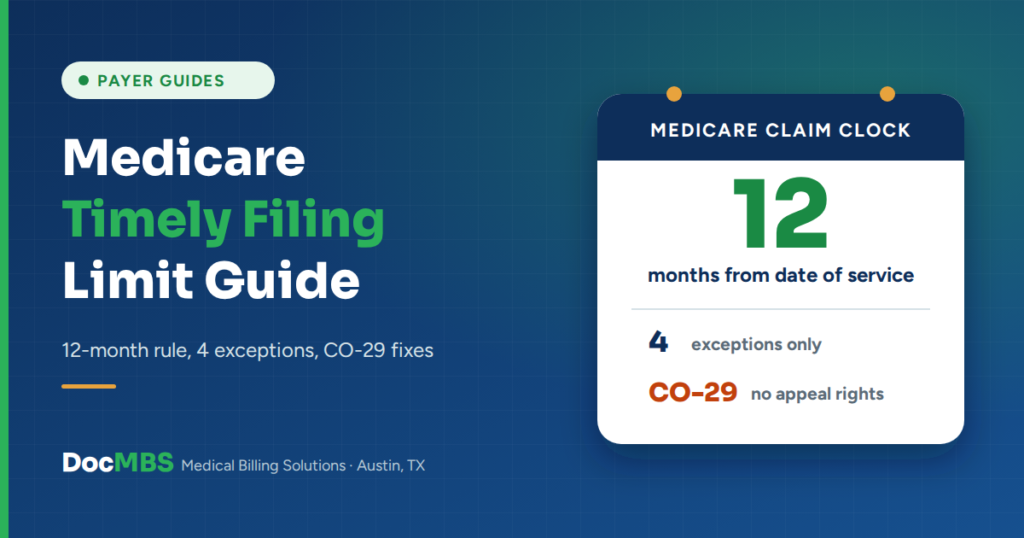
The Medicare timely filing limit is 12 months from the date of service, and it is one of the few Medicare rules with almost no second chances. A claim that sat in a rejection queue for 11 months can’t be saved once the year runs out. A CO-29 denial usually can’t be fixed by rebilling, and it can’t be appealed. On the Medicare claims we work, most late claims weren’t billed late. They were billed on time, rejected, and never fixed.
This guide explains how the Medicare timely filing limit works for Part A and Part B, how to count the 12 months on span claims, the only 4 exceptions CMS allows, and how to keep CO-29 off your remittances.
Quick Answer
The Medicare timely filing limit is 12 months (one calendar year) from the date of service. Part A institutional claims count from the “through” date; Part B claims count from the “from” date. Rejected and RTP claims do not count as filed. CMS allows only 4 exceptions, and CO-29 denials can’t be appealed.
Table of Contents
- What Is the Medicare Timely Filing Limit?
- Medicare Timely Filing Limit at a Glance
- How to Count the 12 Months (Worked Example)
- The 4 Medicare Timely Filing Limit Exceptions
- How to Avoid Medicare Timely Filing Denials: 7 Steps
- Medicare Advantage Timely Filing Is Different
- Common Mistakes and Denials (and How to Fix Them)
- Specialty Note: SNF and Home Health
- Medicare vs Medicaid vs Commercial Timely Filing
- Key Takeaways
- FAQs
- Sources
What Is the Medicare Timely Filing Limit?
The Medicare timely filing limit is the deadline for sending a claim to your Medicare Administrative Contractor (MAC). The rule is in federal regulation at 42 CFR 424.44, and CMS explains it in the Medicare Claims Processing Manual (Pub. 100-04), Chapter 1, Section 70. Since the Affordable Care Act (Section 6404), the limit has been no later than 12 months, or one calendar year, after the date of service.
The rule applies to Part A institutional claims (UB-04 / 837I) and Part B professional claims (CMS-1500 / 837P). It covers hospitals, skilled nursing facilities, home health agencies, physicians, therapists and suppliers alike.
What “filed” means under the Medicare timely filing limit
This is where most practices lose money. A claim only counts as filed when Medicare processes it: paid, denied or rejected in a way that creates a claim record. These do not count:
- Part B claims returned as unprocessable (often with CO-16 and a remark code). They must be corrected and sent again within the 12 months.
- Part A claims returned to provider (RTP). An RTP sitting in your DDE queue is not a filed claim.
- Clearinghouse rejections. If the claim never reached the MAC, the clock never paused.
Watch Out: The 12-month clock does not stop while a claim is rejected or in RTP status. Your first submission date doesn’t protect you. Only the date of the clean, processed claim counts.
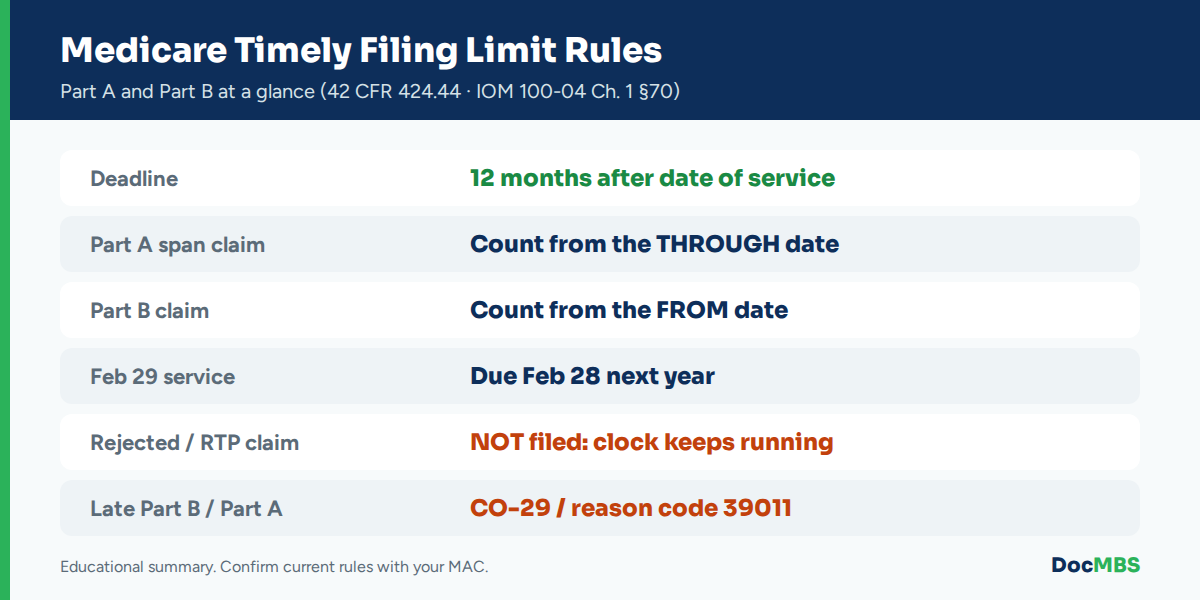
Medicare Timely Filing Limit at a Glance
The table below puts every Medicare timely filing limit rule in one place, with the source for each line.
| Rule | Detail | Source |
|---|---|---|
| Filing deadline | 12 months (1 calendar year) after the date of service | 42 CFR 424.44; IOM 100-04, Ch. 1, §70 |
| Span-date claims, Part A | Count from the “through” date on the claim | IOM 100-04, Ch. 1, §70 |
| Span-date claims, Part B | Count from the “from” date of each line | IOM 100-04, Ch. 1, §70 |
| February 29 date of service | Deadline is February 28 of the next year | IOM 100-04, Ch. 1, §70 |
| Electronic claims after hours | Received after 6 p.m. ET, or on a weekend or holiday, counts as received the next business day (First Coast guidance) | MAC guidance |
| Paper claims | Based on the MAC’s receipt date, not the postmark | MAC guidance |
| Last day falls on a weekend or holiday | Claim is timely if filed on the next workday | Palmetto GBA timeliness criteria |
| Rejected / unprocessable / RTP | Not considered filed | IOM 100-04, Ch. 1, §70 |
| Part B late claim | Denied with CO-29 (time limit expired), often with remark N211 | Noridian JF Part B |
| Part A late claim | Rejected with reason code 39011 | Noridian JF Part A |
How to Count the 12 Months (Worked Example)
Counting the Medicare timely filing limit is simple for a single visit and easy to get wrong for span claims. Here are three real-date examples.
Example 1: Part B office visit
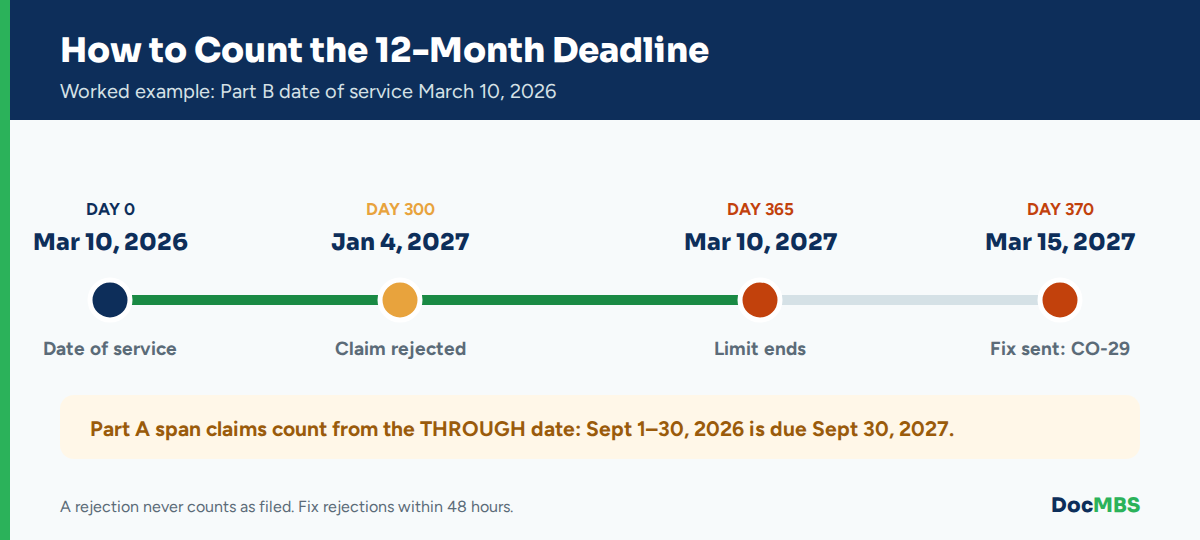
Date of service: March 10, 2026. The Medicare timely filing limit ends on March 10, 2027. That date is a Wednesday, so no weekend adjustment applies.
Example 2: Part A SNF or home health span claim
Claim dates: from September 1 through September 30, 2026. Part A counts from the “through” date, so the deadline is September 30, 2027, not September 1, 2027. If this were a Part B claim with line dates across September, each line would count from its own “from” date.
Example 3: The rejected claim that ran out of time
Same March 10, 2026 Part B visit. The claim was first sent on time, but it was rejected on day 300 (January 4, 2027) for a wrong Medicare Beneficiary Identifier. Nobody worked the rejection until day 370 (March 15, 2027).
| Step | Date | Days since DOS |
|---|---|---|
| Date of service | March 10, 2026 | 0 |
| Claim rejected (not filed) | January 4, 2027 | 300 |
| Medicare timely filing limit ends | March 10, 2027 | 365 |
| Corrected claim sent | March 15, 2027 | 370: 5 days late |
Result: The rejection on day 300 never counted as a filed claim. The corrected claim reaches Medicare 5 days after the deadline and denies with CO-29. None of the 4 exceptions applies, so the money is lost. Had the team fixed the rejection within 48 hours, they would have had about 63 days to spare.
Pro Tip: Noridian offers a free Claim Submission Timeliness Calculator on its website. Use it for odd cases like February 29 or span claims that cross a year.
Losing Medicare claims to CO-29?
Rejections nobody re-sent and RTPs stuck in DDE turn into write-offs once the 12 months run out. Our denial management services track every open Medicare claim against its deadline and fix rejections before time runs out.
The 4 Medicare Timely Filing Limit Exceptions
CMS lists only 4 exceptions to the Medicare timely filing limit in its MLN training “Exceptions for Late Filing” and in 42 CFR 424.44(b). Software problems, staff turnover, a lost EOB or a slow clearinghouse are not exceptions.
| Exception | When it applies | Proof to keep | Time to file after the event |
|---|---|---|---|
| 1. Administrative error | An error or misrepresentation by a Medicare employee, contractor or agent, acting within its authority, caused the late filing | Written proof of the error and a clear link between the error and the late claim | Within 6 months after the month the error is corrected |
| 2. Retroactive Medicare entitlement | The patient wasn’t entitled on the date of service and later got entitlement dated on or before that date | SSA letter or notice of entitlement, dated eligibility screen prints | Through the last day of the 6th month after the month of the notice |
| 3. Retroactive entitlement with State Medicaid | Same as #2, and the state Medicaid agency recouped its payment 6 months or more after the date of service | Medicaid recoupment notice plus the entitlement notice | Through the last day of the 6th month after the month of recoupment |
| 4. Retroactive MA or PACE disenrollment | The patient was disenrolled from a Medicare Advantage plan or PACE organization back to or before the date of service, and the plan recovered its payment 6 months or more after the date of service | Plan recoupment letter and disenrollment proof | Through the last day of the 6th month after the month of recovery |
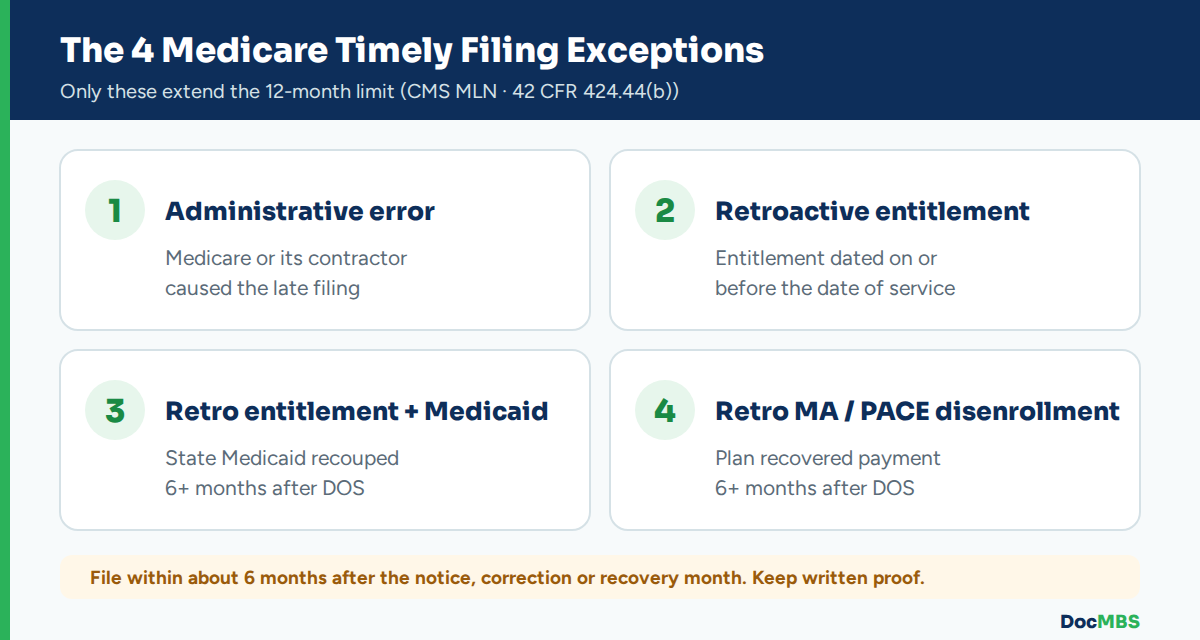
The time limits in the last column come from the Palmetto GBA guidance “Medicare’s Claim Timeliness Requirements and Criteria for a Timeliness Extension,” which follows IOM 100-04, Ch. 1, §70.7. Example: a patient gets a retroactive entitlement notice in May 2027. Under exception 2, the claim must be filed by November 30, 2027.
How to request a Medicare timely filing exception
Each MAC has its own process, so check your MAC’s timely filing page first. Palmetto GBA, for example, asks for a written request on letterhead that matches your enrollment address, your PTAN, NPI and last 5 digits of the EIN, patient details, dates of service and supporting proof. Many MACs also want an explanation in the claim remarks (Item 19 on the CMS-1500 or the electronic equivalent). [VERIFY: exact exception request steps and form for your MAC — your MAC’s timely filing exception page]
How to Avoid Medicare Timely Filing Denials: 7 Steps
- Check eligibility at every visit, including Medicare Advantage enrollment. A claim sent to the wrong payer burns weeks of the clock. Run a HETS or MAC portal check, not just a card scan.
- Submit within 7–14 days of the date of service. Fast billing gives you room to fix problems later. Set this as a team goal, not a nice-to-have.
- Work rejections and RTPs within 48 hours. They don’t stop the Medicare timely filing limit clock, so treat every rejection as urgent.
- Add a “days since DOS” column to your open claims report and sort by it every week.
- Set alerts at 270, 300 and 330 days. For a March 10, 2026 visit, that means December 5, 2026, January 4, 2027 and February 3, 2027.
- Keep 999 and 277CA acceptance reports as proof. They show when the MAC actually received and accepted the claim.
- Request an exception only when one of the 4 applies. Gather the proof first, then follow your MAC’s process. Don’t send an appeal on a CO-29 denial.
Medicare Advantage Timely Filing Is Different
The 12-month Medicare timely filing limit applies to Original Medicare claims sent to a MAC. Medicare Advantage plans set their own filing limits in the provider contract and provider manual. Some plans use limits much shorter than the Medicare timely filing limit, and limits for non-contracted providers can differ from those for in-network providers. [VERIFY: name a specific plan’s limit only with its current provider manual as the source]
This matters most in January, when patients switch between Original Medicare and Medicare Advantage. Our Medicare open enrollment checklist for providers shows how to catch those plan changes before claims deny.
Watch Out: If you bill Original Medicare for a Medicare Advantage member, the claim denies (often CO-109 or a similar “wrong payer” code), and the days spent waiting count against the MA plan’s own deadline, which may be shorter.
Common Mistakes and Denials (and How to Fix Them)
Most Medicare timely filing denials trace back to a small set of habits. The table below shows the codes you’ll see and the fix for each. For a wider plan, see our guide on how to reduce claim denials.
| Code / problem | What it means | How to fix it |
|---|---|---|
| CO-29 (Part B) | The time limit for filing has expired. Usually paired with N211 (you may not appeal this decision). | Check the DOS on the claim. If the DOS was keyed wrong, send a new claim with the right date. If an exception applies, request it with proof. Otherwise, write it off and fix the process. |
| Reason code 39011 (Part A) | The claim’s “through” date is more than 12 months before receipt | Confirm the “through” date and the receipt date. If an exception applies, add the remarks and follow your MAC’s process. |
| CO-16 / unprocessable claim left unfixed | Missing or invalid information; the claim was never filed | Correct and resubmit within days, not weeks. The Medicare timely filing limit keeps running. Track these on your aging report by DOS. |
| CO-22 / Medicare secondary claim filed late | Coordination of benefits issue; another payer may be primary | Bill the primary payer fast so the Medicare secondary claim still meets the 12-month limit. [VERIFY: MSP claims follow the 12-month limit from DOS — IOM 100-04 Ch. 1 §70 / MSP Manual] |
| CO-109 / billed to the wrong payer | The claim belongs to another payer, such as a Medicare Advantage plan | Verify enrollment and rebill the right payer right away. Time spent at the wrong payer still counts. |
| Wrong “from/through” dates | The span dates on the claim don’t match the service | Use the “through” date for Part A deadline tracking and the “from” date for Part B lines. |
Can you appeal a CO-29 timely filing denial?
No. Noridian states that a claim denied for timely filing is not afforded appeal rights, and Palmetto GBA notes that these denials are not initial determinations, so a redetermination request will not work. The only routes are correcting a wrong date of service or requesting one of the 4 exceptions.
Specialty Note: SNF and Home Health
Skilled nursing facilities and home health agencies bill Part A span claims, so the “through” date drives the Medicare timely filing limit. That sounds generous, but these claims often sit in RTP status for MDS, HIPPS or OASIS mismatches. An RTP is not a filed claim, so every day it waits in DDE is a day lost.
- SNFs: Interim claims for long stays each have their own “through” date. Track each one. Our guide to SNF consolidated billing covers the outside services that cause many of these holds.
- Home health: A late or rejected NOA can hold up the period of care claim. See our home health NOA guide for the 5-day rule.
Medicare vs Medicaid vs Commercial Timely Filing
The Medicare timely filing limit is generous compared with many other payers. Texas providers in particular should not use Medicare’s 12 months as a default for every claim.
| Payer | First claim deadline | Where to check |
|---|---|---|
| Original Medicare (Part A and B) | 12 months from the date of service | 42 CFR 424.44; IOM 100-04, Ch. 1, §70 |
| Medicare Advantage plans | Set by each plan’s contract | Plan provider manual |
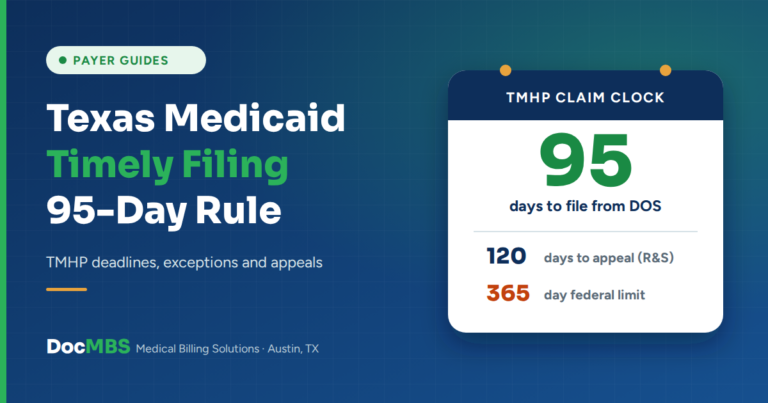
| Texas Medicaid (TMHP) | 95 days from the date of service (in-state providers) | TMPPM Vol. 1, Section 6. See our Texas Medicaid timely filing guide |
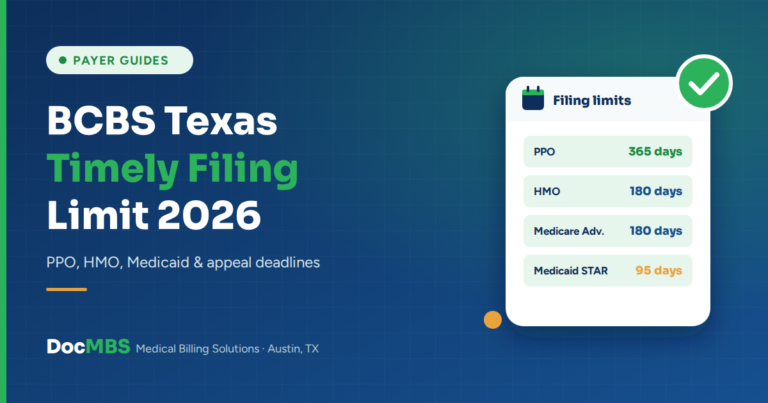
| BCBS Texas | Varies by plan line (PPO, HMO, Medicaid) | See our BCBS Texas timely filing limit guide |
Key Takeaways
- The Medicare timely filing limit is 12 months from the date of service.
- Part A counts from the “through” date; Part B counts from the “from” date.
- Rejected, unprocessable and RTP claims do not count as filed.
- There are only 4 exceptions, each with about 6 months to file after the triggering event.
- CO-29 denials can’t be appealed, so prevention is the only real fix.
- Medicare Advantage plans set their own limits.
FAQs
What is the Medicare timely filing limit?
The Medicare timely filing limit is 12 months, or one calendar year, after the date of service. It applies to Part A and Part B claims sent to your MAC and comes from 42 CFR 424.44. Claims received after that date are denied (CO-29 for Part B) or rejected (reason code 39011 for Part A) unless one of 4 exceptions applies.
Is Medicare timely filing 12 months or 1 year from the date of service?
They are the same thing. CMS describes the Medicare timely filing limit as 12 months, or one calendar year, after the date of service. A March 10, 2026 visit must be filed by March 10, 2027. The one special case is February 29: those claims are due February 28 of the next year.
How is the date of service counted for span claims?
For Part A institutional claims, such as SNF or home health claims, Medicare uses the “through” date on the claim. For Part B claims, Medicare uses the “from” date of each line. So a Part A claim from September 1 through September 30, 2026 is due by September 30, 2027.
What are the exceptions to Medicare timely filing?
CMS allows only 4: administrative error by Medicare or its contractor, retroactive Medicare entitlement, retroactive entitlement where a state Medicaid agency recouped its payment, and retroactive disenrollment from a Medicare Advantage plan or PACE organization with payment recovery. Each needs written proof and has its own filing window.
Can a CO-29 timely filing denial be appealed?
No. MACs such as Noridian state that timely filing denials have no appeal rights. If the date of service on the claim was wrong, send a new claim with the correct date. If one of the 4 exceptions applies, request it through your MAC with proof. Otherwise, the balance is usually a write-off.
Does a rejected claim count as filed on time?
No. A Part B claim returned as unprocessable or a Part A claim returned to provider (RTP) is not a filed claim. The 12-month clock keeps running. You must correct the claim and get it processed before the Medicare timely filing limit ends.
What happens if the 12-month deadline falls on a weekend?
Palmetto GBA’s guidance says that if the last day falls on a Saturday, Sunday, federal non-workday or legal holiday, a claim filed on the next workday is timely. For example, a January 9, 2026 visit hits its deadline on Saturday, January 9, 2027, so Monday, January 11 still works. Don’t plan around it.
Protect Every Claim From the 12-Month Clock
The Medicare timely filing limit gives you a full year, but rejections, RTPs and wrong-payer claims eat that year faster than most teams expect. File within two weeks, fix rejections within 48 hours, and track every open claim by days since service. If CO-29 is already showing up on your remits, our denial management services can find the gaps and protect the claims still in time. Book a free billing review.
This article is for education only. Medicare rules change. Confirm current requirements with CMS and your Medicare Administrative Contractor before you bill.
Sources
- eCFR: 42 CFR 424.44, Time limits for filing claims
- CMS: Medicare Claims Processing Manual, Chapter 1, Section 70
- CMS MLN: Exceptions for Late Filing (CMS-1500 web-based training)
- Noridian JF Part B: Timely Filing reason code guidance (CO-29)
- Noridian JF Part A: Reason Code 39011
- Noridian: Claim Submission Timeliness Calculator
- Palmetto GBA: Medicare’s Claim Timeliness Requirements and Criteria for a Timeliness Extension
Last updated: October 2026.
Need help with medical billing? End-to-end medical billing for US practices: charge entry, claim submission, payment posting, denial follow-up and reporting.