In this article
- What Is the FQHC Wrap-Around Payment?
- When Does an FQHC Qualify for a Wrap-Around Payment?
- How the FQHC Wrap-Around Payment Is Calculated
- How to Set Up and Bill FQHC Wrap-Around Claims: 7 Steps
- Reason Code 37098 and Other Wrap-Around Problems
- Why January Matters: MA Plan Changes and Your Wrap Rates
- FQHC Medicare Wrap vs Medicaid Wrap: Not the Same Thing
- Key Takeaways
- FAQs
- Collect Every FQHC Wrap-Around Payment You’re Owed
- Sources
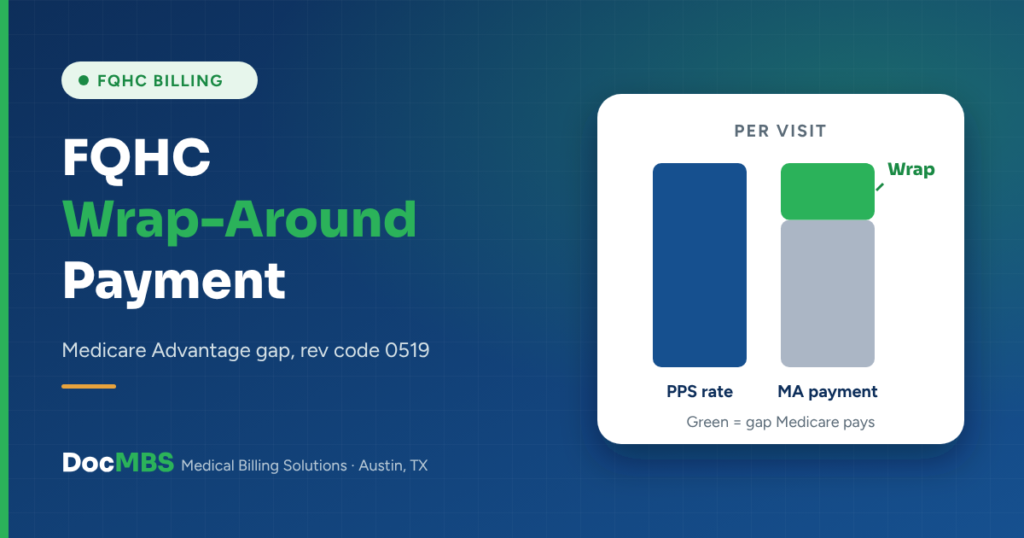
The FQHC wrap-around payment is the money Medicare owes your health center when a Medicare Advantage (MA) plan pays you less than your FQHC PPS rate. Many FQHCs never collect it. The MA plan pays its contract rate, the remit looks normal, and the gap between that rate and the PPS rate is left on the table. Medicare only pays that gap if you file a separate supplemental claim and your Medicare Administrative Contractor (MAC) has the plan’s rate on file. On the FQHC accounts we review, a missing rate or an outdated contract is the most common reason this money goes uncollected.
This guide explains how the FQHC wrap-around payment works, how it’s calculated, how to set it up with your MAC and how to fix reason code 37098.
Quick Answer
The MA plan pays its contract rate. If that rate is lower than your FQHC PPS rate, the MAC pays the difference, minus any cost sharing the patient owes. You bill it on a separate claim with revenue code 0519. The MAC must have the plan’s supplemental rate on file, or the claim returns with reason code 37098.
Table of Contents
- What Is the FQHC Wrap-Around Payment?
- When Does an FQHC Qualify for a Wrap-Around Payment?
- How the FQHC Wrap-Around Payment Is Calculated
- How to Set Up and Bill FQHC Wrap-Around Claims: 7 Steps
- Reason Code 37098 and Other Wrap-Around Problems
- Why January Matters: MA Plan Changes and Your Wrap Rates
- FQHC Medicare Wrap vs Medicaid Wrap
- Key Takeaways
- FAQs
- Sources
What Is the FQHC Wrap-Around Payment?
The FQHC wrap-around payment, also called the MA supplemental payment, protects FQHCs from being paid less for Medicare Advantage patients than for Original Medicare patients. CMS explains the billing rules in the Medicare Claims Processing Manual, Chapter 9, Section 60.4, “Billing for Supplemental Payments to FQHCs under Contract with Medicare Advantage (MA) Plans.” [VERIFY: statutory and regulatory cite, e.g. Social Security Act §1833(a)(3)(B) and 42 CFR 405.2469 — Claims Processing Manual Ch. 9 / Benefit Policy Manual Ch. 13]
Here’s how it works, in plain terms:
- Your FQHC has a written contract with an MA plan.
- The MA plan pays you its contract rate for each visit.
- Medicare compares that MA rate with your FQHC PPS rate.
- If the MA rate is lower, the MAC pays the difference, minus the patient’s cost sharing.
Noridian notes that for revenue code 0519 claims, payment is based on the PPS rate without comparing it to your charge. That’s different from regular Original Medicare FQHC claims, where Medicare pays the lesser of your charge or the PPS rate. For the full PPS rules, see our FQHC PPS rate guide.
When Does an FQHC Qualify for a Wrap-Around Payment?
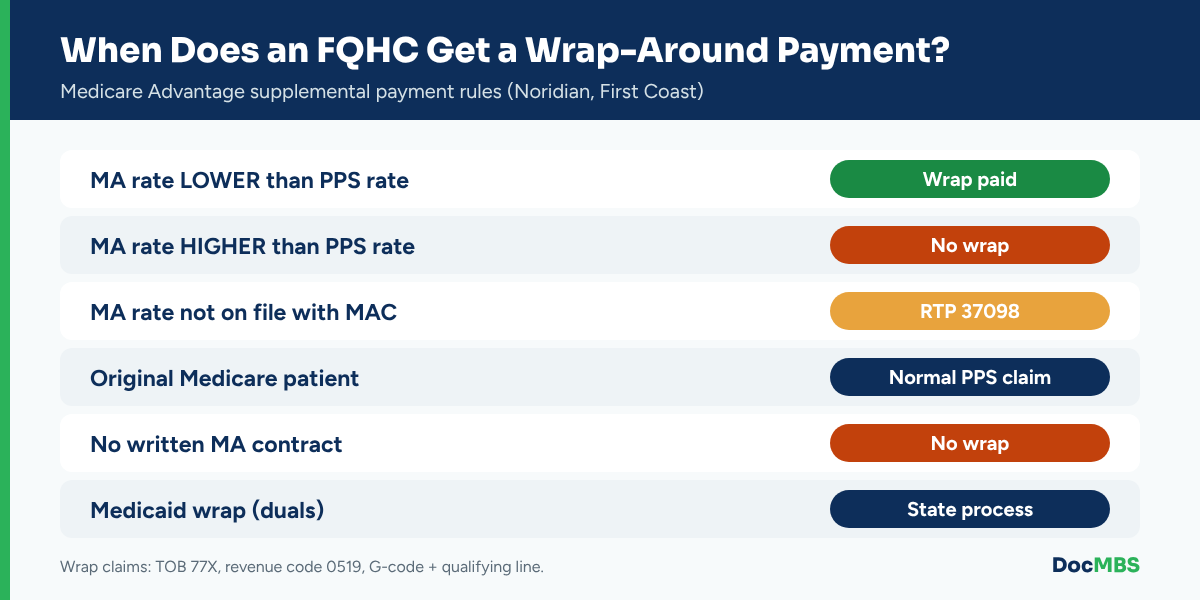
Not every MA visit gets an FQHC wrap-around payment. This table shows when you can expect one.
| Situation | Wrap payment? | Why |
|---|---|---|
| MA contract rate is lower than the FQHC PPS rate | Yes | The MAC pays the difference, minus the patient’s cost sharing (Noridian) |
| MA contract rate is higher than the FQHC PPS rate | No | There’s no gap to cover (Noridian) |
| MA contract not on file with your MAC | Claim returns | Reason code 37098: no supplemental rate for that plan (First Coast) |
| Patient has Original Medicare | No wrap claim | Bill a normal PPS claim: G0466–G0468 on 052X, G0469/G0470 on 0900 |
| No written contract with the MA plan | No | The wrap applies to FQHCs under contract with the MA plan |
| Medicaid wrap for dual-eligibles | Separate process | Paid by the state Medicaid program, not Medicare |
Watch Out: Revenue code 0519 is for MA supplemental claims only (CMS transmittal R13547CP). Never use it on an Original Medicare FQHC claim, and never put a G-code for an MA patient on 052X or 0900 when you’re billing the wrap.
How the FQHC Wrap-Around Payment Is Calculated
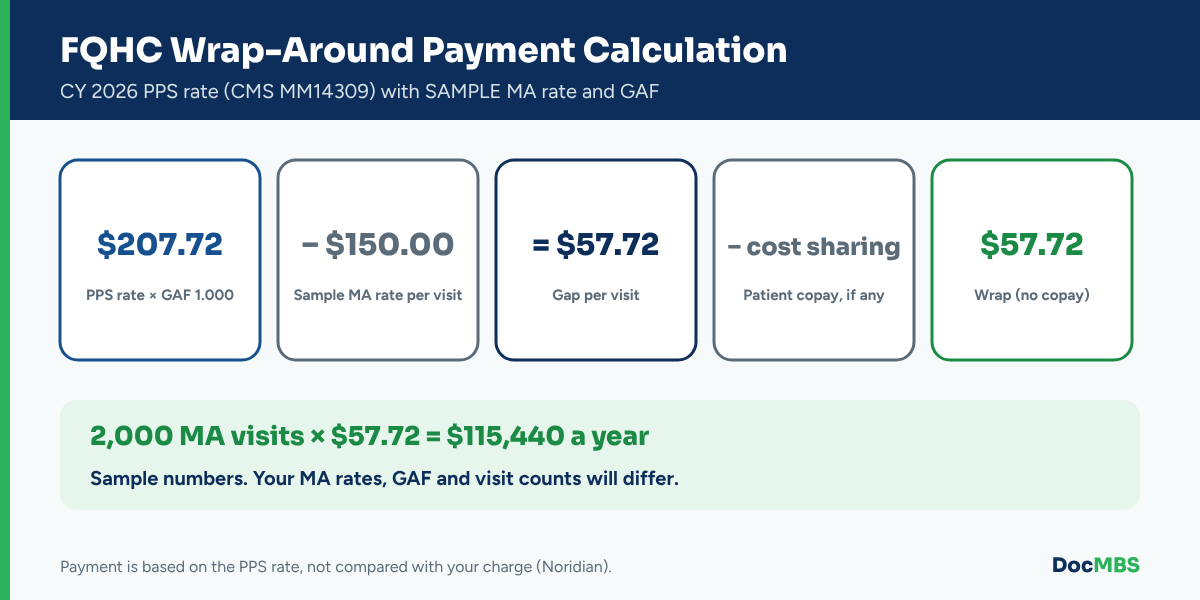
First Coast describes the supplemental amount as the FQHC’s per-visit PPS rate minus the MA plan’s average per-visit payment, less the enrollee’s copay. So the FQHC wrap-around payment uses the plan’s average rate on file with the MAC, not each claim’s actual MA payment. [VERIFY: confirm with your MAC how the average MA rate and the patient’s cost sharing are entered on the Payment Rate Calculation Form]
Worked Example: One MA Plan, CY 2026
The PPS rate comes from CMS. The MA rate, GAF and visit count are sample numbers for illustration only.
| Step | Amount | Source |
|---|---|---|
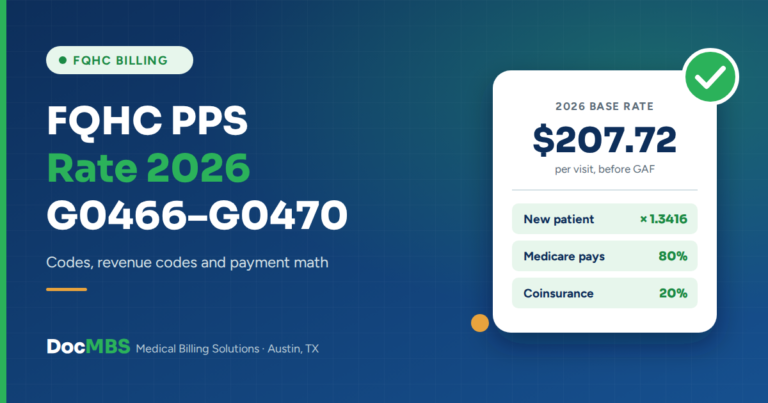
| CY 2026 FQHC PPS base rate | $207.72 | CMS MM14309 |
| × Geographic adjustment factor (GAF) | 1.000 (sample) | Your FQHC’s GAF |
| = Adjusted PPS rate per visit | $207.72 | — |
| − MA plan’s average per-visit payment | $150.00 (sample) | Your Payment Rate Calculation Form |
| = Gap per visit | $57.72 | — |
| − Patient cost sharing owed | $0.00 (sample) | MA plan benefit |
| = FQHC wrap-around payment per visit | $57.72 | — |
If the patient owed a $10 copay under the MA plan, the wrap would drop to $47.72 for that visit.
Yearly impact: With 2,000 MA visits a year under this sample contract, the FQHC wrap-around payment adds up to 2,000 × $57.72 = $115,440 before any cost sharing. That’s money an FQHC loses entirely if the rate is never set up.
For new patients, IPPE and AWV visits, CMS applies a 1.3416 adjustment to the PPS rate (Claims Processing Manual Ch. 9), so the gap on those visits can be larger.
Leaving Medicare Advantage wrap payments uncollected?
If your MAC has no rate on file for an MA plan, or the rate is out of date, the gap between the MA payment and your PPS rate is never paid. Our FQHC billing services set up every MA plan with your MAC and bill each wrap claim on revenue code 0519.
How to Set Up and Bill FQHC Wrap-Around Claims: 7 Steps
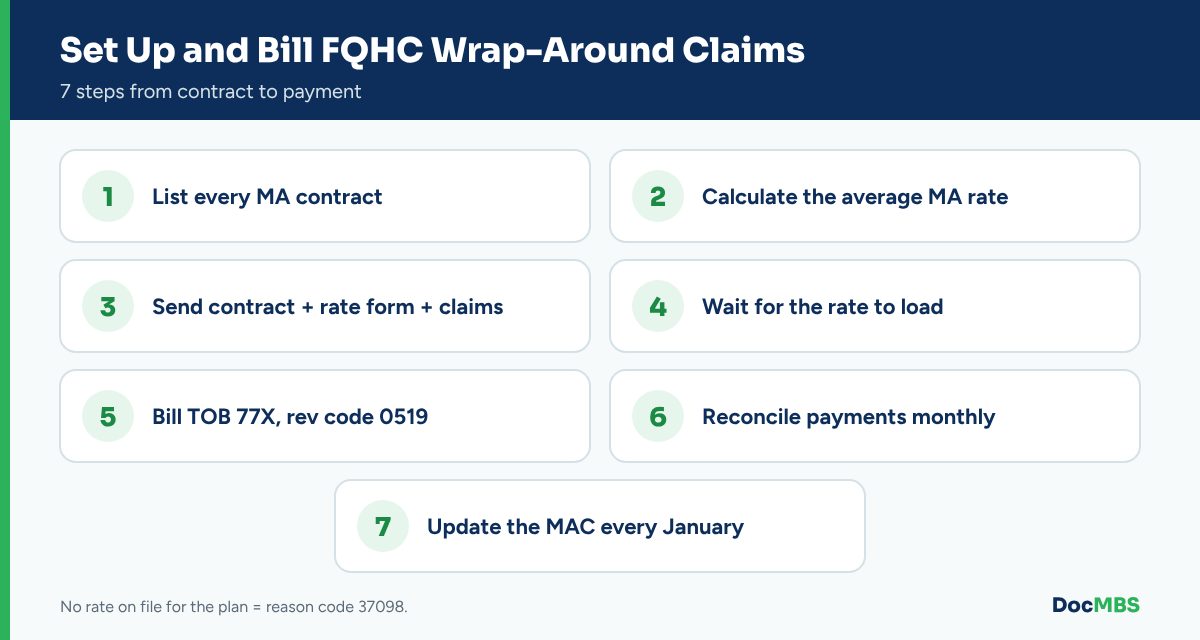
- List every MA contract. Each one needs its own FQHC wrap-around payment rate. Include the plan name, contract number and effective dates. The CMS MA Plan Directory can help you find the contract number.
- Calculate the average per-visit MA payment for each plan, using procedure codes, units, rates and payments from real claims.
- Send your MAC the setup package for each plan: a cover letter with a contact name and signature, a copy of the signed MA contract, a completed Payment Rate Calculation Form and a 12-month estimate (or detailed list) of claims under the contract (Noridian and First Coast).
- Wait for the rate to load before you bill wrap claims for that plan. Ask your MAC to confirm.
- Bill the wrap claim on TOB 77X with revenue code 0519. Report the FQHC payment code (G0466–G0470) on 0519, followed by the qualifying visit line (CMS R13547CP). [VERIFY: any MA plan ID or value code your MAC requires — Claims Processing Manual Ch. 9 §60.4]
- Reconcile payments monthly. Compare each FQHC wrap-around payment with the expected gap for that plan.
- Update the MAC whenever a contract changes, especially every January 1. First Coast says keeping the MAC current on all MA contracts is the FQHC’s responsibility.
Pro Tip: Keep one spreadsheet per MA plan: contract dates, average rate on file, date sent to the MAC and date confirmed. When a 37098 comes back, you’ll know in seconds whether the problem is a missing plan or an expired rate.
Reason Code 37098 and Other Wrap-Around Problems
These are the problems that most often stop an FQHC wrap-around payment. For a wider plan, see how to reduce claim denials.
| Problem | What you’ll see | How to fix it |
|---|---|---|
| No supplemental rate on file for the MA plan | RTP, reason code 37098 | Send the signed contract, Payment Rate Calculation Form and 12-month claims estimate to your MAC’s reimbursement team, then rebill. |
| Wrap claim billed on 052X or 0900 | RTP or wrong payment | Move the G-code and qualifying line to revenue code 0519. |
| G-code without a qualifying visit line | RTP or CO-16 | Add the qualifying service (e.g. 99213 or 90834) after the G-code. |
| MA rate higher than PPS rate | No wrap payment | Expected. No action needed. |
| Outdated MA rate after a contract change | Wrong wrap amount | Send the new contract and rate form to the MAC. |
| Wrap claim filed late | CO-29 [VERIFY: wrap claims follow the 12-month Medicare limit — Claims Processing Manual Ch. 1 §70] | Track wrap claims by date of service like any Medicare claim. |
Each FQHC wrap-around payment claim is a Medicare claim, so treat its deadline like any other. See our Medicare timely filing limit guide.
Why January Matters: MA Plan Changes and Your Wrap Rates
Medicare open enrollment runs October 15 to December 7, and plan changes take effect January 1. That’s when FQHC wrap-around payment problems spike:
- Patients move into new MA plans your MAC has no rate for, so claims return with 37098.
- Your MA contracts renew with new rates, so the rate on file is out of date.
- Patients switch between Original Medicare and MA, so the wrong claim type goes out.
Before January, protect your FQHC wrap-around payment: list every MA plan your patients are moving into and check that each one has a rate on file. Our Medicare open enrollment checklist for providers covers the eligibility side.
FQHC Medicare Wrap vs Medicaid Wrap: Not the Same Thing
Many FQHC teams say “wrap” for two different payments:
| Medicare FQHC wrap-around payment | Medicaid wrap payment | |
|---|---|---|
| Who pays | Your Medicare MAC | Your state Medicaid program |
| When | MA plan pays less than the Medicare FQHC PPS rate | Medicaid managed care pays less than the state’s FQHC rate |
| How you bill | Revenue code 0519 claim to the MAC | State-specific process |
| Rate used | Medicare FQHC PPS rate | State’s FQHC PPS or alternative rate |
Texas note: Texas Medicaid pays FQHCs a provider-specific PPS rate through its own billing rules, separate from the Medicare FQHC wrap-around payment. [VERIFY: Texas Medicaid FQHC encounter billing (e.g. T1015) and managed care wrap process — TMHP FQHC handbook] For more on Medicare telehealth rules for FQHCs, see our FQHC telehealth billing guide, and for the mental health revenue code, our revenue code 0900 guide.
Key Takeaways
- The FQHC wrap-around payment covers the gap when an MA plan pays less than your PPS rate.
- The MAC pays the difference minus the patient’s cost sharing; no wrap when the MA rate is higher.
- Bill it on TOB 77X with revenue code 0519, with a G-code and a qualifying visit line.
- Your MAC needs the signed MA contract, Payment Rate Calculation Form and 12-month claims estimate.
- Reason code 37098 means no supplemental rate is on file for that MA plan.
- Update your MAC every time an MA contract changes, especially before January 1.
FAQs
What is the FQHC Medicare Advantage wrap-around payment?
It’s a supplemental payment from Medicare to an FQHC that has a contract with a Medicare Advantage plan. When the MA plan’s contract rate is lower than the FQHC PPS rate, the MAC pays the difference, minus any cost sharing the patient owes. The FQHC bills it on a separate claim with revenue code 0519.
How is the FQHC wrap-around payment calculated?
The MAC takes your FQHC PPS rate, subtracts the MA plan’s average per-visit payment on file, and then subtracts the patient’s cost sharing. For example, a $207.72 PPS rate and a sample $150.00 MA rate leave a $57.72 gap per visit before cost sharing. Payment isn’t compared with your charge.
When does an FQHC qualify for a wrap-around payment?
The FQHC must have a written contract with the MA plan, the plan’s rate must be on file with the MAC, and the MA contract rate must be lower than the FQHC PPS rate. If the MA rate is higher than the PPS rate, there is no wrap-around payment.
What revenue code is used for FQHC wrap-around claims?
Revenue code 0519. CMS transmittal R13547CP says revenue code 0519 is used for Medicare Advantage supplemental claims only. The FQHC payment code (G0466–G0470) goes on 0519, followed by the qualifying visit line, on a 77X type of bill. Original Medicare FQHC claims use 052X or 0900 instead.
What is reason code 37098?
Reason code 37098 returns an FQHC wrap-around claim to the provider when the MAC has no FQHC PPS supplemental rate on file for that MA plan. Fix it by sending the MAC the signed MA contract, a completed Payment Rate Calculation Form and a 12-month claims estimate, then rebilling once the rate loads.
Is the wrap-around payment different from the Medicaid wrap payment?
Yes. The Medicare FQHC wrap-around payment comes from your MAC when an MA plan pays less than the Medicare FQHC PPS rate. A Medicaid wrap payment comes from the state Medicaid program when Medicaid managed care pays less than the state’s FQHC rate. They use different rates and billing processes.
Do I need a new rate on file when an MA contract changes?
Yes. MACs such as First Coast say keeping them current on all participating MA plan contracts is the FQHC’s responsibility. When a contract renews with new rates or you sign with a new plan, send the updated contract and rate calculation, especially before January 1.
Collect Every FQHC Wrap-Around Payment You’re Owed
The FQHC wrap-around payment can be a large share of your Medicare Advantage revenue, but only if each MA plan’s rate is on file and every wrap claim goes out on revenue code 0519. List your contracts, send your MAC the rate forms, fix 37098s fast and update every January. Our FQHC billing team handles PPS claims and wrap-around payments from setup to monthly reconciliation. Book a free billing review.
This article is for education only. Medicare rules change. Confirm current requirements with CMS and your Medicare Administrative Contractor before you bill.
Sources
- Noridian JF Part A: Medicare Advantage Wrap-Around Payment (FQHC)
- First Coast Service Options: Medicare Advantage supplemental wrap-around payments, reason code 37098
- CGS J15 Part A: MA supplemental wraparound payments notice
- CMS: Transmittal R13547CP (FQHC payment codes and revenue code 0519)
- CMS: Medicare Claims Processing Manual, Pub. 100-04, Chapter 9, Section 60.4
- CMS MLN Matters: MM14309, CY 2026 FQHC PPS rate
Last updated: November 2026.
Need help with revenue cycle management? Claim submission, charge entry, payment posting, denial management and collections, handled promptly so your revenue cycle runs smoothly.