In this article
- 90791 vs 90792: The Short Answer
- Who Can Bill 90791 vs 90792?
- 90791 vs 90792 Medicare Rates for 2026
- Billing Rules: Time, Frequency and Same-Day Limits
- Interactive Complexity: Add-On 90785
- How to Bill an Intake Evaluation: 6 Steps
- Worked Example: Two Intakes
- Common 90791 vs 90792 Mistakes and Denials
- Telehealth, FQHCs and Medicaid
- Texas Note
- Key Takeaways
- FAQs
- Choose Between 90791 vs 90792 With Confidence
- Sources
90791 vs 90792 is the first coding choice on almost every new mental health patient, and it’s easy to get wrong. Bill 90792 when no medical services were provided, or when the clinician can’t provide them, and the claim is denied. Bill 90791 when a prescriber did a full medical evaluation, and you leave money behind on every intake.
This guide explains the 90791 vs 90792 decision in plain terms: what each code covers, who can bill it, the 2026 Medicare rates from CMS, how often you can bill it, same-day rules, and the denials we see most.
Quick Answer
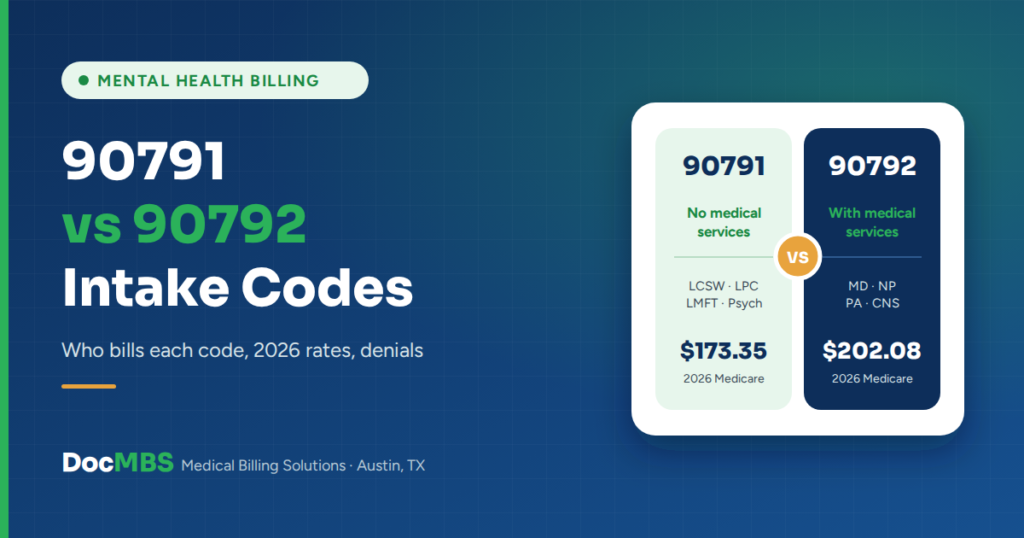
In 90791 vs 90792, the difference is medical services. 90791 is a psychiatric diagnostic evaluation without medical services, used by psychologists, LCSWs, counselors and MFTs. 90792 adds medical services and is used by physicians, NPs and PAs. In 2026, Medicare’s national non-facility rates are $173.35 (90791) and $202.08 (90792).
Table of Contents
- 90791 vs 90792: The Short Answer
- Who Can Bill 90791 vs 90792?
- 90791 vs 90792 Medicare Rates for 2026
- Billing Rules: Time, Frequency and Same-Day Limits
- Interactive Complexity: Add-On 90785
- How to Bill an Intake Evaluation: 6 Steps
- Worked Example: Two Intakes
- Common 90791 vs 90792 Mistakes and Denials
- Telehealth, FQHCs and Medicaid
- Texas Note
- Key Takeaways
- FAQs
- Sources
90791 vs 90792: The Short Answer
Both codes are for the initial psychiatric diagnostic evaluation: the intake visit where you take a full history, do a mental status exam, make a diagnosis and set up a treatment plan. The only real difference in 90791 vs 90792 is whether medical services were part of the visit.
| Feature | 90791 | 90792 |
|---|---|---|
| What it covers | Psychiatric diagnostic evaluation without medical services | Psychiatric diagnostic evaluation with medical services |
| Medical services examples | None | Medical history and exam, medication review and prescribing, ordering and reviewing labs |
| Who typically bills | Psychologists, LCSWs, LPCs/LMHCs, LMFTs (and prescribers) | Psychiatrists and other physicians, psychiatric NPs, PAs, CNSs |
| 2026 Medicare, non-facility | $173.35 | $202.08 |
| Time-based? | No (1 unit per day) | No (1 unit per day) |
| Add-on 90785 allowed? | Yes | Yes |
Descriptions paraphrased from CPT. Rates: CMS 2026 National Physician Fee Schedule Relative Value File × 2026 conversion factor $33.4009, before locality adjustment.
Who Can Bill 90791 vs 90792?
The 90791 vs 90792 choice is really a question about the clinician’s license.
- 90792 needs a clinician who can provide medical services: physicians (psychiatrists), nurse practitioners, physician assistants and clinical nurse specialists, within their state scope of practice. The APA describes 90792 as the evaluation “which includes medical work.”
- 90791 is for clinicians who don’t provide medical services: clinical psychologists, clinical social workers, and, since 2024 under Medicare, marriage and family therapists and mental health counselors.
- Prescribers can also bill 90791 if no medical services were part of the visit, but most psychiatric prescribers do medical work at intake, so 90792 is usually the right code.
- Prescribers have a third option: the APA notes that new patient E/M codes may be used instead of 90792.
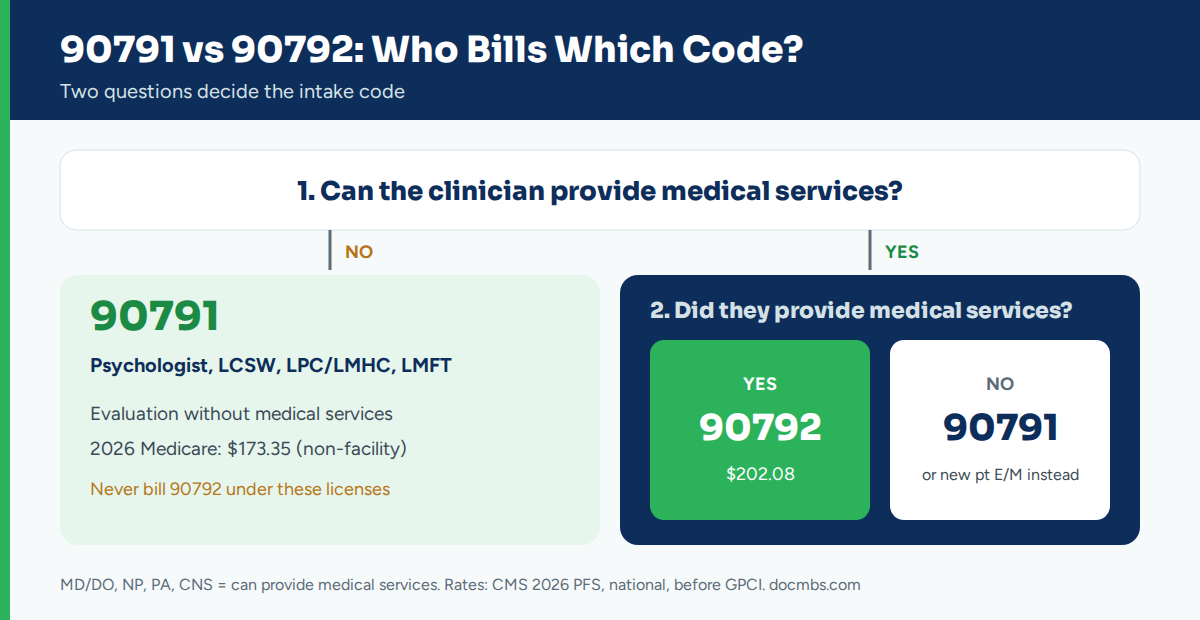
Watch Out: An LCSW, LPC or LMFT billing 90792 is one of the most common intake denials. These clinicians can’t provide medical services under their license, so 90792 isn’t theirs to bill, no matter how thorough the intake was.
90791 vs 90792 Medicare Rates for 2026
| Code | Total RVUs (non-facility / facility) | Non-facility | Facility |
|---|---|---|---|
| 90791 | 5.19 / 4.11 | $173.35 | $137.28 |
| 90792 | 6.05 / 4.77 | $202.08 | $159.32 |
| 90785 (add-on) | 0.44 / 0.35 | $14.70 | $11.69 |
Source: CMS 2026 National Physician Fee Schedule Relative Value File × $33.4009. National amounts before your locality’s GPCI adjustment. Check your locality in the CMS Physician Fee Schedule Look-Up Tool.
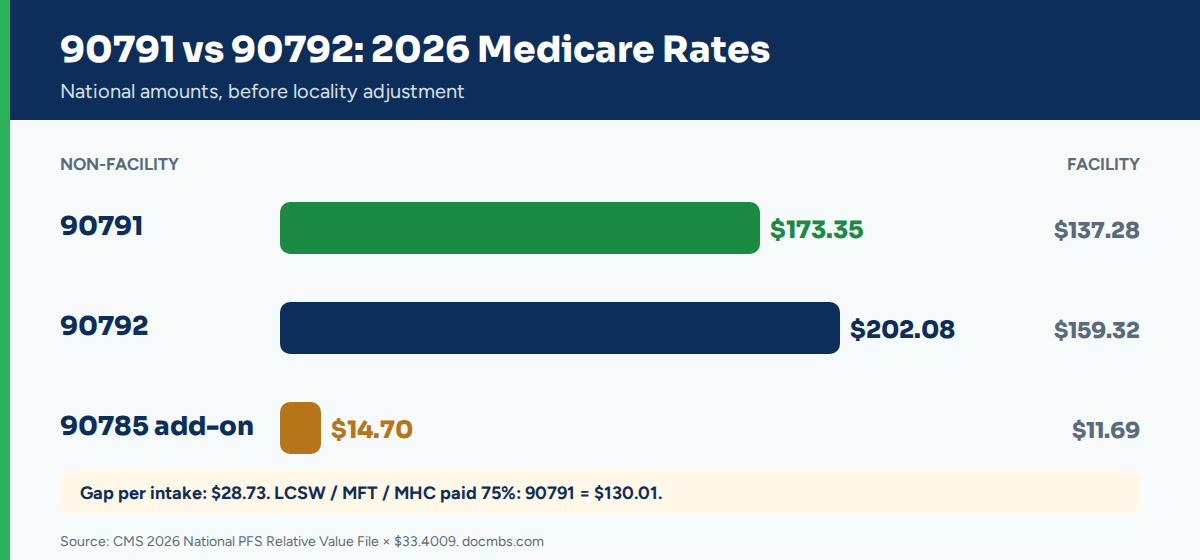
Who gets the full rate: physicians, NPs and PAs are paid under their own fee schedule rules, and psychologists are paid 100% of the fee schedule amount. Clinical social workers are paid 75% of the physician fee schedule amount, and MFTs and mental health counselors are paid 75% of what a clinical psychologist is paid (CMS MFT and MHC guidance). At 75%, 90791 is $130.01 (non-facility, national).
The 90791 vs 90792 gap is $28.73 per intake at the national non-facility rate ($202.08 − $173.35). The CY 2027 Physician Fee Schedule final rule, expected in early November 2026, may change these rates on January 1, 2027.
Intake claims denied or coded to the wrong evaluation?
DocMBS checks every intake against the clinician’s license, the services documented and each payer’s same-day rules, so your 90791 vs 90792 claims pay the first time.
See our mental health billing services for full support with intake codes, psychotherapy codes and telehealth claims.
Billing Rules: Time, Frequency and Same-Day Limits
- Not time-based. 90791 and 90792 are billed as one unit for the evaluation, not by the minute. A 50-minute intake and a 90-minute intake both bill one unit.
- Once per day. Medicare MAC guidance (CGS) says the evaluation is reported once per day.
- Usually once at the start of care. Medicare covers it once at the outset of an illness or suspected illness. WPS’s billing article A57480 allows the same provider to repeat it after an extended break in treatment (about 6 months), for an inpatient psychiatric admission, or for a significant change in mental status. Commercial and Medicaid plans set their own limits.
- Not with an E/M by the same clinician on the same day. CGS says the evaluation is not reported on the same day as an E/M service performed by the same individual for the same patient.
- Not with psychotherapy on the same day. Don’t bill 90791 or 90792 and a psychotherapy code (90832–90838) for the same patient, same day, same clinician. Payer edits deny the pair.
What the evaluation must document (CGS psychotherapy checklist): a complete medical and psychiatric history (including past, family and social history), a mental status exam, an initial diagnosis, the patient’s ability to respond to treatment, and an initial treatment plan.
Interactive Complexity: Add-On 90785
Add-on code 90785 can be reported with both 90791 and 90792 when something makes communication harder during the visit (APA Services). Common examples:
- Caregivers or others involved in the visit whose emotions or behavior get in the way of the evaluation.
- A need to manage conflicting input from family members, often with a child or an adult with a guardian.
- A sentinel event that must be reported to a third party, with discussion during the visit.
- Play equipment or other tools needed because the patient can’t communicate with ordinary language.
90785 can’t be billed alone, and it can’t be billed just because an interpreter was used (APA Services; WPS A57480).
How to Bill an Intake Evaluation: 6 Steps
- Check the clinician’s license. Non-prescribers bill 90791. Prescribers who provided medical services bill 90792 (or a new patient E/M).
- Check eligibility and limits. Confirm the plan, and whether it has already paid an evaluation for this patient recently.
- Document every required element. History, mental status exam, diagnosis, treatment capacity, initial plan. For 90792, document the medical services too.
- Don’t add same-day psychotherapy or E/M. Start psychotherapy at the next visit.
- Add 90785 only when a qualifying complication is documented. Not for interpreter use alone.
- Use the right place of service and modifiers. For telehealth, use the payer’s POS (02 or 10) and modifier (95 or 93).
Pro Tip: On the intake claims we review, the best fix is a simple rule in the billing system: lock 90792 to providers with prescriptive credentials. It stops the most common 90791 vs 90792 denial before the claim is ever sent.
Worked Example: Two Intakes
Two new Medicare patients are seen at an outpatient practice (non-facility, national 2026 rates):
| Visit | Correct codes | Allowed | Common mistake |
|---|---|---|---|
| A. Psychiatric NP intake with medical history, medication review and a new prescription | 90792 | $202.08 | Billed as 90791 → $173.35, $28.73 lost |
| B. LMHC intake for a 14-year-old whose parents disagree and interrupt during the visit | 90791 + 90785 | ($173.35 + $14.70) × 75% = $141.04 | Billed as 90792 → denied |
The math: For visit A, the gap is $202.08 − $173.35 = $28.73. A psychiatric NP who does 10 new intakes a month and codes them all as 90791 loses 10 × $28.73 = $287.30 a month (the intake count is a sample number). For visit B, the counselor is paid 75% of the clinical psychologist amount: $188.05 × 0.75 = $141.04. Medicare pays 80% of the allowed amount after the deductible, and the patient pays 20%.
Common 90791 vs 90792 Mistakes and Denials
| CARC | What it means | Common cause | Fix |
|---|---|---|---|
| CO-185 | Rendering provider not eligible for the service | LCSW, LPC or LMFT billed 90792 | Rebill as 90791. |
| CO-97 | Bundled with another service | Evaluation and psychotherapy or E/M billed the same day by the same clinician | Keep the evaluation; bill psychotherapy at the next visit. |
| CO-119 / CO-151 | Benefit maximum reached / frequency not supported | Repeat evaluation too soon, or a second evaluation by another clinician in the same group | Check prior claims; document the reason for a repeat (break in care, change in status). |
| CO-50 | Not medically necessary | Note missing required elements, like the mental status exam or treatment plan | Complete the documentation and appeal. |
| CO-4 | Modifier missing or wrong | Telehealth intake without the payer’s modifier | Add 95 or 93 per the payer’s telehealth policy. |
| CO-16 | Missing information | 90785 billed alone, or missing POS or rendering NPI | Bill 90785 with its primary code and complete the claim. |
For a full prevention process, see how to reduce claim denials.
Telehealth, FQHCs and Medicaid
- Telehealth: Medicare patients can permanently receive mental health telehealth in their home, including audio-only, and the in-person visit requirement is waived through December 31, 2027 (HHS Telehealth Policy Updates). Use the payer’s POS and modifier.
- FQHCs: 90791 and 90792 are qualifying codes for G0469, the new patient mental health visit, paid at the FQHC PPS rate rather than the fee schedule. See our guide to the FQHC PPS rate.
- Medicaid: many state programs pay intakes with H0031 (mental health assessment) or H0001 (substance use assessment) instead. See our guide to behavioral health H codes.
- After the intake: ongoing therapy moves to 90832, 90834 or 90837. See 90834 vs 90837.
Texas Note
Texas Medicaid and its STAR, STAR+PLUS and STAR Kids plans cover psychiatric diagnostic evaluations under the Behavioral Health and Case Management Services Handbook in the TMHP Texas Medicaid Provider Procedures Manual. Limits on how often an evaluation can be billed, and which provider types can bill each code, can differ from Medicare. [VERIFY: Texas Medicaid limits and eligible provider types for 90791 and 90792 in the current TMHP Behavioral Health and Case Management Services Handbook] Texas practices can get help from our Austin medical billing team.
Key Takeaways
- In 90791 vs 90792, the difference is medical services, not time.
- Psychologists, LCSWs, counselors and MFTs bill 90791. Prescribers who provide medical services bill 90792.
- 2026 Medicare national non-facility rates: $173.35 (90791) and $202.08 (90792).
- Bill it once per day, usually once at the start of care, and not with psychotherapy or E/M the same day.
- Add 90785 only for documented communication complications, not for interpreter use alone.
FAQs
What is the difference between 90791 and 90792?
Both are psychiatric diagnostic evaluation codes for an intake visit. 90791 is the evaluation without medical services. 90792 includes medical services, such as a medical history and exam, medication review or prescribing. 90792 pays more and can only be billed by clinicians who can provide medical services.
Who can bill 90792?
90792 is for clinicians who can provide medical services within their state license: psychiatrists and other physicians, psychiatric nurse practitioners, physician assistants and clinical nurse specialists. Psychologists, LCSWs, counselors and marriage and family therapists bill 90791 instead.
Can a counselor or LCSW bill 90791?
Yes. Clinical social workers can bill 90791 to Medicare, and since 2024 so can marriage and family therapists and mental health counselors. Medicare pays them 75% of the fee schedule amount. Commercial and Medicaid plans set their own rules, so check the contract.
How often can 90791 be billed?
Medicare generally covers it once at the start of an illness or suspected illness, and once per day at most. Some MACs allow a repeat by the same provider after a long break in treatment (WPS uses about 6 months), an inpatient admission, or a major change in mental status. Other payers set their own limits.
Can 90791 and 90837 be billed on the same day?
Not by the same clinician for the same patient. The intake evaluation and a psychotherapy code like 90837 on the same day are denied as bundled. Complete the evaluation on day one and bill psychotherapy starting at the next visit.
Is 90791 a time-based code?
No. 90791 and 90792 are billed as one unit for the evaluation, whatever the length of the visit. That’s different from psychotherapy codes like 90834 and 90837, which are chosen by documented time.
What is the Medicare rate for 90791 in 2026?
The 2026 national Medicare rate for 90791 is $173.35 in a non-facility setting and $137.28 in a facility setting, based on CMS relative value units and the $33.4009 conversion factor. 90792 is $202.08 and $159.32. Your actual rate depends on your locality and provider type.
Choose Between 90791 vs 90792 With Confidence
The 90791 vs 90792 choice comes down to two questions: can this clinician provide medical services, and did they? Answer those, document the required elements, and keep psychotherapy for the next visit.
DocMBS handles intake coding, psychotherapy claims and telehealth billing for mental health practices. See our mental health billing services or book a free billing review.
This article is for education only. Code descriptions are paraphrased. Rates and rules change. Confirm with your Medicare Administrative Contractor or health plan before billing.
Sources
- CMS: Physician Fee Schedule Look-Up Tool
- CMS: PFS Relative Value Files (2026)
- CMS (WPS): Billing and Coding Article A57480: Psychiatry and Psychology Services
- CGS: Psychotherapy Services Checklist
- CMS: Marriage and Family Therapists and Mental Health Counselors
- HHS: Telehealth Policy Updates
- APA Services: Psychotherapy Codes for Psychologists
- TMHP: Texas Medicaid Provider Procedures Manual
Last updated: October 2026.
Need help with behavioral health billing? Billing for behavioral health organizations, community programs and substance use treatment providers, with the authorizations, session limits and payer carve-out rules handled for you.