In this article
- What Are Behavioral Health H Codes?
- Behavioral Health H Codes Master Table
- H-Codes vs CPT Codes: Which One Do You Bill?
- Modifiers Used With H-Codes
- 15-Minute Unit Math for Behavioral Health H Codes
- Step-by-Step: How to Bill an H-Code Claim
- Worked Example: One IOP Day Plus a Crisis Contact
- Common Denials for Behavioral Health H Codes and How to Fix Them
- Texas Note: H-Codes in Texas Medicaid
- Key Takeaways
- FAQs
- Get Behavioral Health H Codes Paid the First Time
- Sources
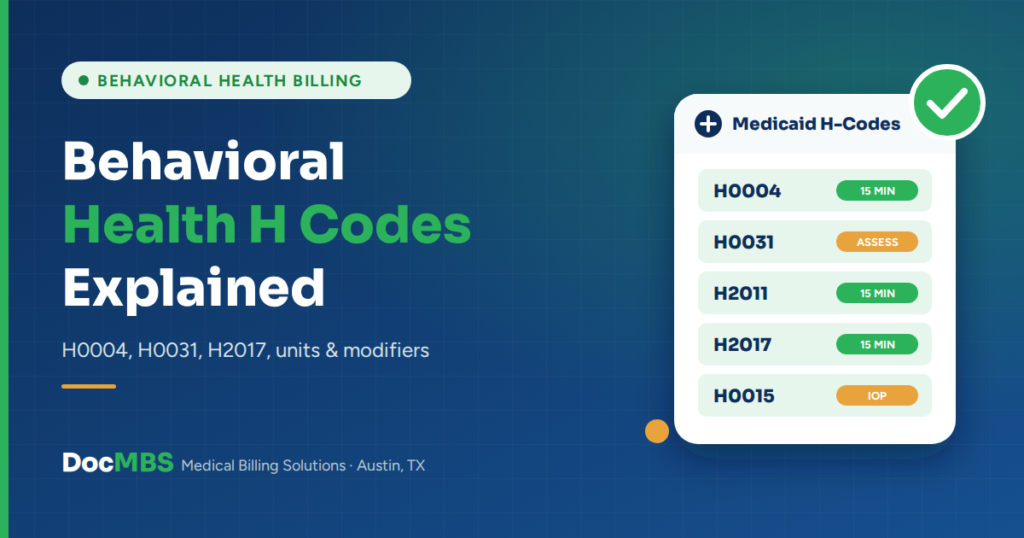
Behavioral health H codes are the HCPCS Level II codes most state Medicaid programs use to pay for counseling, crisis care, peer support, psychosocial rehab and substance use programs. They look simple, but small mistakes get these claims denied: the wrong unit count, a missing HO or HQ modifier, an expired authorization, or an H-code sent to a payer that only accepts CPT.
This guide puts the most-used H-codes in one table, explains when to use an H-code instead of a CPT code, shows the 15-minute unit math, and walks through the denials we see most.
Quick Answer
Behavioral health H codes (the H0001–H2041 range) are HCPCS Level II codes for mental health and substance use services. They are used mainly by state Medicaid programs and their managed care plans, not Medicare. Many are billed per 15 minutes (H0004, H2011, H2017), while others are per day or per service. Each payer sets its own units, modifiers and authorization rules.
Table of Contents
- What Are Behavioral Health H Codes?
- Behavioral Health H Codes Master Table
- H-Codes vs CPT Codes: Which One Do You Bill?
- Modifiers Used With H-Codes
- 15-Minute Unit Math
- Step-by-Step: How to Bill Behavioral Health H Codes
- Worked Example: One IOP Day Plus a Crisis Contact
- Common Denials and How to Fix Them
- Texas Note: H-Codes in Texas Medicaid
- Key Takeaways
- FAQs
- Sources
What Are Behavioral Health H Codes?
HCPCS has two levels. Level I is the CPT code set from the AMA. Level II is the alphanumeric code set kept by CMS. Inside Level II, the H series covers behavioral health, mental health and alcohol and drug services that CPT doesn’t describe well, such as peer support, psychosocial rehab, residential stays and program-based care.
Here is who uses behavioral health H codes:
- State Medicaid programs (fee-for-service) are the main users. Many state plans define community mental health and substance use benefits with H-codes.
- Medicaid managed care plans follow their state’s code list and often add their own authorization rules.
- State-funded and grant programs (for example, county or state behavioral health authorities) often use H-codes for reporting and payment.
- Some commercial plans accept certain H-codes, mostly for substance use programs. Always check the contract.
- Medicare generally does not pay behavioral health H codes. Medicare behavioral health claims use CPT codes and Medicare G-codes instead.
Watch Out: The H range runs past H2037. The current HCPCS file includes codes up to H2041 (coordinated specialty care for first-episode psychosis). Use the latest quarterly HCPCS file, not an old cheat sheet.
Behavioral Health H Codes Master Table
These are the behavioral health H codes we see most on claims. The descriptions are summarized from the CMS HCPCS Level II file. The unit column shows what the code descriptor says. Where the descriptor names no unit, your payer decides it.
| Group | Code | What it covers (summary) | Unit in descriptor |
|---|---|---|---|
| Assessment | H0001 | Alcohol and/or drug assessment | None stated (payer sets) |
| Assessment | H0031 | Mental health assessment by a non-physician | None stated (payer sets) |
| Counseling | H0004 | Behavioral health counseling and therapy | Per 15 minutes |
| Counseling | H0005 | Alcohol and/or drug group counseling by a clinician | None stated (payer sets) |
| Crisis | H2011 | Crisis intervention service | Per 15 minutes |
| Peer support | H0038 | Self-help/peer services | Per 15 minutes |
| Rehab and skills | H2014 | Skills training and development | Per 15 minutes |
| Rehab and skills | H2017 | Psychosocial rehabilitation services | Per 15 minutes |
| Rehab and skills | H2019 | Therapeutic behavioral services | Per 15 minutes |
| Programs | H0015 | Alcohol and/or drug intensive outpatient program (at least 3 hours a day, at least 3 days a week, individualized plan) | None stated (usually billed per day) |
| Programs | H0035 | Mental health partial hospitalization, less than 24 hours | None stated (usually billed per day) |
| Residential | H0017 | Hospital residential treatment program, without room and board | Per diem |
| Residential | H0018 | Short-term non-hospital residential treatment, without room and board | Per diem |
| Residential | H0019 | Long-term non-medical residential treatment, without room and board | Per diem |
| Programs | H2036 | Alcohol and/or other drug treatment program | Per diem |
Summaries are ours. Check the full descriptor in the current CMS HCPCS quarterly file before you build your charge master.
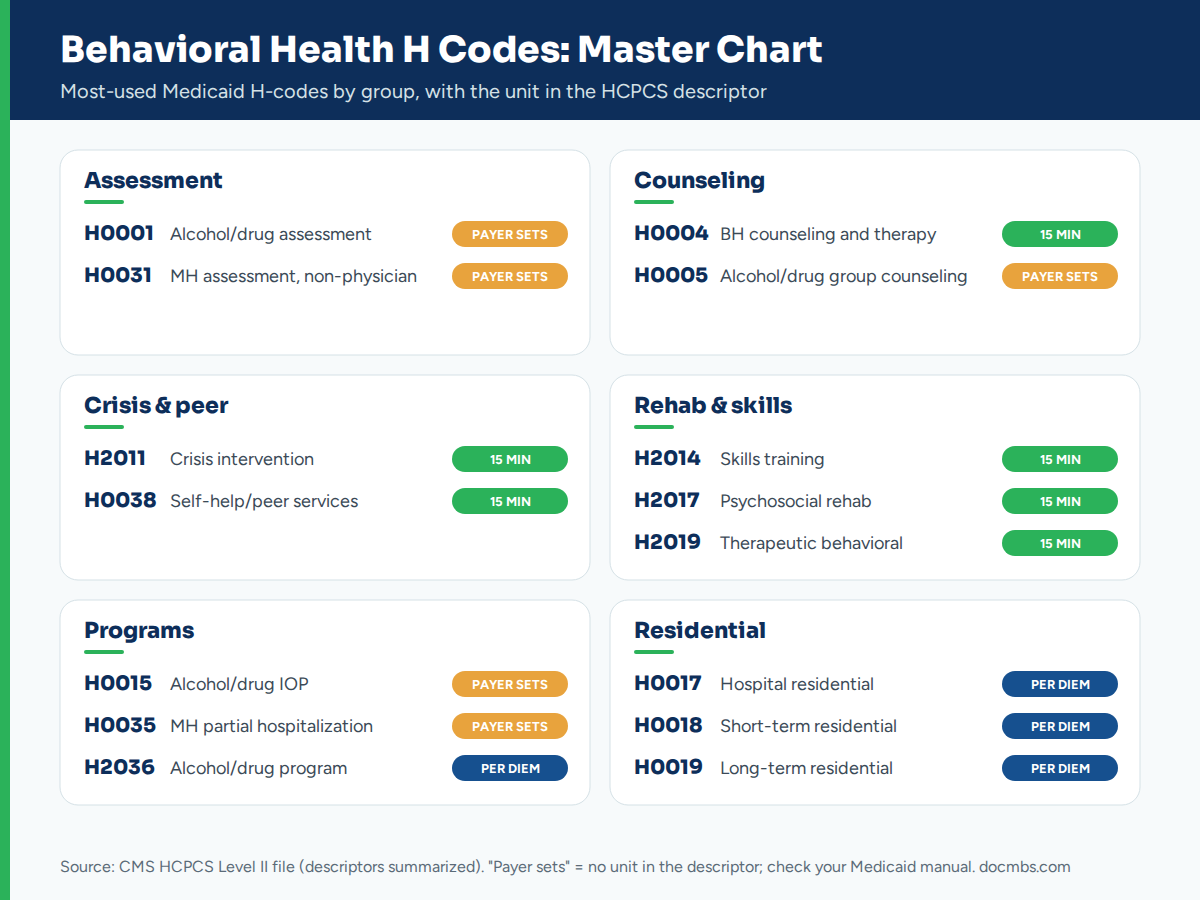
Pro Tip: “None stated” does not mean “bill one unit.” Many Medicaid programs define H0031, H0001 and H0005 as one unit per assessment or per session, but some use time. Your state’s fee schedule or provider manual is the final word.
H-Codes vs CPT Codes: Which One Do You Bill?
The same visit can often be described with an H-code or a CPT code. The payer decides which one it accepts, not the clinician. Here is how the most common pairs compare:
| Service | H-code | CPT code(s) | Key difference |
|---|---|---|---|
| Intake assessment | H0031 (mental health) or H0001 (substance use) | 90791 | 90791 is a psychiatric diagnostic evaluation without medical services. Medicare and most commercial plans want 90791. Many Medicaid programs accept H0031/H0001, often from a wider range of staff. |
| Individual therapy | H0004 (per 15 min) | 90832, 90834, 90837 | CPT psychotherapy codes are time bands (about 30, 45 and 60 minutes). H0004 is billed in 15-minute units, so a 60-minute session is usually 4 units. |
| Group therapy | H0005 (substance use) or H0004 with HQ | 90853 | 90853 is per session. H-code group billing depends on the payer’s unit rule. |
| Crisis | H2011 (per 15 min) | 90839, 90840 | CPT crisis psychotherapy has a first-hour code plus add-on. H2011 is community crisis intervention in 15-minute units. |
Rule of thumb: Medicare and most commercial plans want CPT. State Medicaid and its managed care plans often want H-codes for community, program-based and paraprofessional services. If your clinic bills both, map each service by payer in your billing system. For CPT therapy codes, see our guide to CPT code 90837 and our mental health billing services.
Modifiers Used With H-Codes
Medicaid programs add HCPCS modifiers to behavioral health H codes to show who provided the service, how (individual, group, family) and which program it belongs to. A missing or wrong modifier is one of the fastest ways to get behavioral health H codes denied.
| Modifier | Meaning | Typical use |
|---|---|---|
| HM | Less than bachelor’s degree level | Paraprofessional staff, some peer specialists |
| HN | Bachelor’s degree level | Bachelor’s-level staff, often under supervision |
| HO | Master’s degree level | LPC, LCSW, LMFT and other master’s-level clinicians |
| HP | Doctoral level | Psychologists and other doctoral-level staff |
| HQ | Group setting | Group versions of H0004, H2014, H2017 and others |
| HR / HS | Family/couple with client present / without client present | Family sessions billed under an H-code |
| HA | Child/adolescent program | Youth services (Texas MCOs use it on several MHR codes) |
| HF / HE | Substance abuse program / mental health program | Program identifiers some states require |
| 95 | Synchronous telemedicine (real-time audio and video) | Telehealth H-code visits, if the payer allows them |
Watch Out: Modifier rules are set by each state and plan. One plan may require HO on every H0004 line, while another pays H0004 with no credential modifier. Some states pay a different rate for each credential level, so a missing HO can mean an underpayment, not just a denial.
H-code claims coming back for units, modifiers or authorizations?
DocMBS maps every behavioral health service to the right H-code or CPT code by payer, checks authorizations before the claim goes out and works Medicaid denials until they are paid.
See our behavioral health billing services for full support with Medicaid H-codes, substance use programs, IOP and partial hospitalization claims.
15-Minute Unit Math for Behavioral Health H Codes
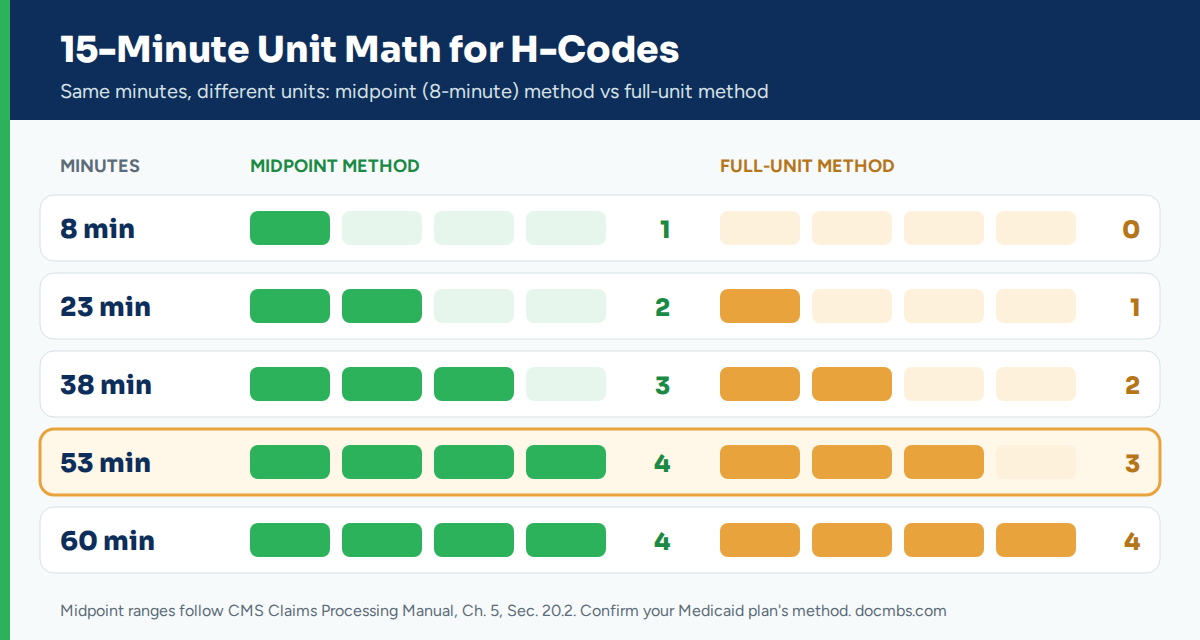
Many behavioral health H codes, like H0004, H0038, H2011, H2014, H2017 and H2019, are billed in 15-minute units. The tricky part is the leftover minutes. Payers use one of two methods:
- Midpoint method (8-minute rule). A unit counts once you pass the midpoint, 8 minutes. Medicare uses this for its own timed codes (CMS Claims Processing Manual, Chapter 5). Many Medicaid programs use the same idea for H-codes.
- Full-unit method. Only complete 15-minute blocks count. Some Medicaid programs and plans require this.
| Minutes documented | Units: midpoint method | Units: full-unit method |
|---|---|---|
| 1–7 | 0 | 0 |
| 8–14 | 1 | 0 |
| 15–22 | 1 | 1 |
| 23–29 | 2 | 1 |
| 30–37 | 2 | 2 |
| 38–44 | 3 | 2 |
| 45–52 | 3 | 3 |
| 53–59 | 4 | 3 |
| 60–67 | 4 | 4 |
Midpoint column follows the unit ranges in CMS Claims Processing Manual, Chapter 5, Section 20.2. Confirm which method your state Medicaid program or plan uses.
Two more rules apply on most Medicaid claims:
- Document start and stop times (or total minutes) in the note. Auditors recount units from the note.
- Don’t add minutes across different codes to reach a unit unless your payer’s manual allows it. 10 minutes of H2014 and 10 minutes of H2017 are not one 20-minute unit of either code.
Step-by-Step: How to Bill an H-Code Claim
- Check eligibility and the plan. Confirm whether the member is fee-for-service Medicaid or in a managed care plan. The plan decides the code list, modifiers and authorization rules.
- Confirm the authorization. Many behavioral health H codes (IOP, PHP, residential, rehab services) need prior authorization. Match the code, units and date range on the authorization to what you plan to bill.
- Match the code to the payer. Use the payer’s crosswalk: H0031 or 90791, H0004 or 90834, and so on. Don’t send H-codes to Medicare.
- Add the right modifiers. Credential (HM/HN/HO/HP), setting (HQ, HR, HS), program (HA, HF) and telehealth (95) as the payer requires. Put them in the order the payer’s manual shows.
- Count units from the note. Use the payer’s unit method. Per diem codes are one unit per day.
- Check the place of service and rendering provider. Make sure the rendering provider is enrolled with the plan and allowed to bill that code.
- Submit and track. Watch the filing limit (Texas Medicaid is generally 95 days from the date of service) and work any denial quickly.
Pro Tip: On the behavioral health claims we work, the cleanest clinics keep a one-page “code grid” per payer: code, modifiers, unit rule, auth needed (yes/no) and who can render it. Billers check the grid, not their memory.
Worked Example: One IOP Day Plus a Crisis Contact
An adult Medicaid managed care member attends a substance use intensive outpatient program on Tuesday. That evening, a master’s-level clinician provides a 53-minute crisis intervention in the community.
The rates below are sample numbers for the math only. They are not a fee schedule. Use your own state or plan rates.
| Line | Code + modifiers | Units | Sample rate | Sample total |
|---|---|---|---|---|
| 1. IOP day | H0015 (+ program modifier if required) | 1 (per day) | $150.00 per day | $150.00 |
| 2. Crisis, midpoint method | H2011 HO | 4 (53 min) | $30.00 per unit | $120.00 |
| 2. Crisis, full-unit method | H2011 HO | 3 (45 of 53 min) | $30.00 per unit | $90.00 |
The math: 53 minutes is 3 full units (45 minutes) plus 8 minutes left over. Under the midpoint method, the 8 leftover minutes count, so you bill 4 units. Under the full-unit method, they don’t, so you bill 3 units. Billing 4 units to a full-unit payer is an overbilling risk. Billing 3 units to a midpoint payer leaves money on the table.
The bundling check: Some plans treat crisis care as part of the IOP per diem when it happens during program hours. Here the crisis call happened in the evening, outside program hours, and the note says so. That separate time and setting is what supports billing H2011 on its own line. If your plan bundles it anyway, expect a CO-97 denial and appeal with the note.
Claim total (midpoint payer): $150.00 + $120.00 = $270.00 in sample charges. Full-unit payer: $150.00 + $90.00 = $240.00.
Common Denials for Behavioral Health H Codes and How to Fix Them
| CARC | What it means | Common H-code cause | Fix |
|---|---|---|---|
| CO-197 | Precertification/authorization absent | IOP, PHP, residential or rehab billed with no auth, or outside the auth dates | Request a retro auth if the plan allows it. Otherwise fix the intake process so auths are checked before day one. |
| CO-151 / CO-119 | Units/frequency not supported / benefit maximum reached | More units than authorized, or daily or yearly unit caps passed | Compare units billed with the auth and note. Request more units before you go over, not after. |
| CO-4 | Code inconsistent with modifier, or required modifier missing | Missing HO/HN, HQ on an individual session, or 95 where telehealth isn’t allowed | Correct the modifier from the payer’s code grid and submit a corrected claim. |
| CO-185 | Rendering provider not eligible to perform the service billed | Peer specialist or bachelor’s-level staff billed on a code the plan limits to licensed clinicians | Check the provider’s credential against the plan’s rules and their enrollment with the plan. |
| CO-97 | Service included in another service already paid | Counseling or crisis billed on the same day as an IOP, PHP or residential per diem | Check the plan’s bundling rules. Appeal only if the note shows a separate service outside program hours. |
| CO-96 / CO-16 | Non-covered charge / missing information | H-code sent to Medicare or a commercial plan that only takes CPT | Rebill with the payer’s accepted CPT or G-code. |
For a full process to cut denials, read how to reduce claim denials, or let our denial management team work the backlog.
Watch Out: Auth and unit denials pile up fast on per-15-minute codes. A daily H2017 program billed for 30 days with the wrong unit count can mean 30 denied lines, all with the same filing clock running.
Texas Note: H-Codes in Texas Medicaid
Texas Medicaid publishes its behavioral health rules in the Texas Medicaid Provider Procedures Manual (TMPPM), maintained by TMHP. STAR, STAR+PLUS and STAR Kids managed care plans follow it and add their own authorization rules.
- Mental health rehabilitative (MHR) services in Texas use behavioral health H codes. Superior HealthPlan’s Texas clinical policy for these services (TX.CP.BH.544) lists H0034 (medication training and support), H2011 (crisis intervention), H2014 (skills training and development) and H2017 (psychosocial rehabilitation), with HA for child/youth and HQ for group.
- The same policy says a recovery plan that includes H2017 can’t also include H2014, and H2017 can’t be provided while the person is admitted to a crisis stabilization unit.
- Prior authorization: Superior announced a new prior authorization requirement for MHR and mental health targeted case management services, effective March 1, 2026. Other STAR plans set their own rules, so check each plan’s auth list.
- Filing limit: Texas Medicaid claims generally must be filed within 95 days of the date of service.
- Texas substance use disorder codes, unit rules and modifiers for outpatient and residential treatment are in the TMPPM. [VERIFY: Texas SUD H-code list and unit rules in the current TMPPM Behavioral Health handbook]
For Texas rates, see [INTERNAL LINK: Texas Medicaid behavioral health fee schedule]. If you are a Texas provider, our Austin medical billing team works with TMHP and the STAR plans every day, and our Texas credentialing guide covers enrollment before you bill.
Key Takeaways
- Behavioral health H codes are HCPCS Level II codes used mainly by state Medicaid and its managed care plans, not Medicare.
- H0004, H0038, H2011, H2014, H2017 and H2019 are per 15 minutes. Residential codes H0017–H0019 and H2036 are per diem.
- The payer decides H-code vs CPT: H0031 vs 90791, H0004 vs 90832–90837.
- Modifiers (HM/HN/HO/HP, HQ, HR/HS, HA, 95) change payment and cause most CO-4 denials.
- Know your payer’s unit method. 53 minutes can be 3 or 4 units.
- In Texas, MHR services use H0034, H2011, H2014 and H2017, and some STAR plans now require prior authorization.
FAQs
What are behavioral health H codes?
They are HCPCS Level II codes in the H range (H0001 to H2041) for mental health and substance use services, such as assessments, counseling, crisis intervention, peer support, psychosocial rehab and residential treatment. State Medicaid programs and their managed care plans use them most. Each payer sets its own unit, modifier and authorization rules.
Does Medicare pay for H-codes?
Generally, no. Medicare behavioral health claims use CPT codes such as 90791 and 90834, plus Medicare G-codes. H-codes are mainly used by state Medicaid programs, Medicaid managed care plans and state-funded programs. If you send an H-code to Medicare, expect a denial and rebill with the correct CPT or G-code.
What is the difference between H0004 and 90834?
Both describe individual therapy. H0004 is a HCPCS code billed per 15 minutes, used mainly by Medicaid. 90834 is a CPT psychotherapy code for a session of about 45 minutes, used by Medicare and most commercial plans. The payer decides which one you bill. A 45-minute H0004 session is usually 3 units.
What is H0031 used for?
H0031 is a mental health assessment by a non-physician. Medicaid programs use it for intake and reassessments, often by licensed clinicians and sometimes by other qualified staff. The descriptor names no time unit, so the payer decides whether it is billed per assessment or by time. Medicare and most commercial plans want 90791 instead.
How many units is a 60-minute H2017 session?
H2017 is psychosocial rehabilitation per 15 minutes, so 60 documented minutes equal 4 units under both the midpoint and full-unit methods. The methods only differ when there are leftover minutes. For example, 53 minutes is 4 units under the midpoint method but 3 units under the full-unit method.
Which modifier shows a master’s-level clinician?
HO is the HCPCS modifier for a master’s degree level provider. HN is bachelor’s level, HM is less than bachelor’s level, and HP is doctoral level. Many Medicaid programs require one of these on H-code lines, and some pay a different rate for each level, so check the payer’s code grid.
Do H-codes need prior authorization?
Often, yes. Program-based codes like H0015 (IOP), H0035 (partial hospitalization), residential codes and rehab codes such as H2017 commonly need prior authorization from the Medicaid plan. Requirements differ by state and plan. In Texas, some STAR plans added prior authorization for mental health rehabilitative services in 2026.
Get Behavioral Health H Codes Paid the First Time
Behavioral health H codes pay well for community and program-based care, but only when the code, modifiers, units and authorization all match what the payer expects. Build a code grid for each payer, count units from the note, and check authorizations before the first visit.
DocMBS bills Medicaid H-codes, IOP and PHP programs and substance use services for behavioral health providers. See our behavioral health billing services or book a free billing review.
Sources
- CMS: HCPCS Quarterly Update (Level II code file)
- CMS: Medicare Claims Processing Manual, Chapter 5, Section 20.2 (timed code units)
- X12: Claim Adjustment Reason Codes
- TMHP: Texas Medicaid Provider Procedures Manual
- Superior HealthPlan: Clinical Policy TX.CP.BH.544, Mental Health Rehabilitative Services
- Superior HealthPlan: Effective March 1, 2026: New Clinical Policy for MHR Services and MHTCM
Last updated: October 2026. This article is for education only. Code rules, units and modifiers vary by state and payer. Confirm with your Medicaid program or health plan before submitting claims.