In this article
- What Is IOP Billing?
- IOP Billing Codes by Payer
- Medicare IOP Rules: The 9-Hour Rule and Certification
- 2026 Medicare IOP Rates
- IOP vs PHP: What’s the Difference?
- How to Bill an IOP Claim: 7 Steps
- Worked Example: One IOP Week
- Common IOP Billing Mistakes and Denials
- IOP Billing in FQHCs and RHCs
- Texas Note
- Key Takeaways
- FAQs
- Get IOP Billing Right for Every Payer
- Sources
IOP billing is where behavioral health programs lose money most quietly. Medicare, Medicaid and commercial payers each want different codes, claim forms and rules for the same intensive outpatient day, so claims get returned, denied or paid at the wrong per diem rate.
This IOP billing guide sorts it out by payer. You’ll see the Medicare rules (condition code 92, the 9-hour rule, certification), the 2026 per diem rates from CMS, how IOP compares with PHP, a worked example, and the mistakes we see most on IOP claims.
Quick Answer
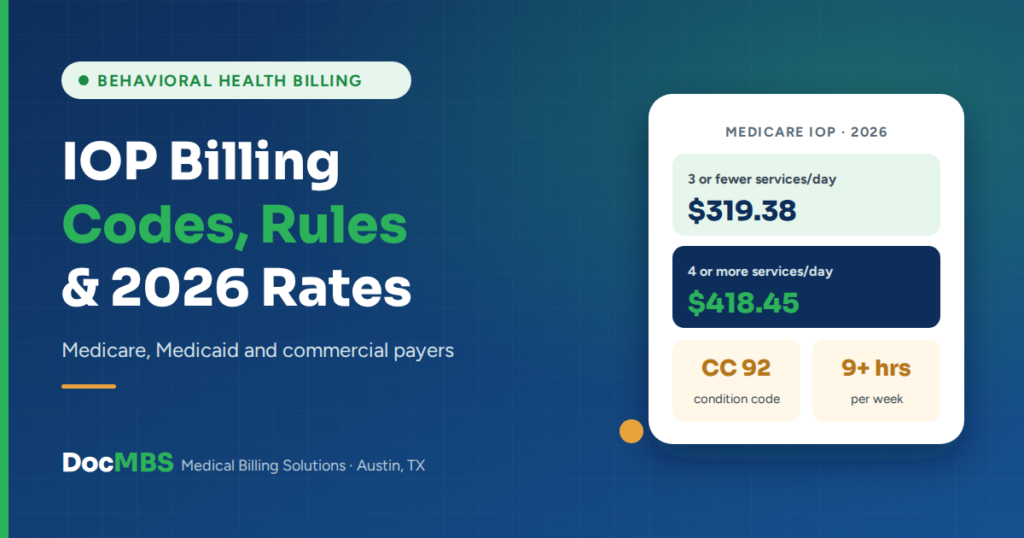
Medicare has covered IOP since January 1, 2024. Claims need condition code 92, and the patient needs at least 9 hours of services a week. Medicare pays per day: in 2026, $319.38 for 3 or fewer services and $418.45 for 4 or more (hospital and FQHC). Medicaid and commercial plans often use H0015 or S9480 instead.
Table of Contents
- What Is IOP Billing?
- IOP Billing Codes by Payer
- Medicare IOP Rules: The 9-Hour Rule and Certification
- 2026 Medicare IOP Rates
- IOP vs PHP: What’s the Difference?
- How to Bill an IOP Claim: 7 Steps
- Worked Example: One IOP Week
- Common IOP Billing Mistakes and Denials
- IOP Billing in FQHCs and RHCs
- Texas Note
- Key Takeaways
- FAQs
- Sources
What Is IOP Billing?
An intensive outpatient program (IOP) gives patients structured mental health or substance use treatment several hours a day, several days a week, while they live at home. IOP billing is how a program gets paid for that care. It’s more intense than weekly therapy, but less intense than a partial hospitalization program (PHP).
Who can bill IOP depends on the payer:
- Medicare: hospital outpatient departments, community mental health centers (CMHCs), critical access hospitals, rural health clinics (RHCs), federally qualified health centers (FQHCs) and opioid treatment programs (Medicare Benefit Policy Manual, Chapter 6, §70.4).
- Medicaid: enrolled programs under each state’s rules, often licensed substance use or mental health programs.
- Commercial plans: licensed IOP facilities in network with the plan, under the contract’s codes and authorization rules.
IOP Billing Codes by Payer
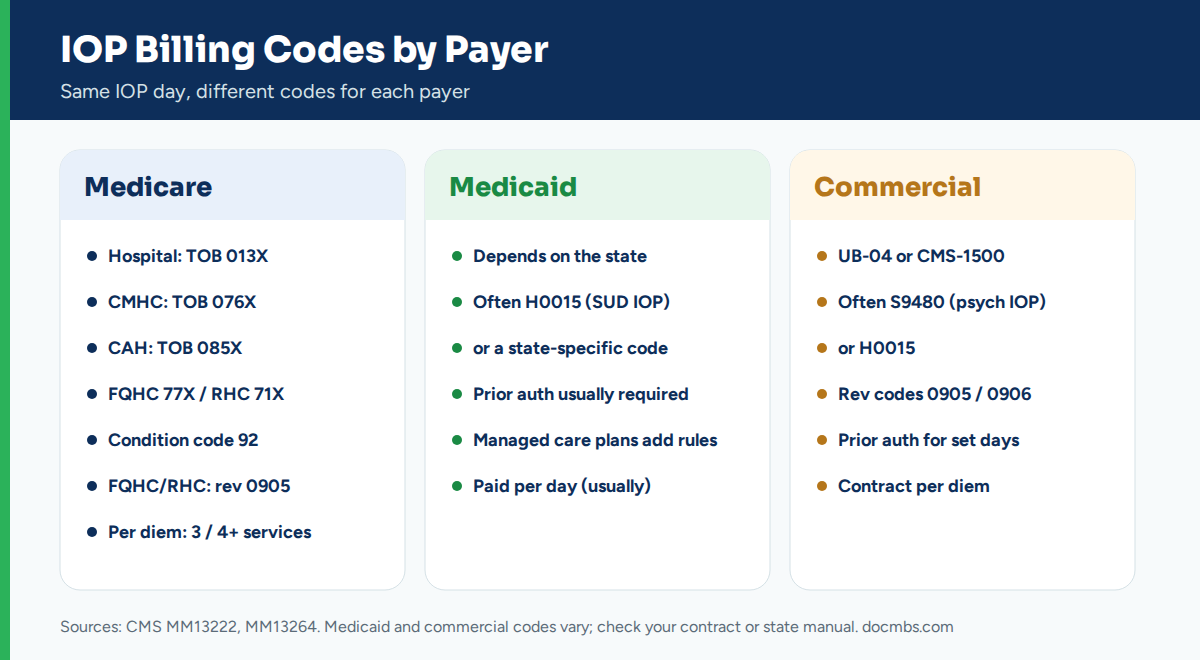
The biggest source of IOP billing errors is using one payer’s codes on another payer’s claim. Here’s how they differ:
| Payer / setting | Claim / type of bill | Key codes | How it’s paid |
|---|---|---|---|
| Medicare: hospital outpatient | UB-04, TOB 013X | Condition code 92 + revenue code and HCPCS lines from CMS’s IOP list | Per diem under OPPS (3 or fewer / 4+ services) |
| Medicare: CMHC | UB-04, TOB 076X | Condition code 92 + IOP service lines | Per diem under OPPS (CMHC rate) |
| Medicare: critical access hospital | UB-04, TOB 085X | Condition code 92 + IOP service lines | 101% of reasonable cost |
| Medicare: FQHC / RHC | UB-04, TOB 77X (FQHC) / 71X (RHC) | Condition code 92 + revenue code 0905 + IOP HCPCS | IOP per diem, not the PPS or AIR rate |
| Medicaid | Depends on the state and program | Often H0015 (alcohol/drug IOP) or a state code | State or managed care rate, usually per day |
| Commercial | UB-04 or CMS-1500, per contract | Often S9480 (intensive outpatient psychiatric services, per diem), H0015, or revenue codes 0905 / 0906 | Contract rate, usually per diem |
Medicare rows: CMS MM13222 and MM13264. Medicaid and commercial codes vary by payer. Always use the code set in your contract or state manual.
Watch Out: S9480 and H0015 are HCPCS codes Medicare doesn’t use for its IOP benefit. Sending them on a Medicare IOP claim is a common reason for denials. Medicare wants condition code 92 and the service lines on CMS’s list.
Medicare IOP Rules: The 9-Hour Rule and Certification
Medicare IOP billing rests on a few firm requirements (CMS MM13222; 42 CFR 424.24; Benefit Policy Manual, Chapter 6, §70.4):
- 9 hours a week. The patient must need at least 9 hours of IOP services per week, shown in the plan of care.
- Physician certification. A physician certifies the need for IOP at admission.
- Recertification. Required at intervals the program sets, but no less often than every 60 days. It must state that the patient still needs at least 9 hours a week, and describe response to treatment and discharge goals.
- Written plan of care. An individualized plan from the physician with structured, active treatment and measurable goals.
- The right patient. Someone who needs more than routine outpatient care but less than PHP, can take part in active treatment, and doesn’t need 24-hour supervision.
- Condition code 92 on every Medicare IOP claim from hospitals and CMHCs.
Covered IOP services include individual and group psychotherapy, occupational therapy, peer support, family counseling, patient education, non-self-administered drugs, activity therapy that isn’t mainly recreational, and related diagnostic services (Benefit Policy Manual, Chapter 6, §70.4).
2026 Medicare IOP Rates
Medicare pays IOP as a per diem: one amount per day, based on how many qualifying services the patient got that day.
| Setting | 3 or fewer services / day | 4 or more services / day | Source |
|---|---|---|---|
| Hospital outpatient | $319.38 | $418.45 | CY 2026 OPPS final rule |
| CMHC | $127.74 | $167.38 | CY 2026 OPPS final rule |
| FQHC | $319.38 | $418.45 | CMS MM14309 |
| RHC | $319.38 | $418.45 | CMS MM14303 |
National amounts before wage index adjustment. FQHCs are paid the lesser of their charges or the IOP rate. CMS has proposed new rates for 2027 in the CY 2027 OPPS proposed rule. The final rule is expected in November 2026.
IOP claims coming back or paid at the wrong rate?
DocMBS sets up IOP billing by payer, checks condition code 92, service counts and certifications before the claim goes out, and works returns until they’re paid.
See our behavioral health billing services for full support with IOP, PHP, substance use programs and Medicaid H-codes.
IOP vs PHP: What’s the Difference?
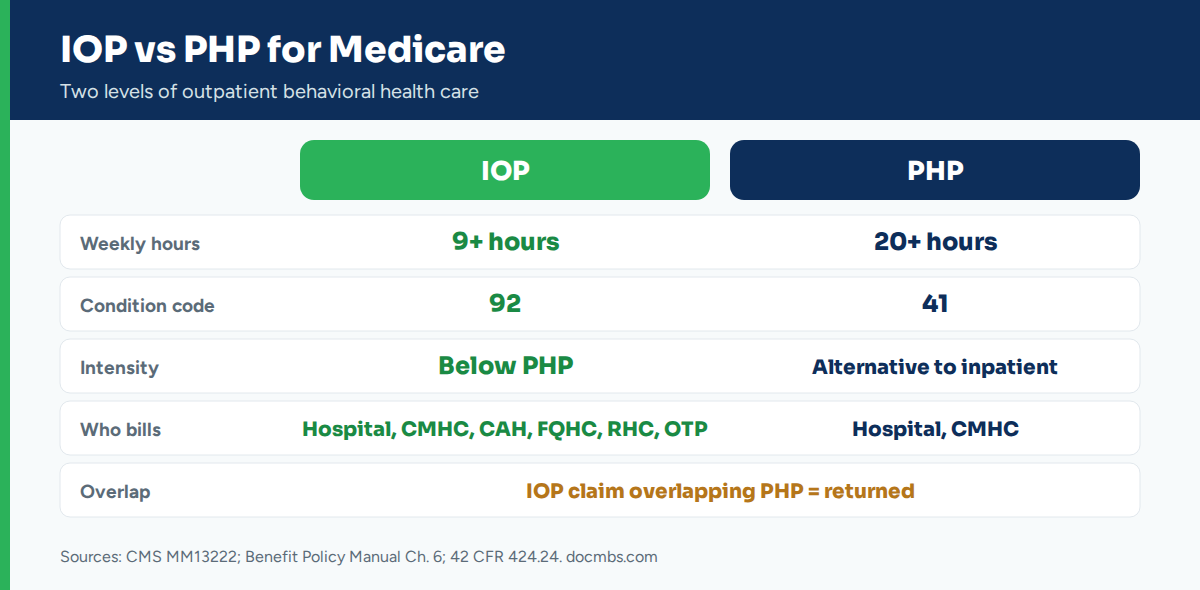
| Feature | IOP | PHP |
|---|---|---|
| Intensity | Less than PHP, more than routine outpatient | The most intense outpatient level, an alternative to inpatient care |
| Medicare hours | At least 9 hours a week | At least 20 hours a week |
| Condition code | 92 | 41 |
| Who bills (Medicare) | Hospitals, CMHCs, CAHs, FQHCs, RHCs, OTPs | Hospitals and CMHCs |
| 2026 hospital per diem | $319.38 / $418.45 | $319.38 / $418.45 |
| Overlap | An IOP claim that overlaps a PHP claim (condition code 41) is returned to the provider (CMS MM13222) | |
Sources: CMS MM13222; Benefit Policy Manual Ch. 6; 42 CFR 424.24; CY 2026 OPPS final rule.
How to Bill an IOP Claim: 7 Steps
- Confirm the payer and benefit. Check whether the patient has Original Medicare, Medicare Advantage, Medicaid or a commercial plan. Each one uses different IOP billing codes.
- Get the certification and plan of care. For Medicare, the physician certifies the need for IOP and the plan of care shows at least 9 hours a week. Set a reminder for recertification within 60 days.
- Get prior authorization if required. Most Medicaid managed care and commercial plans require authorization for IOP, often for a set number of days.
- Use the right claim, TOB and condition code. For Medicare: TOB 013X, 076X, 085X, 77X or 71X, with condition code 92.
- Report every service as its own line. Use the correct revenue code and HCPCS for each service, with the date of service on each line. FQHCs and RHCs use revenue code 0905.
- Count services per day. Medicare pays the 3-or-fewer or 4-or-more per diem based on qualifying services that day. Make sure the count on the claim matches the notes.
- Check for overlaps before you submit. Make sure the patient doesn’t have a PHP claim (condition code 41) for the same dates, and that documentation supports each day billed.
Pro Tip: On the IOP claims we work, the most common underpayment is a 4-service day billed as 3. Group, individual and education sessions on the same day each count. Build a daily service tally into the attendance sheet so billers don’t have to guess.
Worked Example: One IOP Week
A Medicare patient attends a hospital outpatient IOP three days in one week, 3 hours each day, which meets the 9-hour weekly minimum. The amounts below are the 2026 national hospital per diem rates before wage index adjustment.
| Day | Hours | Qualifying services | Per diem |
|---|---|---|---|
| Monday | 3 | 3 (group therapy, individual therapy, education) | $319.38 |
| Wednesday | 3 | 4 (adds family counseling) | $418.45 |
| Friday | 3 | 3 | $319.38 |
| Week total | 9 | $1,057.21 |
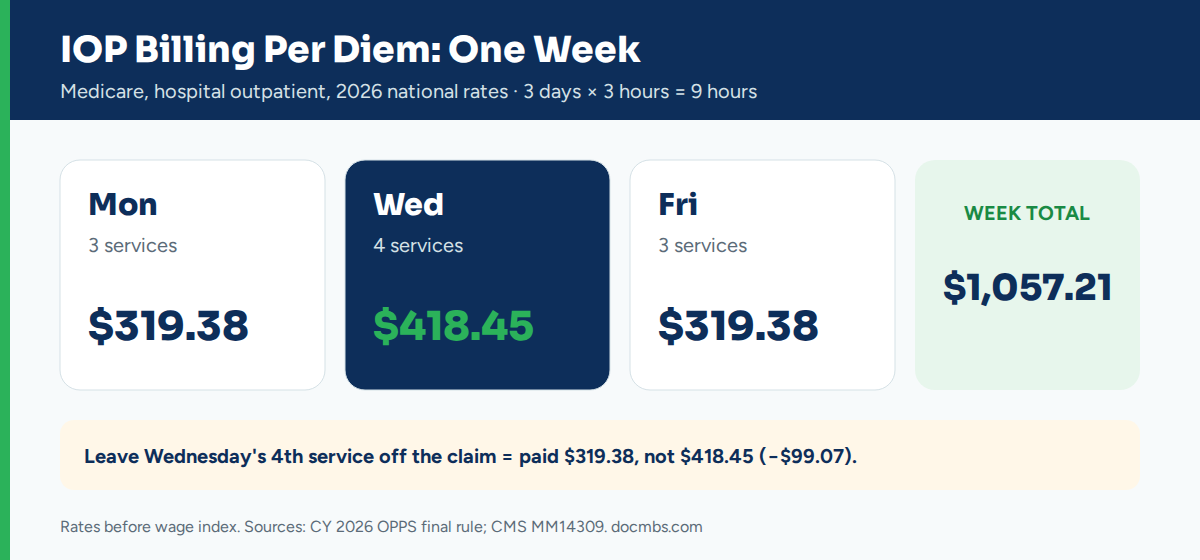
The math: $319.38 + $418.45 + $319.38 = $1,057.21 for the week. If Wednesday’s fourth service were left off the claim, that day would pay $319.38 instead of $418.45, a loss of $99.07 for one day. Over a 12-week program with one 4-service day a week, that’s $1,188.84 per patient (12 × $99.07).
Common IOP Billing Mistakes and Denials
| Code / result | Common cause | Fix |
|---|---|---|
| Return to provider (RTP) | Missing condition code 92, or IOP dates overlap a PHP claim (condition code 41) | Add condition code 92. Check for PHP overlap and correct the dates or level of care. |
| CO-16 (missing information) | Missing HCPCS on a line, wrong revenue code, or missing line dates | Add the HCPCS and line dates; use 0905 for FQHC/RHC IOP. |
| CO-50 (not medically necessary) | No certification, plan of care under 9 hours a week, or no recertification by day 60 | Get the certification and plan in place. Track recertification dates. |
| CO-197 (no authorization) | Medicaid or commercial IOP billed without prior authorization, or past the approved days | Request authorization before day one and extensions before the last approved day. |
| CO-4 / CO-96 | S9480 or H0015 sent to a payer that doesn’t accept them (including Medicare) | Rebill with the payer’s IOP code set. |
| CO-97 (bundled) | Separate therapy claim billed for the same day as the IOP per diem | Report the service as part of the IOP day, unless the payer allows separate billing. |
| Underpayment (no denial) | 4-service day billed with only 3 services | Match the claim to the daily attendance and service log. |
For a full prevention process, see how to reduce claim denials.
IOP Billing in FQHCs and RHCs
Since 2024, FQHCs and RHCs can bill Medicare for IOP. The rules differ from regular FQHC visits (CMS MM13264, MM14309, MM14303):
- Report condition code 92 and revenue code 0905 on IOP claims. Revenue code 0900 stays with regular mental health visits (G0469/G0470).
- Include at least one primary IOP service from CMS’s list on each day billed.
- IOP is paid at the IOP rate ($319.38 or $418.45 in 2026), not the FQHC PPS rate or the RHC all-inclusive rate. FQHCs are paid the lesser of charges or the IOP rate.
See our guide to the FQHC PPS rate for regular FQHC visit billing.
For Medicaid substance use IOP, many states use H0015. See our guide to behavioral health H codes for H0015 and related codes.
Texas Note
Texas Medicaid covers substance use disorder treatment, including intensive outpatient services, under the TMHP Texas Medicaid Provider Procedures Manual. STAR, STAR+PLUS and STAR Kids plans add their own authorization rules. [VERIFY: Texas Medicaid SUD intensive outpatient procedure codes, units and prior authorization rules in the current TMHP Behavioral Health / Substance Use Disorder handbook] Texas programs can get help from our Austin medical billing team.
Key Takeaways
- Medicare has paid for IOP since January 1, 2024. Every claim needs condition code 92.
- Patients need 9+ hours a week, a physician certification and recertification at least every 60 days.
- 2026 Medicare per diem: $319.38 (3 or fewer services) and $418.45 (4+) for hospitals, FQHCs and RHCs.
- FQHCs and RHCs bill IOP on revenue code 0905, paid outside the PPS or AIR rate.
- Medicaid and commercial IOP billing often uses H0015 or S9480. Medicare doesn’t.
- A 4-service day billed as 3 costs $99.07 with no denial to warn you.
FAQs
What codes are used for IOP billing?
It depends on the payer. Medicare IOP claims use condition code 92 with revenue code and HCPCS lines from CMS’s IOP list; FQHCs and RHCs use revenue code 0905. Medicaid often uses H0015 for substance use IOP, and commercial plans often use S9480 or revenue codes 0905/0906. Check each payer’s manual or contract.
Does Medicare cover intensive outpatient programs?
Yes. Medicare has covered IOP for mental health and substance use disorders since January 1, 2024. Hospital outpatient departments, CMHCs, critical access hospitals, FQHCs, RHCs and opioid treatment programs can bill it, with condition code 92 and a physician’s certification.
How many hours per week is IOP for Medicare?
The patient must need at least 9 hours of IOP services per week, shown in the plan of care. The physician certifies this at admission, and the recertification, required at least every 60 days, must state that the patient still needs at least 9 hours a week.
What is condition code 92?
Condition code 92 identifies a claim as intensive outpatient program services. CMS requires it on all Medicare IOP claims from hospitals and CMHCs, and FQHCs and RHCs report it too. Claims without it may be returned or processed incorrectly.
What is the difference between IOP and PHP?
PHP is more intense: Medicare requires at least 20 hours a week for PHP and 9 for IOP. PHP claims use condition code 41, and IOP claims use 92. An IOP claim that overlaps a PHP claim for the same patient is returned to the provider.
Can an FQHC bill for IOP?
Yes. Since 2024, FQHCs can bill Medicare for IOP using condition code 92 and revenue code 0905. They’re paid the lesser of charges or the IOP rate, $319.38 for 3 or fewer services and $418.45 for 4 or more in 2026, not the FQHC PPS rate.
What is the IOP payment rate for 2026?
For hospitals, FQHCs and RHCs, Medicare’s 2026 IOP per diem is $319.38 for 3 or fewer services and $418.45 for 4 or more services a day, before wage index adjustment. CMHCs are paid $127.74 and $167.38. New 2027 rates are expected in the CY 2027 OPPS final rule.
Get IOP Billing Right for Every Payer
Clean IOP billing comes down to using each payer’s codes, keeping certifications current and counting services every day. Get those right and your per diem pays the way it should.
DocMBS handles IOP, PHP and substance use program billing for behavioral health providers. See our behavioral health billing services or book a free billing review.
This article is for education only. Codes, rates and rules vary by payer and change every year. Confirm with your Medicare Administrative Contractor, state Medicaid program or health plan before billing.
Sources
- CMS (via HHS Guidance Portal): MLN Matters MM13222: New Condition Code 92, IOP Billing Requirements
- CMS (via HHS Guidance Portal): MLN Matters MM13264: IOP Billing for FQHCs and RHCs
- CMS: MLN Matters MM14309: FQHC IOP Payment Rates, CY 2026
- CMS: MLN Matters MM14303: RHC IOP Payment Rates, CY 2026
- CMS: Medicare Benefit Policy Manual, Chapter 6, §70.4 (Transmittal R12425BP)
- eCFR: 42 CFR 424.24: Certification Requirements
- TMHP: Texas Medicaid Provider Procedures Manual
Last updated: October 2026.
Need help with revenue cycle management? Claim submission, charge entry, payment posting, denial management and collections, handled promptly so your revenue cycle runs smoothly.