In this article
- What Is CPT Code 90833?
- CPT Code 90833 vs 90836 vs 90838
- Who Can Bill CPT Code 90833?
- How to Bill CPT Code 90833 With an E/M: 6 Steps
- CPT Code 90833 Worked Examples
- How to Document Psychotherapy Time With an E/M
- What Changes for 2027
- CPT Code 90833 Mistakes and Denials
- Texas Note: Medicaid and Managed Care
- Key Takeaways
- FAQs
- Bill CPT Code 90833 With Confidence
- Sources
CPT code 90833 is the add-on you report when a psychiatrist or other prescriber does psychotherapy during the same visit as a medication-management E/M. It’s one of the most audited codes in mental health billing. The reason is simple: when the note shows one block of time for the whole visit, the payer can’t tell where the E/M ended and the therapy began, so the add-on gets denied or recouped.
This guide covers the 90833 time rules, how it compares to 90836 and 90838, who can bill it, a 6-step billing process, worked examples and what changes for 2027.
Quick Answer
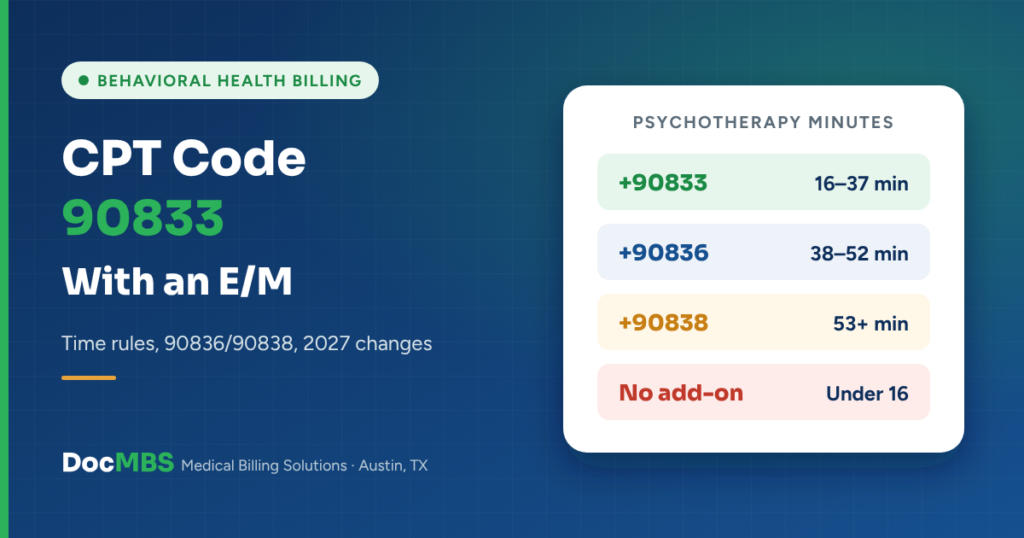
CPT code 90833 is a psychotherapy add-on for 16–37 minutes of therapy done on the same visit as an E/M service. Use 90836 for 38–52 minutes and 90838 for 53 minutes or more. Under 16 minutes isn’t billable. It can’t be billed alone, and E/M time and psychotherapy time must be documented separately.
Table of Contents
- What Is CPT Code 90833?
- CPT Code 90833 vs 90836 vs 90838
- Who Can Bill CPT Code 90833?
- How to Bill CPT Code 90833 With an E/M: 6 Steps
- CPT Code 90833 Worked Examples
- How to Document Psychotherapy Time With an E/M
- What Changes for 2027
- CPT Code 90833 Mistakes and Denials
- Texas Note: Medicaid and Managed Care
- Key Takeaways
- FAQs
- Sources
What Is CPT Code 90833?
CPT code 90833 describes about 30 minutes of individual psychotherapy with the patient (and/or a family member) when it’s performed during the same session as an evaluation and management (E/M) service. It’s an add-on code, marked with a “+” in the CPT book.
- Add-on only: it must be reported with an E/M code from the same visit. It’s never billed alone.
- Time-based: the add-on you pick depends only on psychotherapy minutes.
- Same practitioner: the same physician or NPP performs both the E/M and the psychotherapy.
- No modifier needed: because it’s an add-on, you don’t need modifier 25 to report it with the E/M.
A typical visit: a psychiatrist reviews symptoms and side effects, adjusts a medication (the E/M), then spends 25 minutes on supportive therapy (the add-on). That’s an E/M code plus CPT code 90833.
For therapy without an E/M, see our guides to CPT code 90837 and 90834 vs 90837.
CPT Code 90833 vs 90836 vs 90838
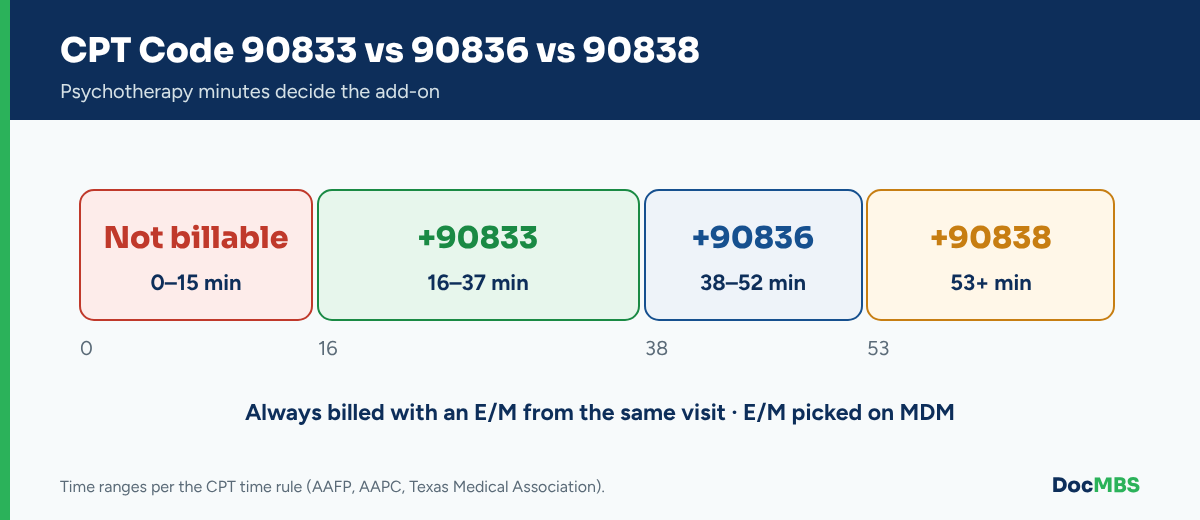
The three psychotherapy add-ons work the same way. Only the time range changes. These ranges come from the CPT time rule as summarized by the AAFP, AAPC and the Texas Medical Association.
| Add-on code | Named time | Psychotherapy time range | Billed with | Example |
|---|---|---|---|---|
| +90833 | 30 minutes | 16–37 minutes | An E/M code, same visit | 99214 + 90833 for 25 min of therapy |
| +90836 | 45 minutes | 38–52 minutes | An E/M code, same visit | 99213 + 90836 for 40 min of therapy |
| +90838 | 60 minutes | 53+ minutes | An E/M code, same visit | 99214 + 90838 for 55 min of therapy |
| None | — | Under 16 minutes | E/M only | Bill the E/M; no add-on |
The stand-alone versions (90832, 90834, 90837) use the same time ranges, but they’re billed when there’s no E/M that day by the same practitioner.
Watch Out: The E/M level has no bearing on which add-on you choose. A 99215 doesn’t “earn” a longer add-on, and a 99212 doesn’t limit you to 90833. Psychotherapy minutes alone decide the add-on.
Who Can Bill CPT Code 90833?
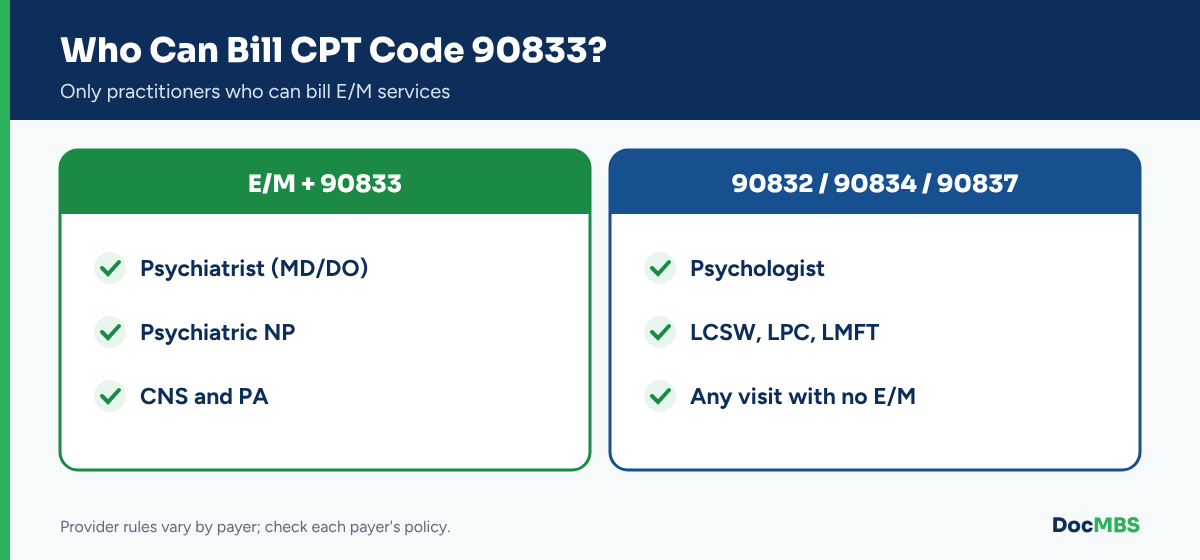
Because CPT code 90833 must ride on an E/M, only practitioners who can bill E/M services can report it. Payer policies (for example, Johns Hopkins Health Plans) list physicians, nurse practitioners, clinical nurse specialists and physician assistants. Therapists who can’t bill E/M use the stand-alone psychotherapy codes instead.
| Provider type | E/M + 90833? | Stand-alone codes |
|---|---|---|
| Psychiatrist (MD/DO) | Yes | 90832, 90834, 90837 |
| Psychiatric NP / PMHNP | Yes | 90832, 90834, 90837 |
| Clinical nurse specialist | Yes | 90832, 90834, 90837 |
| Physician assistant | Yes | 90832, 90834, 90837 |
| Psychologist (PhD/PsyD) | No (can’t bill E/M) | 90832, 90834, 90837 |
| LCSW, LPC, LMFT | No (can’t bill E/M) | 90832, 90834, 90837 [VERIFY: each payer] |
Keep separate charge templates for prescribers and therapists so the wrong code family never reaches the claim. Our behavioral health billing page explains how we handle mixed practices.
How to Bill CPT Code 90833 With an E/M: 6 Steps
- Pick the E/M level on medical decision making. When psychotherapy is added, choose the E/M on MDM, not on total time. The APA’s CPT overview says the E/M isn’t selected on the basis of time in this case.
- Record psychotherapy time separately. Note the start and stop times, or the total minutes, of the psychotherapy alone.
- Choose the add-on by psychotherapy minutes. 16–37 = 90833, 38–52 = 90836, 53+ = 90838. Under 16 = no add-on.
- Add 90785 if it applies. Interactive complexity (+90785) can be reported with 90833, 90836 or 90838 when a communication factor complicates the session.
- Put both codes on one claim. Same date, same rendering provider, E/M first, add-on second. Link the right mental health diagnosis to each line.
- Check 2027 modifiers. Add B1 to the office E/M when the visit qualifies for the longitudinal care add-on [VERIFY], and use the payer’s telehealth POS and modifier rules for virtual visits.
Pro Tip: Build the psychotherapy time as its own required field in the note template. On the psychiatric claims we review, a separate time field is the simplest fix for 90833 recoupments.
CPT Code 90833 Worked Examples
These examples show how psychotherapy minutes decide the add-on. The E/M level comes from MDM in every case. Payment amounts depend on your locality, so check the 2027 numbers in the CMS Physician Fee Schedule Look-Up Tool [VERIFY: 2027 national amounts for 90833, 90836, 90838].
| Visit | E/M (by MDM) | Psychotherapy time | Bill |
|---|---|---|---|
| Med check + supportive therapy | 99214 | 25 minutes | 99214 + 90833 |
| Med change + CBT session | 99213 | 40 minutes | 99213 + 90836 |
| Complex visit + long session | 99215 | 55 minutes | 99215 + 90838 |
| Med check + brief counseling | 99213 | 12 minutes | 99213 only (no add-on) |
| Med check + therapy with an interpreter-related complication | 99214 | 30 minutes | 99214 + 90833 + 90785 |
Example in detail: the note shows MDM for a moderate-complexity medication change, then “Psychotherapy: 2:10–2:35 pm (25 minutes), CBT for panic symptoms.” That supports 99214 + CPT code 90833. If the note said only “Visit 45 minutes,” neither the E/M time nor the 90836 add-on would hold up in an audit.
Losing 90833 add-ons to audits?
Our mental health billing services check every E/M + psychotherapy visit for separate time and the right add-on before it goes out.
How to Document Psychotherapy Time With an E/M
CMS has flagged blended time as a common billing error. The Texas Medical Association explains that E/M time is separate from psychotherapy time, and psychotherapy time can’t be used to meet E/M criteria. CMS’s psychiatric codes billing article (A57520) expects start and stop times or the total time devoted to psychotherapy, and that total doesn’t include the E/M time.
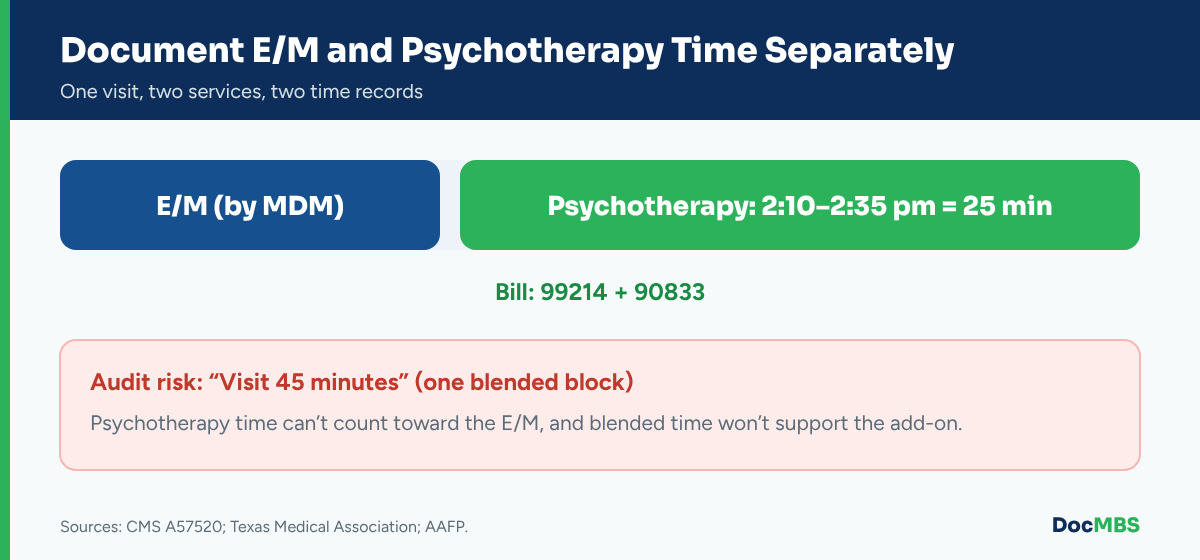
- Two sections: one for the E/M (history, exam if done, MDM) and one for psychotherapy.
- Psychotherapy minutes: start/stop times or a total, for therapy alone. It doesn’t have to be one continuous block.
- Technique and response: name the therapy approach (CBT, supportive, DBT) and how the patient responded.
- Separately identifiable: the note should show the two services were distinct.
- Realistic E/M time: the APA has warned against cutting E/M time to an unrealistically small number to stretch psychotherapy time.
Your MAC’s local coverage article may add details, so check it in the CMS Medicare Coverage Database [VERIFY: your MAC’s psychiatric LCD/billing article].
What Changes for 2027
The CY 2027 Physician Fee Schedule final rule (released November 4, 2026) doesn’t change the 90833 time ranges, but it changes payments around it:
- G2211 becomes modifier B1. CMS’s fact sheet says B1 is appended to the E/M base code and raises its payment by 16%. Whether B1 applies on a psych E/M billed with 90833 follows the old G2211 rules [VERIFY: CMS-1848-F / MLN]. See our G2211 modifier B1 guide.
- Lower conversion factor. The non-QP conversion factor drops to $32.6286 (down 2.31%). Read more in our 2027 Medicare conversion factor post.
- Practice expense changes. CMS’s new practice expense method is expected to shift payments toward behavioral health, according to early analyses of the rule [VERIFY: 2027 RVUs for 90833].
- Same-day 80% rule doesn’t touch 90833. The new same-day reduction applies to an E/M with a 0-day global procedure, not to psychotherapy add-ons. See our modifier 25 reduction guide.
CPT Code 90833 Mistakes and Denials
These are the CPT code 90833 problems we see most. Reason codes vary by payer, so check your own remits.
| Mistake | What you’ll see | How to fix it |
|---|---|---|
| 90833 billed without an E/M | CO-107 or B15 (primary service missing) [VERIFY] | Add the E/M from the same visit, or bill 90832 if there was no E/M. |
| One block of time for the whole visit | Audit recoupment of the add-on | Document psychotherapy minutes separately from the E/M. |
| E/M chosen on total time | Downcoded E/M or recoupment | Pick the E/M on MDM when you add psychotherapy. |
| Wrong add-on for the minutes | Overpayment or lost revenue | Use the 16–37 / 38–52 / 53+ ranges. |
| 90832 billed with an E/M (instead of 90833) | CO-97 or NCCI edit [VERIFY] | Use the add-on family with an E/M. |
| Therapist (LCSW, LPC) bills 90833 | CO-185 (provider not eligible) or CO-170 [VERIFY] | Therapists bill 90832/90834/90837. |
For a full prevention plan, see how to reduce claim denials.
Texas Note: Medicaid and Managed Care
Texas Medicaid (TMHP) and STAR managed care plans set their own rules for which provider types can bill E/M with psychotherapy add-ons, and for prior authorization and visit limits. Check the TMHP Behavioral Health and Case Management Services Handbook before billing [VERIFY: TMHP coverage and provider types for 90833]. Our Austin medical billing team can check your Texas payer mix.
Key Takeaways
- CPT code 90833 = psychotherapy add-on for 16–37 minutes with an E/M.
- 90836 = 38–52 minutes; 90838 = 53+; under 16 minutes = no add-on.
- Pick the E/M on MDM and the add-on on psychotherapy minutes.
- Document the two times separately; blended time is a top audit finding.
- Only E/M-eligible practitioners bill it; therapists use 90832/90834/90837.
- For 2027, check modifier B1 and the new conversion factor.
FAQs
What is CPT code 90833?
CPT code 90833 is an add-on code for about 30 minutes of individual psychotherapy performed during the same visit as an E/M service. You report it with the E/M code, by the same practitioner, when documented psychotherapy time is 16 to 37 minutes. It’s common in psychiatric medication-management visits.
How many minutes for 90833?
90833 covers 16 to 37 minutes of psychotherapy, counted separately from the E/M time. At 38–52 minutes, use 90836. At 53 minutes or more, use 90838. Psychotherapy under 16 minutes isn’t separately reportable, so you’d bill the E/M alone and document the brief counseling in the note.
Can 90833 be billed alone?
No. 90833 is an add-on code, so it must be billed with an E/M code from the same visit. If there was no E/M service, bill the stand-alone psychotherapy code instead: 90832 for 16–37 minutes, 90834 for 38–52 minutes or 90837 for 53 minutes or more.
What E/M codes can be billed with 90833?
The add-on goes with E/M visits in settings where psychotherapy is done, such as office/outpatient, hospital, nursing facility and home visits. Highmark’s coding tips, for example, list E/M ranges 99202–99255, 99304–99337 and 99341–99350 with 90833, 90836 and 90838. Check your own payer’s list.
What is the difference between 90833, 90836 and 90838?
Only the psychotherapy time. 90833 is 16–37 minutes, 90836 is 38–52 minutes and 90838 is 53 minutes or more. All three are add-ons billed with an E/M on the same visit, and all three need psychotherapy time documented separately from E/M time.
Can a therapist (LCSW or LPC) bill 90833?
Usually not. 90833 must be billed with an E/M, and LCSWs, LPCs, LMFTs and psychologists can’t bill E/M codes. They use 90832, 90834 and 90837 instead. Psychiatrists, psychiatric NPs, CNSs and PAs can bill E/M plus 90833. Check each payer’s provider rules.
Does modifier B1 apply to visits with 90833 in 2027?
Modifier B1 replaces G2211 on January 1, 2027 and goes on the office or home E/M code, not on 90833. CMS says B1 is billed under the same circumstances as G2211. Confirm in the final rule or MLN guidance whether your psych E/M with 90833 qualifies.
How should psychotherapy time be documented with an E/M?
Record psychotherapy start and stop times, or total psychotherapy minutes, separately from the E/M. Don’t use one time for the whole visit. Describe the therapy technique and the patient’s response, and show the E/M and psychotherapy were separately identifiable services.
Bill CPT Code 90833 With Confidence
CPT code 90833 pays for real work, but only when the note proves it: E/M on MDM, psychotherapy minutes on their own line, and the right add-on for the time. Update your templates for 2027 before January claims go out. Our mental health billing team codes E/M plus psychotherapy visits with the right add-on and time documentation. Book a free billing review.
This article is for education only. CPT is a registered trademark of the AMA; code descriptions here are summaries. Confirm rules with your payer.
Sources
- CMS: Billing and Coding: Psychiatric Codes (A57520)
- CMS: CY 2027 Medicare Physician Fee Schedule Final Rule fact sheet
- CMS: Physician Fee Schedule Look-Up Tool
- Texas Medical Association: Document Time for Psychotherapy Services
- AAFP FPM: Potential pitfall in Medicare billing (psychotherapy with E/M)
- TMHP: Texas Medicaid Provider Procedures Manual
Last updated: November 2026.
Need help with behavioral health billing? Behavioral health billing for therapy practices, CMHCs and substance use programs, with authorizations, H-codes, IOP claims and denials handled for you.