In this article
- What Is CoCM Billing?
- CoCM Billing Codes and Time Requirements
- CoCM Billing Requirements Before You Bill
- How to Bill Collaborative Care: 6 Steps
- CoCM Billing Worked Example
- CoCM vs General BHI (99484, G0323)
- What Changed for CoCM Billing in 2027
- Psychiatry, Mental Health Practices and FQHCs
- Common Mistakes and Denials
- Texas Note: Texas Medicaid and Managed Care
- Key Takeaways
- FAQs
- Start Getting Paid for Collaborative Care
- Sources
CoCM billing turns the time your behavioral health care manager already spends on patients into monthly revenue, but many practices miss it. The care manager calls patients, updates the registry and reviews cases with the psychiatrist every week. Then the practice either never bills it, or bills it without the minutes and consent to back it up. Both cost money.
This guide explains how CoCM billing works for codes 99492, 99493, 99494 and G2214, what you need before you bill, how to count the minutes, and what changes in 2027.
Quick Answer
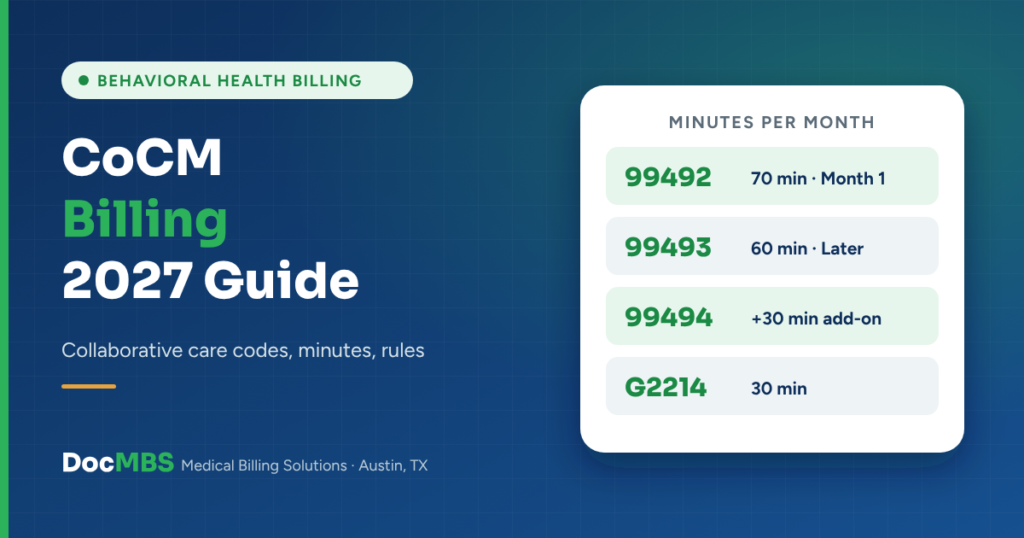
CoCM billing uses 99492 for the first month (70 minutes), 99493 for later months (60 minutes), 99494 for each extra 30 minutes and G2214 for 30 minutes. The time is care manager time per calendar month. You also need a psychiatric consultant, a registry, documented consent and an initiating visit.
Table of Contents
- What Is CoCM Billing?
- CoCM Billing Codes and Time Requirements
- CoCM Billing Requirements Before You Bill
- How to Bill Collaborative Care: 6 Steps
- CoCM Billing Worked Example
- CoCM vs General BHI (99484, G0323)
- What Changed for CoCM Billing in 2027
- Psychiatry, Mental Health Practices and FQHCs
- Common Mistakes and Denials
- Texas Note: Texas Medicaid and Managed Care
- Key Takeaways
- FAQs
- Sources
What Is CoCM Billing?
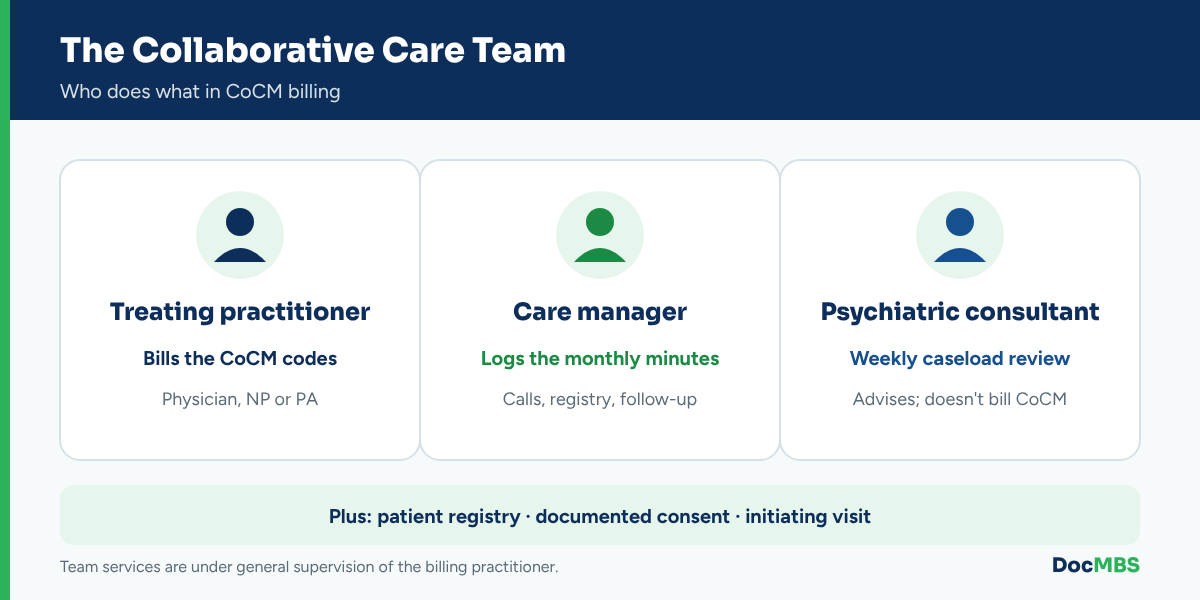
The Psychiatric Collaborative Care Model (CoCM) is a team approach to treating behavioral health conditions, like depression and anxiety, in a primary care setting. Three people work together:
- the treating (billing) practitioner, usually a primary care physician, NP or PA,
- a behavioral health care manager, who follows the patient between visits, and
- a psychiatric consultant, who reviews the caseload and advises on treatment.
CoCM billing pays for that team’s work each calendar month. The rules in this guide come from the CMS MLN booklet “Behavioral Health Integration Services” (MLN909432). The codes are CPT codes owned by the AMA, so check your CPT book for the full descriptors.
CoCM Billing Codes and Time Requirements
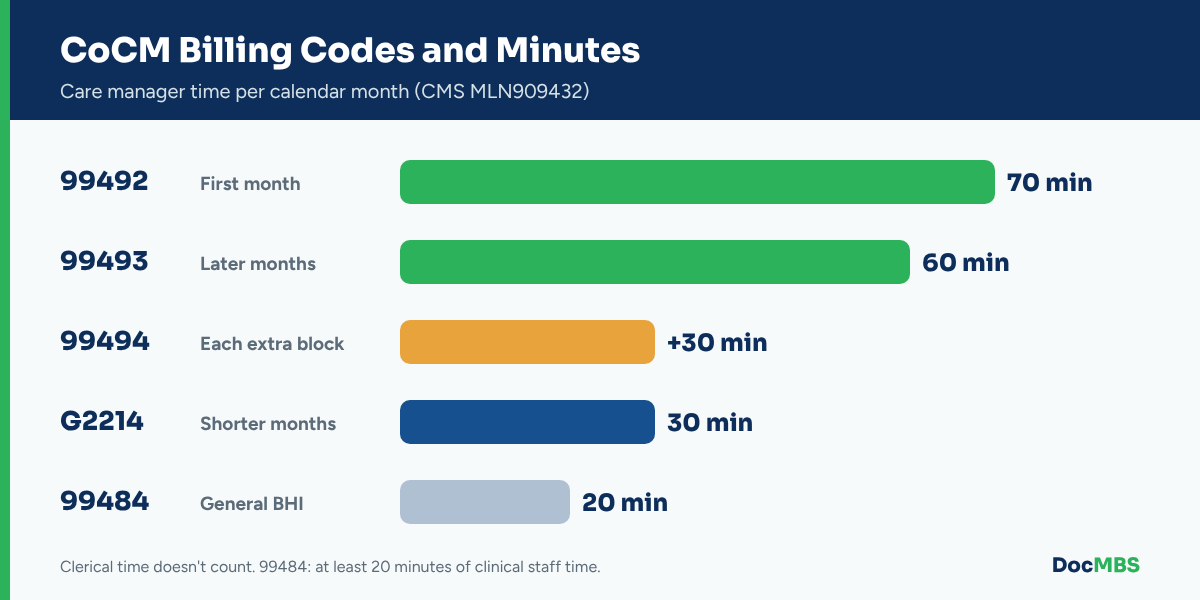
The time on these codes is mostly the behavioral health care manager’s time in a calendar month, under the billing practitioner’s direction. The billing practitioner’s own work is built into the code.
| Code | What it covers | Time per calendar month | Who bills |
|---|---|---|---|
| 99492 | First month of CoCM | 70 minutes of care manager time | Treating practitioner |
| 99493 | Later months of CoCM | 60 minutes | Treating practitioner |
| 99494 | Add-on: each extra 30 minutes | +30 minutes, with 99492 or 99493 | Treating practitioner |
| G2214 | CoCM, first or later month | 30 minutes | Treating practitioner |
| 99484 | General behavioral health integration (BHI) | At least 20 minutes of clinical staff time | Physician or NPP |
| G0323 | Behavioral health care management | At least 20 minutes | Clinical psychologist or clinical social worker |
When can you bill with less than the full time? CPT time rules generally let you report a timed unit once you pass the midpoint. For CoCM billing, that’s often shown as about 36 minutes for 99492 and 31 minutes for 99493, with G2214 used for shorter months. [VERIFY: time thresholds for 99492, 99493, 99494 and G2214 — CPT book / MLN909432 time table]
Watch Out: Only clinical time counts. Scheduling calls, faxing records and other clerical tasks don’t count toward CoCM minutes, even if the care manager does them.
CoCM Billing Requirements Before You Bill
Before the first CoCM billing claim, make sure each of these is in place and documented:
| Requirement | What it means | How to document it |
|---|---|---|
| Initiating visit | Needed for new patients or patients not seen in the past year (e.g. an AWV, IPPE, TCM or qualifying E/M visit) | Date and type of visit in the chart |
| Patient consent | Verbal consent is enough; tell the patient cost sharing applies | A note that consent was given and cost sharing was explained |
| Psychiatric consultant | Required for CoCM; advises on diagnosis and treatment | Consultant’s name and caseload review notes |
| Behavioral health care manager | Required for CoCM; follows the patient and tracks outcomes | Dated time log with minutes and activity |
| Patient registry | A list used to track patients and their scores (e.g. PHQ-9) | Registry entry for each patient |
| Weekly caseload review | The care manager reviews patients with the psychiatric consultant | Review date and recommendations |
| General supervision | Team services are incident-to the billing practitioner; no physical presence needed | Follow state scope-of-practice rules |
The initiating visit is billed on its own and isn’t part of the CoCM billing time. For G0323, CMS lists 90791 as the initiating visit. [VERIFY: whether the initiating visit can be done by telehealth or audio-only — CMS / MLN909432]
How to Bill Collaborative Care: 6 Steps
- Do the initiating visit. Confirm the patient had a qualifying visit with the billing practitioner within the past year.
- Document consent and the cost-sharing talk. Note the date, that consent was verbal, and that the patient knows coinsurance applies.
- Enroll the patient in the registry. Add the baseline score and start the caseload review.
- Log care manager minutes every day. Record the date, minutes and what was done (call, check-in, care planning, consultant review).
- Total the minutes at month end and pick the codes. Use 99492 for the first month, 99493 after that, 99494 for extra 30-minute blocks, and G2214 when the time is shorter.
- Bill once per calendar month. Use the billing practitioner’s NPI and the last date of service in the month, or the date your payer requires. [VERIFY: date of service rule — your MAC]
Pro Tip: On the behavioral health claims we review, the most common gap is the time log. Build a shared log in your EHR so every care manager entry is dated and totaled automatically at month end.
Doing collaborative care but not getting paid for it?
Our behavioral health billing services track CoCM minutes and bill every eligible month.
CoCM Billing Worked Example
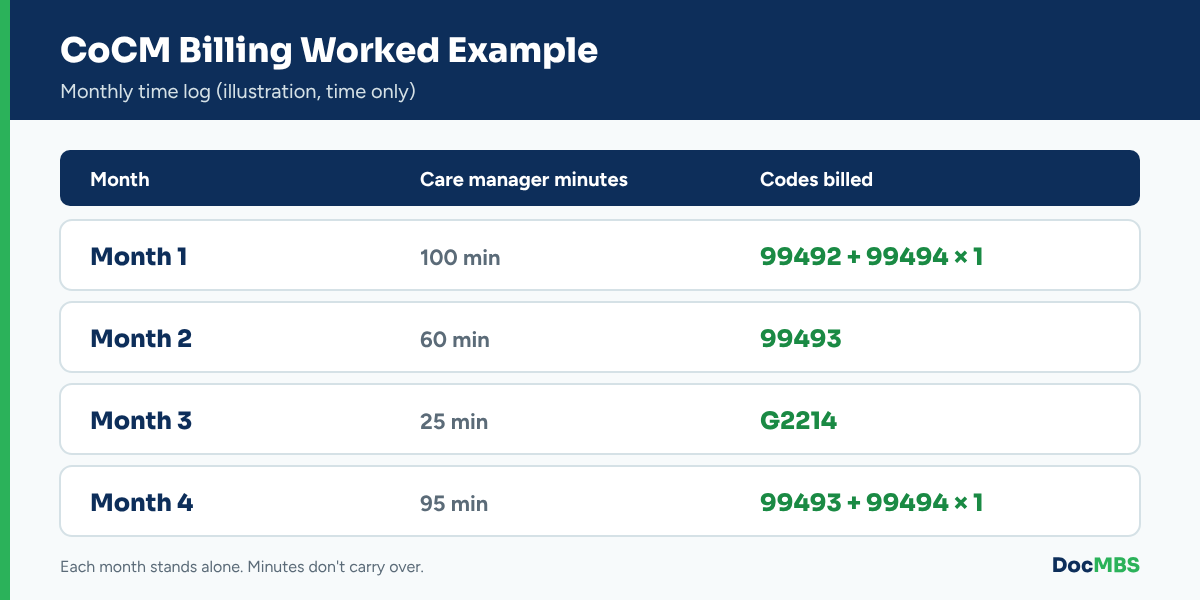
This example shows time only. It doesn’t include dollar amounts, because payment depends on your locality and payer. The patient is an illustration, not a real person.
| Month | Care manager minutes | Codes to bill | Why |
|---|---|---|---|
| Month 1 (first CoCM month) | 100 minutes | 99492 + 99494 × 1 | 70 minutes for 99492, plus one extra 30-minute block |
| Month 2 | 60 minutes | 99493 | Meets the 60-minute later-month code |
| Month 3 | 25 minutes | G2214 | Below the 99493 threshold [VERIFY] |
| Month 4 | 95 minutes | 99493 + 99494 × 1 | 60 minutes, plus one extra 30-minute block |
Each month stands on its own. Minutes don’t carry over to the next month, and you can’t combine two short months into one claim.
To estimate payment, look up each code in the CMS Physician Fee Schedule Look-Up Tool for your locality, using the 2027 conversion factor. [VERIFY: 2027 national payment amounts for 99492, 99493, 99494, G2214 — CMS PFS Look-Up Tool]
CoCM vs General BHI (99484, G0323)
- CoCM (99492–99494, G2214): needs a psychiatric consultant, a care manager, a registry and weekly caseload review. Higher time and higher payment.
- General BHI (99484): at least 20 minutes of clinical staff time a month. A psychiatric consultant is optional. Good for practices that don’t have the full CoCM team yet.
- G0323: at least 20 minutes of care management by a clinical psychologist or clinical social worker, who bills it directly.
You generally can’t bill CoCM and general BHI for the same patient in the same month. [VERIFY: same-month billing rules for CoCM and 99484 — MLN909432]
What Changed for CoCM Billing in 2027
The CY 2027 Physician Fee Schedule final rule (CMS-1848-F) raised the work RVUs for the Collaborative Care Model codes. In the July 2026 proposed rule, CMS accepted RUC-recommended increases, as reported by the Path Forward Coalition from an APA analysis:
| Code | Work RVU before | Proposed 2027 work RVU | Change |
|---|---|---|---|
| 99492 | 1.88 | 2.75 | +46.3% |
| 99493 | 2.05 | 2.26 | +10.2% |
| 99494 | 0.82 | 1.13 | +37.8% |
| G2214 | 0.77 | 1.13 | +46.8% |
[VERIFY: final 2027 work RVUs for each CoCM code — CMS-1848-F addenda / PFS Look-Up Tool]. Some coding summaries also say some CoCM HCPCS codes may move to new CPT codes. [VERIFY: whether G2214 is replaced by a new CPT code on January 1, 2027 — CPT 2027 code set / CMS-1848-F]
The higher RVUs come on top of a lower 2027 conversion factor: $32.63 for most clinicians and $32.95 for qualifying APM participants. See our 2027 Medicare conversion factor guide. If the billing practitioner also sees the patient for a visit, the new modifier B1 rules apply; see our G2211 modifier B1 guide.
Psychiatry, Mental Health Practices and FQHCs
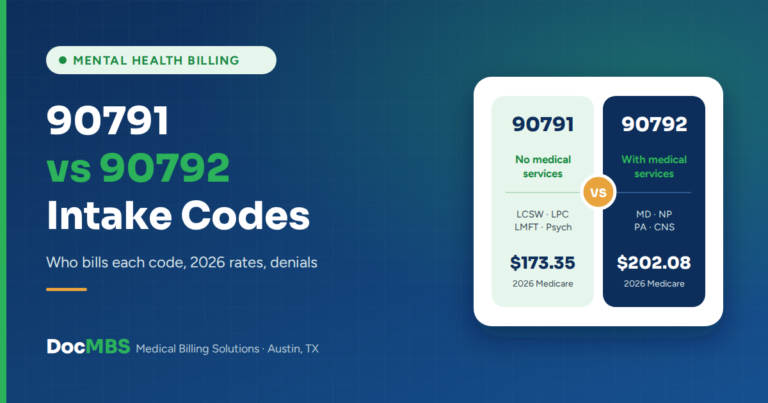
- Psychiatrists: as the psychiatric consultant, the psychiatrist doesn’t bill the CoCM codes. The treating practitioner does. A psychiatrist who sees the patient directly bills that visit separately (for example, 90792). See our 90791 vs 90792 guide.
- Mental health practices: therapy practices usually bill psychotherapy codes, not CoCM. Clinical psychologists and social workers can bill G0323 for care management. Our mental health billing services cover both.
- FQHCs and RHCs: FQHCs have their own care management billing rules, separate from the PPS visit rate. In recent rules, CMS moved RHCs and FQHCs from single G-codes to the individual care management codes. [VERIFY: how FQHCs/RHCs bill CoCM in 2027 (G0512 vs 99492–99494 / G2214) and how it’s paid — CMS FQHC MLN / CMS-1848-F] See our FQHC PPS rate guide.
Common Mistakes and Denials
These are the CoCM billing problems we see most often. Reason codes vary by payer, so check your own remits.
| Mistake | What you’ll see | How to fix it |
|---|---|---|
| No initiating visit in the past year | Denial; e.g. CO-50 or CO-16 [VERIFY] | Do and document the initiating visit first. |
| No documented consent | Audit recoupment | Add a dated consent note with the cost-sharing talk. |
| Billed more than once in a calendar month | Duplicate denial; e.g. CO-18 or CO-151 [VERIFY] | Total the month and bill one claim. |
| Counting clerical time | Audit risk; overpayment | Log only clinical care manager activities. |
| 99494 billed alone | CO-4 or CO-16 | Bill 99494 only with 99492 or 99493. |
| CoCM billed by the psychiatric consultant | Denial; e.g. CO-170 [VERIFY] | Bill under the treating practitioner’s NPI. |
For more prevention steps, read how to reduce claim denials.
Texas Note: Texas Medicaid and Managed Care
Medicare covers CoCM billing nationwide, but Medicaid coverage varies by state. Check whether Texas Medicaid and your STAR or STAR+PLUS plans cover 99492–99494 and G2214, and what they require. [VERIFY: Texas Medicaid and managed care coverage of CoCM codes — TMHP fee schedule / plan policies]
Commercial plans in Texas also set their own rules. Our Austin medical billing team can check coverage for each payer before you start a CoCM program.
Key Takeaways
- CoCM billing uses 99492 (first month, 70 min), 99493 (later months, 60 min), 99494 (+30 min) and G2214 (30 min).
- Time is care manager time per calendar month; clerical time doesn’t count.
- You need an initiating visit, verbal consent, a psychiatric consultant and a registry.
- The treating practitioner bills CoCM, not the psychiatric consultant.
- 2027 brings higher CoCM work RVUs and a lower conversion factor.
- Bill once per calendar month; minutes don’t carry over.
FAQs
What is CoCM billing?
CoCM billing is how practices bill Medicare and other payers for the Psychiatric Collaborative Care Model. The treating practitioner bills monthly codes 99492, 99493, 99494 or G2214 for behavioral health care manager time, supported by a psychiatric consultant, a patient registry and weekly caseload reviews.
How many minutes are needed for 99492?
CPT 99492 covers the first month of CoCM and is built around 70 minutes of behavioral health care manager time in the calendar month. Under CPT time rules, you may be able to report it once you pass the midpoint. Check the CPT book and CMS time table for the exact threshold.
What is the difference between 99492 and 99493?
99492 is for the first month a patient receives CoCM and is built on 70 minutes. 99493 is for each later month and is built on 60 minutes. Both can be paired with 99494 for each additional 30 minutes of care manager time in the same month.
When do I bill 99494?
Bill 99494 as an add-on when care manager time in a month goes 30 minutes beyond what 99492 or 99493 covers. It can’t be billed alone. For example, 100 minutes in the first month would be billed as 99492 plus one unit of 99494.
What is G2214 used for?
G2214 is a Medicare code for 30 minutes of CoCM in a first or later month. It’s used when the care manager’s time in the month is too short to report 99492 or 99493, so practices can still bill for the work done.
Do CoCM services need patient consent?
Yes. The patient must agree to CoCM, but verbal consent documented in the medical record is enough. You must also tell the patient that cost sharing, such as Part B coinsurance, applies to both face-to-face and non-face-to-face services.
Can FQHCs and RHCs bill collaborative care?
Yes, FQHCs and RHCs can bill for CoCM, but their billing rules differ from physician practices and have changed in recent years. CMS moved them from single G-codes toward the individual care management codes. Check the current CMS FQHC and RHC guidance before you bill.
Start Getting Paid for Collaborative Care
CoCM billing pays for work your team is already doing, if the minutes, consent and team roles are documented every month. With higher CoCM RVUs in 2027, now is the time to get it right. Our behavioral health billing team tracks CoCM minutes and bills every eligible month. Book a free billing review.
This article is for education only. Confirm current rules with CMS, the AMA CPT code set and each payer before you bill.
Sources
- CMS MLN: Behavioral Health Integration Services (MLN909432)
- Federal Register: CY 2027 Physician Fee Schedule proposed rule (CMS-1848-P)
- CMS: Physician Fee Schedule Look-Up Tool
- CMS newsroom: CY 2027 Medicare Physician Fee Schedule Final Rule fact sheet (CMS-1848-F), November 4, 2026
Last updated: November 2026.
Need help with medical coding? Complete clinical coding with in-depth expertise in ICD-10, CPT and modifiers for accurate, compliant claims.