In this article
- What Is Claim Frequency Code 7?
- Frequency Code 7 vs 8 (and 1)
- Where Claim Frequency Code 7 Goes
- How to Submit a Corrected Claim: 7 Steps
- Claim Frequency Code 7 Worked Example
- Medicare Part A and Part B Corrected Claims
- Texas Medicaid and Managed Care Corrected Claims
- Common Mistakes and Denials
- Tips for SNF, Home Health, FQHC and Behavioral Health
- Key Takeaways
- FAQs
- Get Claim Frequency Code 7 Right the First Time
- Sources
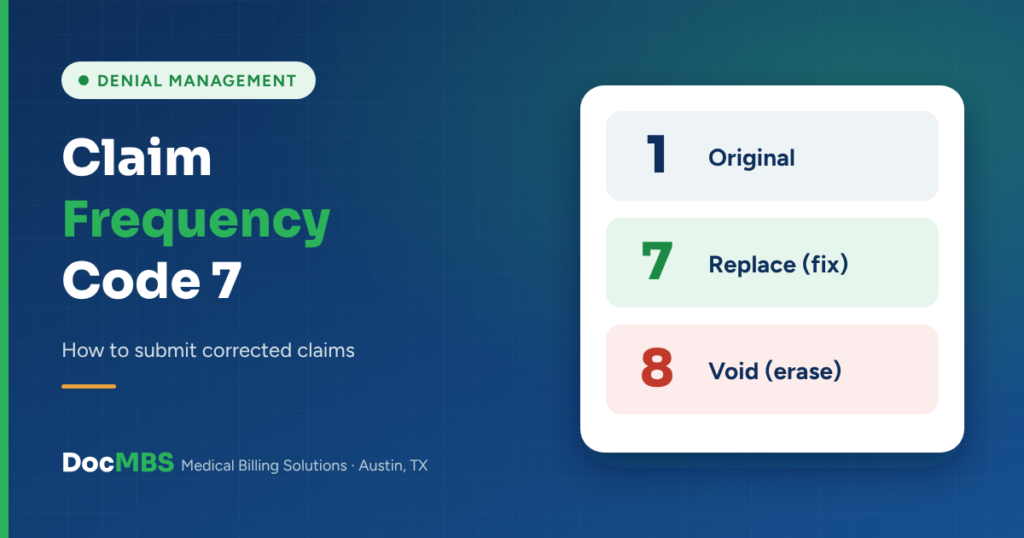
Claim frequency code 7 tells a payer, “replace the claim you already processed with this one.” Used right, it fixes a wrong unit, code or date in a single step. Used wrong, it creates duplicate denials, recouped lines and missed deadlines. Medicare Part B doesn’t even take it the way commercial payers do.
This guide explains what claim frequency code 7 means, how it differs from code 8, where it goes on the CMS-1500, UB-04 and 837, and how Medicare Part A, Part B and Texas Medicaid each handle corrected claims.
Quick Answer
Claim frequency code 7 marks a replacement (corrected) claim. It goes in Item 22 on the CMS-1500, the last digit of the type of bill on the UB-04 and CLM05-3 in the 837, with the payer’s original claim number. Code 8 voids a claim. Medicare Part B uses reopenings instead.
Table of Contents
- What Is Claim Frequency Code 7?
- Frequency Code 7 vs 8 (and 1)
- Where Claim Frequency Code 7 Goes
- How to Submit a Corrected Claim: 7 Steps
- Claim Frequency Code 7 Worked Example
- Medicare Part A and Part B Corrected Claims
- Texas Medicaid and Managed Care Corrected Claims
- Common Mistakes and Denials
- Tips for SNF, Home Health, FQHC and Behavioral Health
- Key Takeaways
- FAQs
- Sources
What Is Claim Frequency Code 7?
Every claim carries a claim frequency code. It tells the payer whether the claim is new, a replacement or a cancellation. The codes come from the X12 837 claim standard and the National Uniform Billing Committee (NUBC).
Claim frequency code 7 means “replacement of prior claim.” You send it when the payer already accepted and processed a claim, and something on it was wrong: units, a CPT or HCPCS code, a modifier, a diagnosis, a date or a charge.
Two rules make a replacement claim work:
- It must point to the original claim. You include the payer’s original claim number (ICN or DCN).
- It replaces the whole claim. The payer throws out the old claim and processes the new one. Send every line, not only the line you fixed.
Watch Out: If the original claim was rejected (never accepted into the payer’s system), there is nothing to replace. Fix it and send it as a new claim with frequency code 1.
Frequency Code 7 vs 8 (and 1)
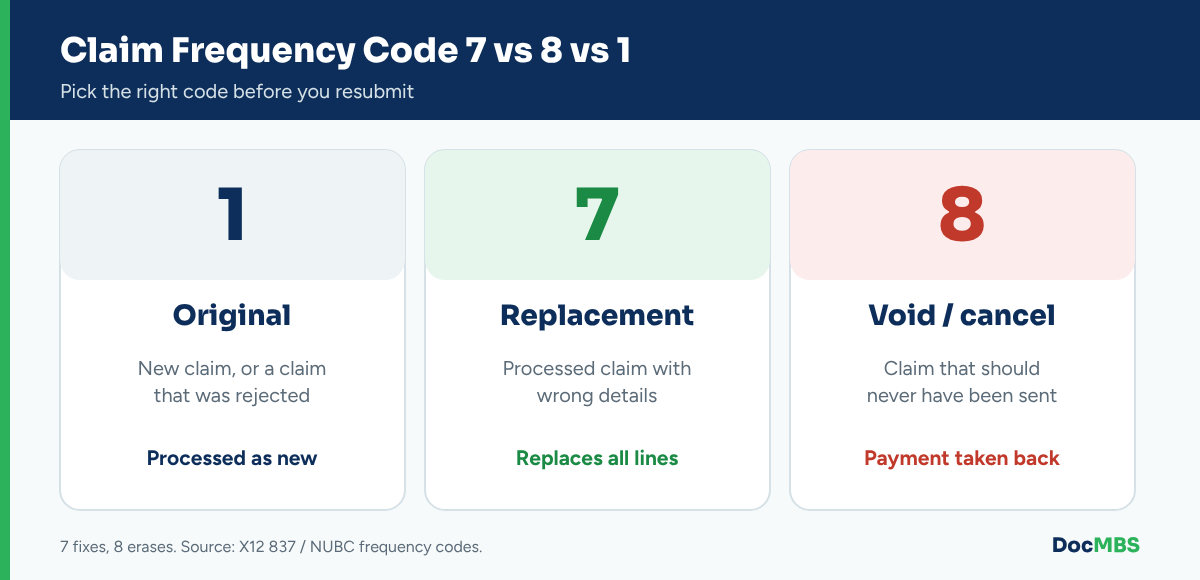
Most claim frequency code 7 problems come from picking the wrong code. Here’s how the three main codes compare:
| Code | Meaning | When to use it | What the payer does |
|---|---|---|---|
| 1 | Original claim | First submission, or resubmitting a claim that was rejected | Processes it as a new claim |
| 7 | Replacement of prior claim | A processed claim needs a change (units, codes, dates, charges) | Replaces the original and reprocesses all lines |
| 8 | Void/cancel of prior claim | The claim should not exist (wrong patient, wrong provider, billed in error) | Cancels the original and takes back any payment |
A simple way to remember it: 7 fixes, 8 erases. If the service happened and only the details were wrong, use claim frequency code 7. If the claim should never have been sent, use 8, then send a new claim if needed.
Where Claim Frequency Code 7 Goes
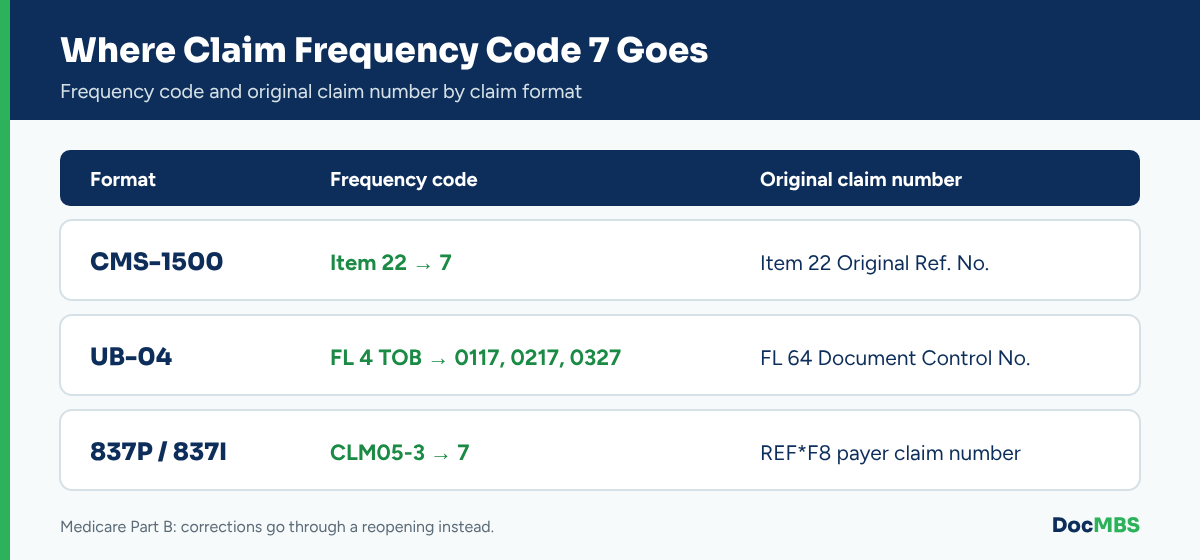
Claim frequency code 7 goes in a different place on each claim format:
| Claim format | Where the frequency code goes | Where the original claim number goes |
|---|---|---|
| CMS-1500 (paper professional) | Item 22, “Resubmission Code”: enter 7 | Item 22, “Original Ref. No.” |
| UB-04 (paper institutional) | FL 4, type of bill: the last digit (e.g. 0117, 0137, 0327) | FL 64, Document Control Number |
| 837P / 837I (electronic) | CLM05-3 | REF segment with qualifier F8 (payer claim control number) |
On the UB-04, the type of bill is four digits with a leading zero. The last digit is the frequency. So 0117 is a hospital inpatient replacement claim, 0217 is a SNF inpatient replacement claim, and 0327 is a home health replacement claim.
Some payers print the bill type without the leading zero, as 117 or 137. It’s the same thing.
How to Submit a Corrected Claim: 7 Steps
- Read the remit first. Check whether the claim was paid, denied or rejected. Only processed claims (paid or denied) can be replaced.
- Check the payer’s rule. Medicare Part B, Medicare Part A and each commercial or Medicaid plan handle corrections differently (see below).
- Fix the error in your system. Change the units, code, modifier, date or diagnosis on the original claim record.
- Set claim frequency code 7 in Item 22, the type of bill or CLM05-3.
- Add the original claim number exactly as it appears on the payer’s remit.
- Send every line, including the lines that were already right.
- Track the deadline and the result. Note the corrected-claim deadline and check the new remit for the right payment.
Pro Tip: On the corrected claims we work, the most common reason for a second denial is a missing or mistyped original claim number. Copy it straight from the ERA, never from memory.
Claim Frequency Code 7 Worked Example
The amounts below are sample numbers, not real payer rates.
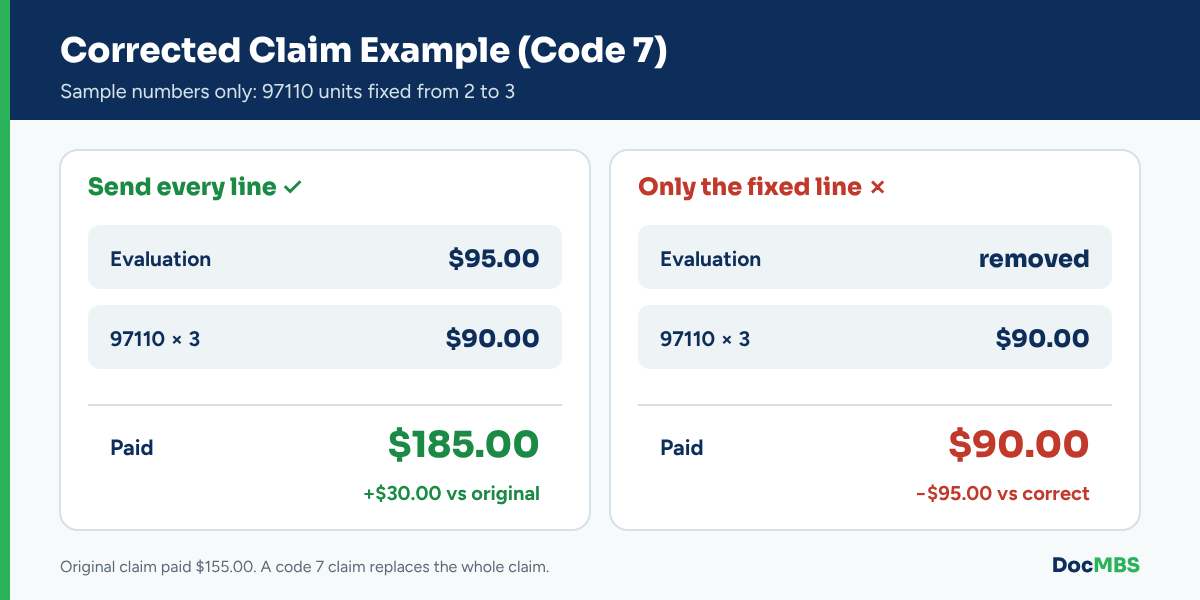
A physical therapy clinic billed a commercial payer for one visit: an evaluation and 2 units of therapeutic exercise (97110). The therapist actually documented 3 units. The payer paid the claim.
| Line | Original claim (paid) | Corrected claim (code 7) |
|---|---|---|
| Evaluation (sample allowed $95.00) | $95.00 | $95.00 |
| 97110 (sample allowed $30.00 per unit) | 2 units = $60.00 | 3 units = $90.00 |
| Total paid | $155.00 | $185.00 |
Result: the payer reverses the $155.00 payment and pays $185.00 on the replacement claim, a net gain of $30.00.
What goes wrong if you send only the 97110 line: the payer replaces the whole claim with your one-line claim. It takes back the evaluation payment, so you receive $90.00 instead of $185.00, a $95.00 loss.
Corrected claims coming back as duplicates?
Our denial management services fix, resubmit and track corrected claims for Medicare, Texas Medicaid and commercial payers.
Medicare Part A and Part B Corrected Claims
Medicare Part A (UB-04 / 837I)
Part A institutional providers, such as SNFs, home health agencies, hospitals and FQHCs, use the type of bill to correct claims. According to First Coast Service Options (JN MAC), “Claims: adjusting, reopening, cancelling and resubmitting” (February 2026):
- Adjustments use TOB xx7 and must be filed within 1 year of the date of service. After that, you need a reopening (TOB xxQ).
- Cancellations use TOB xx8, with condition code D5 (to correct the Medicare number or provider ID) or D6 (to repay a duplicate payment or OIG overpayment).
- Each adjustment needs one claim change reason code.
| Claim change reason code | Use it when you change… |
|---|---|
| D0 | Service dates |
| D1 | Charges |
| D2 | Revenue codes, HCPCS or HIPPS codes |
| D3 | Second or later interim PPS bill [VERIFY: D3 description — NUBC / your MAC] |
| D4 | ICD diagnosis or procedure codes |
| D5 / D6 | Cancel only (used with TOB xx8) |
| D7 / D8 | Make Medicare secondary / make Medicare primary |
| D9 | Any other change |
Choose the code that matches the main change. If you changed more than one thing, D9 is usually the safe choice. [VERIFY: multi-change rule with your MAC]
Medicare Part B (CMS-1500 / 837P)
Medicare Part B works differently. Part B MACs don’t process claim frequency code 7 replacement claims the way commercial payers do. The CMS-1500 instructions in the Medicare Claims Processing Manual, Chapter 26, say to leave Item 22 blank for Medicare. [VERIFY: Item 22 instruction — Claims Processing Manual Ch. 26]
To fix a processed Part B claim, you have three options:
- Clerical error reopening: for minor errors or omissions, through your MAC’s portal or phone line. CGS, for example, says to submit a reopening “when a claim that was either paid or denied was processed with minor errors or omissions.”
- Redetermination: when you disagree with how Medicare decided the claim.
- New claim: when the original was rejected as unprocessable (for example, with remark code MA130). It has no appeal rights, so you correct it and send it again.
Reopenings for any reason must generally be requested within 1 year of the initial determination, and within 4 years for good cause (42 CFR 405.980). Don’t cancel a Part B claim just to correct it. CGS warns that canceling can cause unnecessary recoupments.
Texas Medicaid and Managed Care Corrected Claims
Texas Medicaid has its own deadlines. Under Texas Administrative Code, Title 1, §354.1003:
- Most initial claims must be received within 95 days of the date of service.
- Appeals and requests for adjustments must be received within 120 days of the last denial or adjustment to the original claim.
For fee-for-service claims, TMHP handles adjustments and appeals. [VERIFY: TMHP electronic adjustment steps and frequency code use — TMHP Claims Filing Handbook]
STAR, STAR+PLUS and other Medicaid managed care plans set their own corrected-claim rules. Community Health Choice’s 2026 billing guidelines, for example, ask for resubmission code 7 in Box 22 on the CMS-1500, code 7 in the third digit of the bill type on the UB-04 (117 or 137), and the original claim number in Box 64. Always check each plan’s provider manual.
For BCBS Texas deadlines, see our BCBS Texas timely filing limit guide. Our Austin medical billing team handles TMHP and Texas managed care corrections every day.
Common Mistakes and Denials
These are the claim frequency code 7 problems we see most often. Codes vary by payer, so check your own remits.
| Mistake | What you’ll see | How to fix it |
|---|---|---|
| Sent the correction as a new claim (code 1) | CO-18 (duplicate) | Resend with claim frequency code 7 and the original claim number. |
| Missing or wrong original claim number | Rejection or CO-16 | Copy the ICN/DCN from the ERA exactly. |
| Only the corrected line sent | Other lines recouped | Send a new code 7 claim with every line. |
| Code 7 used on a rejected claim | Rejection (no claim to replace) | Send it as a new claim with code 1. |
| Code 8 used when a change was needed | Full payment taken back | Send a new original claim; use code 7 next time. |
| Correction sent after the deadline | CO-29 (timely filing) | Track correction deadlines by payer; see our Medicare timely filing limit guide. |
For a full prevention plan, read how to reduce claim denials.
Tips for SNF, Home Health, FQHC and Behavioral Health
- SNFs: a changed HIPPS code after an MDS correction is a D2 adjustment on TOB 0217. Make sure the occurrence span code 70 dates don’t change by mistake. See our SNF 3-day rule guide.
- Home health: claim frequency code 7 adjustments go on TOB 0327. Check that the period dates still match the notice of admission.
- FQHCs: a missed qualifying visit or wrong G-code (G0466–G0470) is a D2 adjustment on TOB 0777.
- Behavioral health: most corrections are units or time-based codes (for example 90834 vs 90837). Use claim frequency code 7 with commercial and Medicaid plans, and a reopening for Medicare Part B.
Key Takeaways
- Claim frequency code 7 = replacement; 8 = void; 1 = original.
- It goes in Item 22 (CMS-1500), the last TOB digit (UB-04) or CLM05-3 (837).
- Always include the original claim number and send every line.
- Medicare Part A uses TOB xx7 within 1 year, with one D-code.
- Medicare Part B uses reopenings, not code 7 replacement claims.
- Texas Medicaid adjustments are due within 120 days of the last denial or adjustment.
FAQs
What is claim frequency code 7?
Claim frequency code 7 means “replacement of prior claim.” You use it to correct a claim the payer already processed, such as wrong units, codes or dates. The replacement claim must include the payer’s original claim number and every line from the claim, because it replaces the whole original.
What is the difference between frequency code 7 and 8?
Code 7 replaces a processed claim with a corrected version. Code 8 voids, or cancels, a processed claim and takes back any payment. Use 7 when the service happened but details were wrong. Use 8 when the claim should never have been billed, such as the wrong patient or provider.
Where does the frequency code go on the CMS-1500 and UB-04?
On the CMS-1500, it goes in Item 22 as the resubmission code, with the original reference number next to it. On the UB-04, it’s the last digit of the type of bill in FL 4, and the original claim number goes in FL 64. Electronically, it’s CLM05-3 in the 837.
Does Medicare accept corrected claims with frequency code 7?
Medicare Part A does. Institutional providers use TOB xx7 with a claim change reason code, within 1 year of the date of service. Medicare Part B generally doesn’t process code 7 replacement claims. Part B corrections go through a clerical error reopening, a redetermination, or a new claim if the original was rejected.
What is a claim change reason code (D0–D9)?
It’s a condition code that tells Medicare why a Part A claim is being adjusted. For example, D0 is for changed service dates, D1 for charges, D2 for revenue, HCPCS or HIPPS codes, D4 for ICD codes and D9 for any other change. Use only one per adjustment.
How long do I have to send a corrected claim?
It depends on the payer. Medicare Part A adjustments are due within 1 year of the date of service. Texas Medicaid adjustments are due within 120 days of the last denial or adjustment. Commercial and managed care plans set their own limits, so check each contract.
Why was my corrected claim denied as a duplicate?
Usually because it was sent as a new claim (frequency code 1) instead of a replacement (code 7), or the original claim number was missing. The payer sees the same patient, date and services twice and denies it with CO-18. Resend it with code 7 and the correct original claim number.
Get Claim Frequency Code 7 Right the First Time
Claim frequency code 7 is simple once you know the rules: send the whole claim, include the original claim number, and use the right method for each payer. Medicare Part B needs a reopening instead. Our denial management team fixes and resubmits corrected claims before the deadline. Book a free billing review.
This article is for education only. Confirm current rules with CMS, your Medicare Administrative Contractor and each payer before you bill.
Sources
- CMS: Medicare Claims Processing Manual, Chapter 26 (CMS-1500 instructions)
- eCFR: 42 CFR 405.980 — Reopening of initial determinations
- CGS Medicare: Part B Reopenings
- Texas Administrative Code: 1 TAC §354.1003 — Time Limits for Submitted Claims
- First Coast Service Options: Claims: adjusting, reopening, cancelling and resubmitting (February 25, 2026)
Last updated: November 2026.
Need help with revenue cycle management? Claim submission, charge entry, payment posting, denial management and collections, handled promptly so your revenue cycle runs smoothly.