In this article
- What Is the SNF 3-Day Rule?
- How to Count the 3 Days
- SNF 3-Day Rule Worked Examples
- How to Bill the Qualifying Stay: 7 Steps
- Occurrence Span Code 70 on the UB-04
- SNF 3-Day Rule Waivers
- Medicare Advantage and the SNF 3-Day Rule
- Common Mistakes and Denials
- What It Means for Your SNF Revenue
- Texas Note: Medicaid Nursing Facility vs Medicare SNF
- Key Takeaways
- FAQs
- Get the SNF 3-Day Rule Right on Every Claim
- Sources
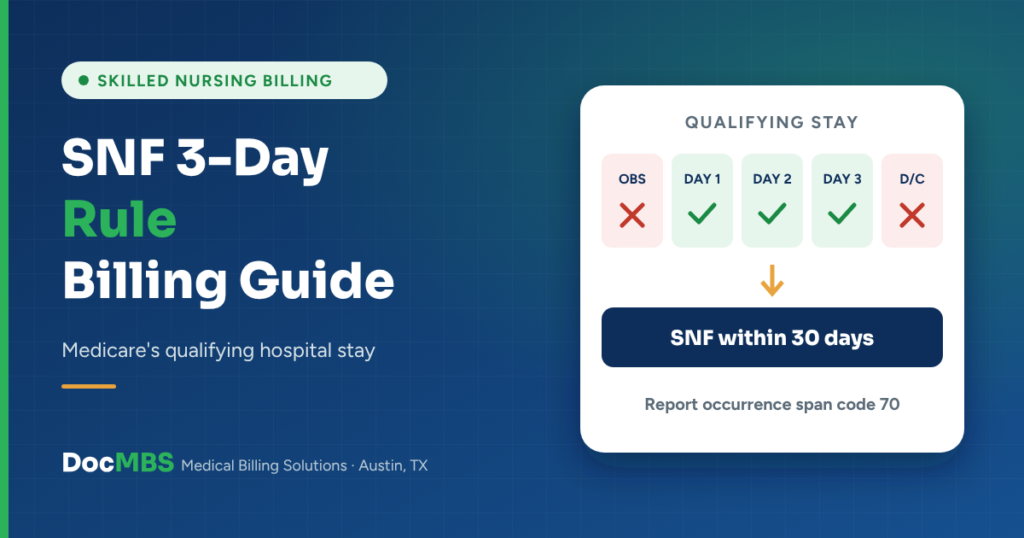
The SNF 3-day rule is the first thing Medicare checks on a skilled nursing Part A claim, and it’s the easiest one to get wrong. A patient arrives “after 3 days in the hospital,” but one of those nights was observation. Now the whole Part A stay is at risk. If the qualifying stay is short, Medicare rejects the claim and won’t pay for the SNF days. Patient liability protections don’t apply either.
This guide explains how to count the days, how to report occurrence span code 70, who has a waiver, and how to avoid the denials we see most often.
Quick Answer
The SNF 3-day rule requires 3 consecutive medically necessary inpatient days in a hospital before a Medicare Part A SNF stay. The admission day counts; the discharge day, ER time and observation don’t. SNF care must start within 30 days of discharge, and the SNF reports occurrence span code 70. Only approved ACO and model waivers skip it.
Table of Contents
- What Is the SNF 3-Day Rule?
- How to Count the 3 Days
- SNF 3-Day Rule Worked Examples
- How to Bill the Qualifying Stay: 7 Steps
- Occurrence Span Code 70 on the UB-04
- SNF 3-Day Rule Waivers
- Medicare Advantage and the SNF 3-Day Rule
- Common Mistakes and Denials
- What It Means for Your SNF Revenue
- Texas Note: Medicaid Nursing Facility vs Medicare SNF
- Key Takeaways
- FAQs
- Sources
What Is the SNF 3-Day Rule?
The SNF 3-day rule is Medicare’s qualifying hospital stay requirement. Before Medicare Part A pays for skilled nursing care, the patient must have a medically necessary inpatient stay of at least 3 consecutive days in one or more hospitals. Critical access hospitals (CAHs) and swing beds count.
CMS explains the rule in its MLN fact sheet “Skilled Nursing Facility 3-Day Rule Billing” (MLN9730256, May 2026). The legal basis is 42 CFR 409.30 and the Medicare Benefit Policy Manual, Chapter 8. [VERIFY: exact Chapter 8 section number — Medicare Benefit Policy Manual]
The SNF 3-day rule has two parts:
- The qualifying stay: 3 consecutive inpatient days, counted midnight to midnight.
- The 30-day window: SNF care must start within 30 days after the hospital or swing bed discharge, unless admitting within 30 days is medically inappropriate.
If either part fails, Medicare doesn’t pay for the SNF stay.
How to Count the 3 Days
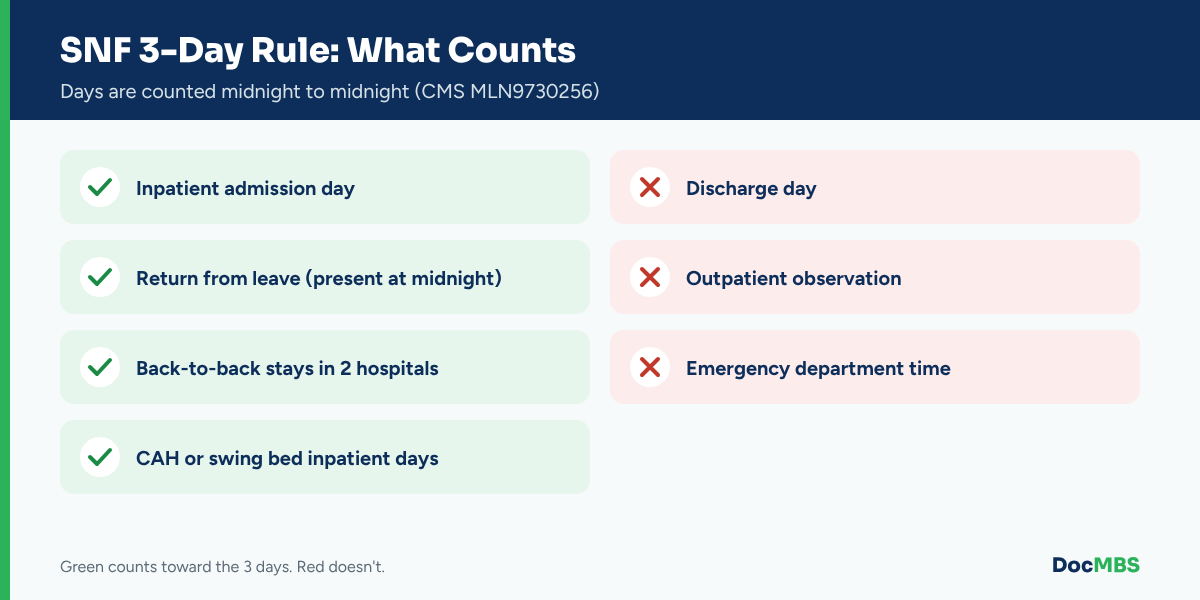
Hospitals count days midnight to midnight. Any part of a day counts as a full day, including the admission day. Here is how each situation counts:
| Situation | Counts toward the 3 days? | Why |
|---|---|---|
| Inpatient admission day | Yes | The admission day counts as a full day. |
| Discharge day | No | CMS doesn’t count the discharge day. |
| Outpatient observation before admission | No | Observation is outpatient, not inpatient. |
| Time in the emergency department before admission | No | ER time is outpatient. |
| Return day from a leave of absence | Yes, if present at midnight | It counts as an admission day. |
| Back-to-back inpatient stays in 2 hospitals | Yes | The stay can be in one or more hospitals, if consecutive. |
| Inpatient days at a CAH or in a swing bed | Yes | CAHs and swing beds are included. |
Watch Out: “Three nights in the hospital” is not the same as 3 inpatient days. Always ask for the inpatient admission order date, not the date the patient arrived at the ER.
SNF 3-Day Rule Worked Examples
These dates are illustrations, not real patients. They show how the count works on a calendar.
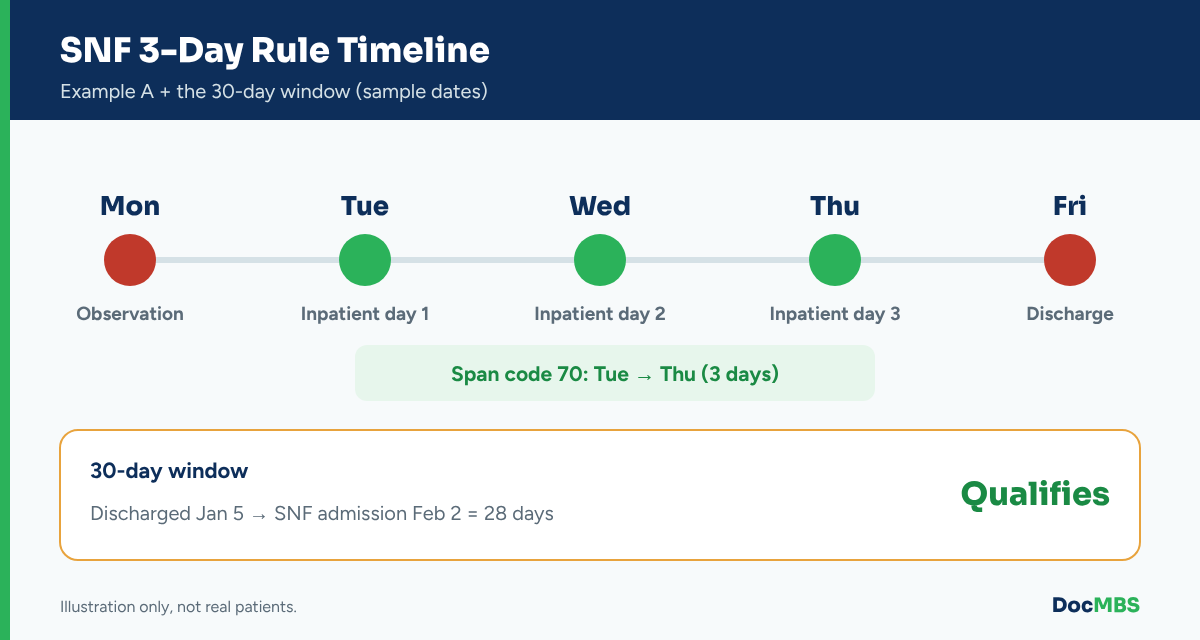
Example A: Observation First, Then Inpatient (Qualifies)
The patient is in observation on Monday. The inpatient order is written Tuesday at 10 p.m. The patient is discharged on Friday.
- Monday (observation): doesn’t count
- Tuesday, Wednesday, Thursday (inpatient): 3 days
- Friday (discharge day): doesn’t count
Result: 3 inpatient days. The SNF 3-day rule is met.
Example B: Short Inpatient Stay (Doesn’t Qualify)
The patient is admitted as an inpatient on Monday at 2 p.m. and discharged on Wednesday.
- Monday and Tuesday: 2 days
- Wednesday (discharge day): doesn’t count
Result: only 2 inpatient days. No Medicare Part A SNF coverage.
Example C: The 30-Day Window
The patient has a qualifying 4-day inpatient stay and is discharged home on January 5. On February 2, the patient needs skilled care for the same condition and is admitted to a SNF.
Result: February 2 is 28 days after discharge, inside the 30-day window. The stay qualifies.
Pro Tip: On the SNF claims we review, most qualifying-stay problems start at intake. Build the day count into your admission checklist, and get the hospital’s inpatient dates in writing before the patient arrives.
Getting Part A claims rejected for the qualifying stay?
Our skilled nursing facility billing services verify every hospital stay and span code 70 before you bill.
How to Bill the Qualifying Stay: 7 Steps
- Get the hospital’s inpatient dates. Ask for the inpatient admission date and the discharge date in writing. CMS says hospitals should tell the SNF and the patient the number of inpatient days.
- Confirm inpatient status. Make sure the days were inpatient, not observation or ER time.
- Count the days. Count from the admission day up to, but not including, the discharge day. You need at least 3.
- Check the 30-day window. Confirm the SNF admission is within 30 days of the hospital or swing bed discharge.
- Check waiver eligibility. If the stay is short, see whether the patient qualifies under an approved SNF 3-day rule waiver.
- Report occurrence span code 70 on the UB-04 with the qualifying stay dates.
- Give a SNF ABN (CMS-10055) when there’s no qualifying stay. It isn’t required in this case, but CMS strongly encourages it.
Occurrence Span Code 70 on the UB-04
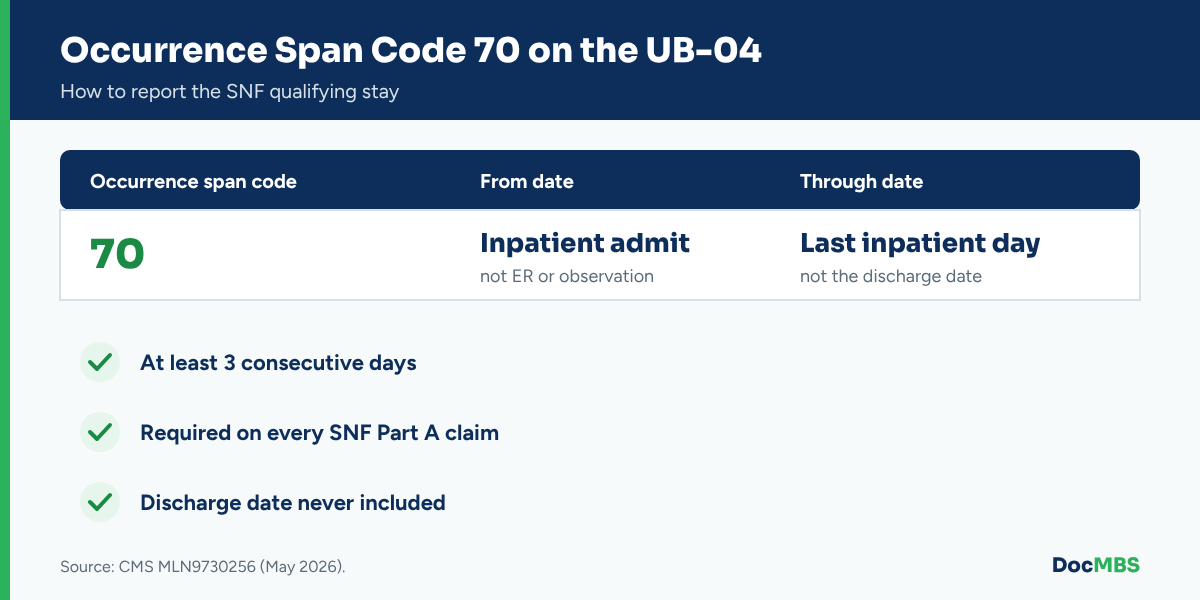
Occurrence span code 70 tells Medicare the dates of the qualifying hospital stay. CMS says SNFs must report it, and the dates should not count the discharge date.
| UB-04 item | What to enter | Common error |
|---|---|---|
| Occurrence span code (FL 35–36) [VERIFY: FL numbers — NUBC UB-04 manual] | 70 | Code left off the claim |
| From date | The inpatient admission date | Using the ER or observation date |
| Through date | The last inpatient day before discharge | Entering the discharge date |
| Stay length | At least 3 consecutive days | Stays of 2 days that “felt like 3” |
Using Example A, the span code 70 dates would run from Tuesday through Thursday.
How Medicare checks it: CMS rejects a SNF claim that includes an inpatient stay of less than 3 consecutive days. It also rejects the SNF claim when a span code 70 date matches a hospital claim within 30 days of the SNF admission and that hospital stay is under 3 days. Claims that meet certain bypass criteria are paid.
SNF 3-Day Rule Waivers
Some providers can admit patients to a SNF without a 3-day inpatient stay. According to the CMS fact sheet, SNF 3-day rule waivers are available through:
- ACO REACH
- Transforming Episode Accountability Model (TEAM)
- Medicare Shared Savings Program ACOs in tracks that can use or apply for a waiver
A waiver doesn’t cover every patient. The patient must meet the program’s eligibility criteria, and the SNF must be approved to take part. If you’re not sure your facility is on an approved list, treat the stay as needing a qualifying stay. [VERIFY: waiver claim coding for your program — CMS Innovation Center / ACO waiver guidance]
Medicare Advantage and the SNF 3-Day Rule
Medicare Advantage plans set their own coverage rules. Many MA plans don’t require a 3-day hospital stay, but many do require prior authorization for a SNF admission.
CMS says hospitals should give MA enrollees accurate stay information, but that alone doesn’t guarantee MA coverage. Before you admit an MA patient:
- check the plan’s 2027 Evidence of Coverage or provider manual,
- get prior authorization when the plan requires it, and
- keep the authorization number with the admission paperwork.
[VERIFY: 2027 SNF admission policy for each MA plan you contract with — plan Evidence of Coverage]
Common Mistakes and Denials
These are the SNF 3-day rule problems we see most often. Reason codes vary by MAC, so check your own remits.
| Mistake | What you’ll see | How to fix it |
|---|---|---|
| Observation days counted as inpatient | Claim rejected; e.g. CO-50 [VERIFY] | Count only days after the inpatient order. |
| Discharge day counted | Claim rejected (stay under 3 days) | Stop the count the day before discharge. |
| Span code 70 missing or dates wrong | RTP or CO-16 | Add code 70 with the correct from/through dates and resubmit. |
| SNF admission more than 30 days after discharge | Denied; e.g. CO-50 or CO-96 [VERIFY] | Document medical reasons if a later admission was appropriate. |
| No SNF ABN when there’s no qualifying stay | Collection disputes with the patient | Issue the SNF ABN (CMS-10055) at admission. |
| Physician visits billed with POS 32 during a Part A stay | Wrong payment; possible CO-5 [VERIFY] | Use POS 31 during a Part A SNF stay. |
If Medicare paid a claim it shouldn’t have, liability depends on who was at fault (Social Security Act §1870). A SNF found at fault must return the overpayment within 60 calendar days of identifying it.
For more prevention tips, see how to reduce claim denials and our SNF consolidated billing guide.
What It Means for Your SNF Revenue
Once the SNF 3-day rule is met, the Part A stay is paid under PDPM. Medicare covers up to 100 SNF days per benefit period. Days 1–20 have no coinsurance, and days 21–100 have a daily coinsurance. [VERIFY: 2027 SNF coinsurance for days 21–100 — CMS, mid-November 2026]
A missed qualifying stay doesn’t cost you one line. It costs the whole Part A stay. Make sure the rest of the claim is right too:
- the HIPPS code from the MDS: see our PDPM HIPPS code guide
- revenue code 0022 lines: see our revenue code 0022 guide
- the right daily rate: see our SNF Medicare daily rate guide
Texas Note: Medicaid Nursing Facility vs Medicare SNF
The SNF 3-day rule is a Medicare Part A rule. Texas Medicaid nursing facility stays, including those under STAR+PLUS, follow Texas Medicaid rules instead, and don’t use the Medicare qualifying stay. [VERIFY: Texas Medicaid nursing facility admission rules — TMHP / HHSC]
Dual-eligible residents are where Texas facilities get caught. The Medicare Part A stay must meet the SNF 3-day rule first, before Medicaid picks up coinsurance or later days. Our Austin medical billing team can check your Medicare and Medicaid billing for dual-eligible residents.
Key Takeaways
- The SNF 3-day rule requires 3 consecutive inpatient days, counted midnight to midnight.
- The admission day counts; the discharge day, observation and ER time don’t.
- SNF care must start within 30 days of hospital discharge.
- Report occurrence span code 70 with the qualifying stay dates, without the discharge date.
- Waivers apply only to ACO REACH, TEAM and approved MSSP ACOs.
- Without a qualifying stay, Medicare won’t pay. Give a SNF ABN.
FAQs
What is the SNF 3-day rule?
The SNF 3-day rule is Medicare’s requirement that a patient have a medically necessary inpatient hospital stay of at least 3 consecutive days before Part A pays for skilled nursing care. The SNF stay must also start within 30 days of the hospital discharge, with a few exceptions.
Does observation count toward the 3-day rule?
No. Time under outpatient observation, and time in the emergency department before admission, doesn’t count. Only days after the inpatient admission order count. A patient can spend several nights in the hospital and still not meet the 3-day rule.
Does the discharge day count for the 3-day stay?
No. Hospitals count the admission day but not the discharge day. Days are counted midnight to midnight. An inpatient admitted Monday and discharged Thursday has 3 days: Monday, Tuesday and Wednesday.
What is the 30-day transfer rule for SNF?
SNF care must start within 30 days after the hospital or swing bed discharge. If the patient is admitted later, Medicare doesn’t cover the stay, unless admitting within 30 days would have been medically inappropriate. Document the medical reason in that case.
What is occurrence span code 70?
Occurrence span code 70 reports the qualifying hospital stay dates on the SNF’s UB-04 claim. CMS requires SNFs to report it. The from date is the inpatient admission date, and the through date is the last inpatient day, not the discharge date.
Who has a SNF 3-day rule waiver?
Waivers are available through ACO REACH, the Transforming Episode Accountability Model (TEAM) and certain Medicare Shared Savings Program ACO tracks. The patient must meet the program’s eligibility rules, and the SNF must be approved to take part.
Do Medicare Advantage plans require a 3-day hospital stay?
It depends on the plan. Medicare Advantage plans set their own SNF coverage rules, and many waive the 3-day stay but require prior authorization. Check each plan’s 2027 Evidence of Coverage and get the authorization before admission.
Get the SNF 3-Day Rule Right on Every Claim
The SNF 3-day rule decides whether Medicare pays for the whole Part A stay. Count the inpatient days the right way, check the 30-day window and report span code 70 on every claim. Our skilled nursing facility billing team checks the qualifying stay and span code 70 before every Part A claim goes out. Book a free billing review.
This article is for education only. Confirm current rules with CMS and your Medicare Administrative Contractor before you bill.
Sources
- CMS MLN: Skilled Nursing Facility 3-Day Rule Billing (MLN9730256, May 2026)
- eCFR: 42 CFR 409.30 — Basic requirements for SNF coverage
- CMS: Medicare Benefit Policy Manual, Chapter 8
- CMS MLN: SNF provider resources
Last updated: November 2026.
Need help with medical billing? End-to-end medical billing for US practices: charge entry, claim submission, payment posting, denial follow-up and reporting.