In this article
- What Is the 2027 Modifier 25 Reduction?
- Proposed vs Final Modifier 25 Reduction
- Who the Modifier 25 Reduction Applies To
- How Much You Lose: Worked Example
- How to Prepare for the Modifier 25 Reduction: 6 Steps
- Modifier 25 Rules That Still Apply in 2027
- What It Means for FQHCs, Behavioral Health and SNFs
- Common Mistakes and Denials
- Will Congress Delay the Modifier 25 Cut?
- Texas Note: Medicare Advantage and Commercial Contracts
- Key Takeaways
- FAQs
- Get Ready for the Modifier 25 Reduction Now
- Sources
The modifier 25 reduction starts on January 1, 2027, and it hits the “see and treat” visits many practices bill every day. A joint injection after an office visit, or a skin biopsy during a problem visit, will pay less from the first claim of the year. Most practices won’t notice until the first 2027 ERAs show smaller payments than expected.
This guide explains what CMS finalized, who the modifier 25 reduction applies to, how much it costs with simple sample math, and the steps to take before January 1.
Quick Answer
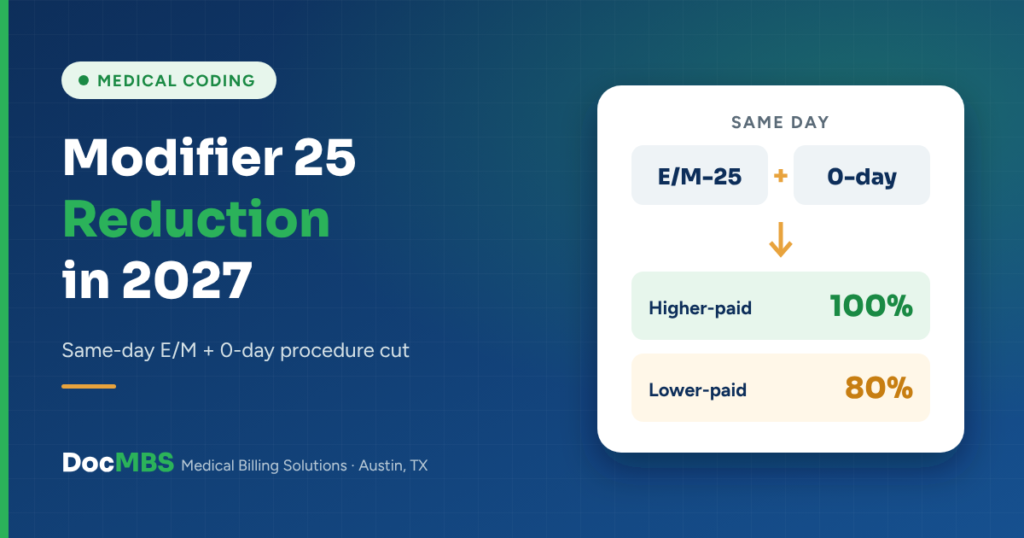
From January 1, 2027, when an office or outpatient E/M visit with modifier 25 and a 0-day global procedure are billed on the same day by the same physician (or a same-specialty colleague in the same group), Medicare pays the higher-paid service at 100% and the other at 80%.
Table of Contents
- What Is the 2027 Modifier 25 Reduction?
- Proposed vs Final Modifier 25 Reduction
- Who the Modifier 25 Reduction Applies To
- How Much You Lose: Worked Example
- How to Prepare for the Modifier 25 Reduction: 6 Steps
- Modifier 25 Rules That Still Apply in 2027
- What It Means for FQHCs, Behavioral Health and SNFs
- Common Mistakes and Denials
- Will Congress Delay the Modifier 25 Cut?
- Texas Note: Medicare Advantage and Commercial Contracts
- Key Takeaways
- FAQs
- Sources
What Is the 2027 Modifier 25 Reduction?
The modifier 25 reduction is a new Medicare Physician Fee Schedule (PFS) payment rule in the CY 2027 PFS final rule (CMS-1848-F). CMS released it on November 4, 2026, and it takes effect on January 1, 2027.
Here is how it works. When a significant, separately identifiable office or outpatient E/M visit is billed with modifier 25 on the same day as a procedure with a 0-day global period, Medicare pays:
- the higher-paid service at 100%, and
- the lower-paid service at 80% (a 20% cut).
The reduced service can be the procedure or the visit. It depends only on which one pays less.
CMS’s reasoning is about practice expense. When a patient gets a visit and a procedure in one trip, some costs happen only once: check-in, rooming, and cleaning and turning over the room. CMS says paying both services in full pays for those costs twice. The modifier 25 reduction is CMS’s way of removing that overlap.
Watch Out: The 80% payment is a payment rule, not a denial. When it shows up on your 2027 remits, don’t appeal it as an underpayment. Do check that it was applied to the correct (lower-paid) line.
Proposed vs Final Modifier 25 Reduction
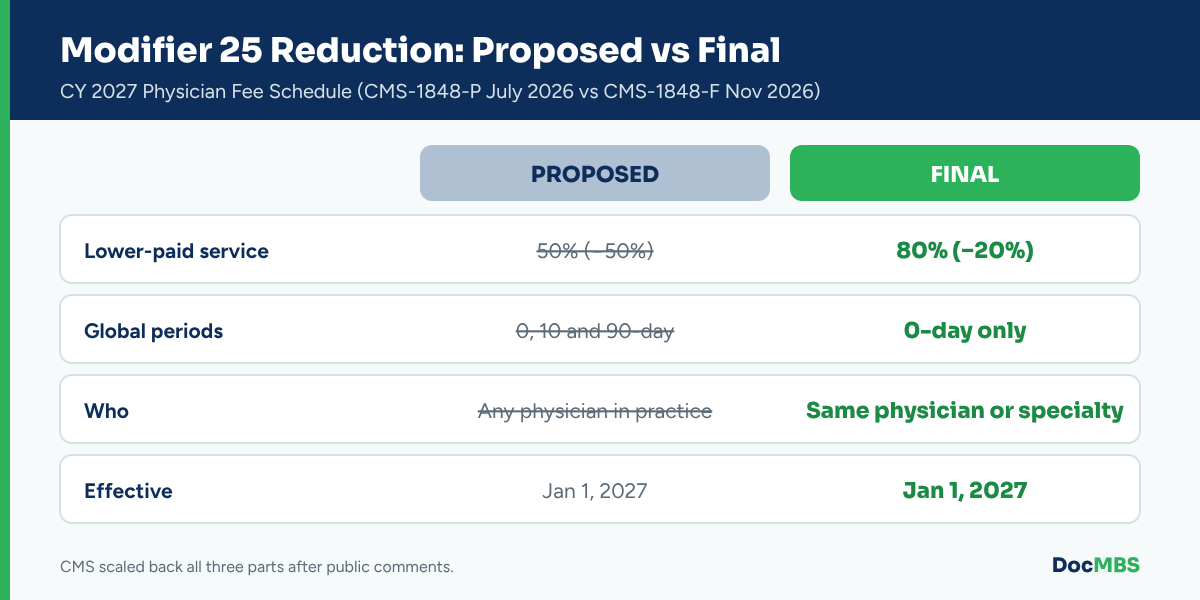
The final modifier 25 reduction is much smaller than what CMS proposed in July 2026. After strong pushback from physician groups, CMS scaled it back in three ways.
| Item | July 2026 proposal | Final rule (Nov 2026) |
|---|---|---|
| Payment for the lower-paid service | 50% (a 50% cut) | 80% (a 20% cut) |
| Global periods included | 0-day, 10-day and 90-day | 0-day only |
| Who it applies to | Any physician in the same practice | Same physician, or same specialty in the same group |
| Visit type | Office/outpatient E/M with modifier 25 | Office/outpatient E/M with modifier 25 |
| Effective date | January 1, 2027 | January 1, 2027 |
So if you heard “50% cut” over the summer, that is no longer the rule. The final cut is 20%, and only for 0-day global procedures.
Who the Modifier 25 Reduction Applies To
The modifier 25 reduction applies when both of these are true:
- Same day: an office/outpatient E/M visit billed with modifier 25 and a 0-day global procedure on the same date of service.
- Same physician or same specialty: the same physician does both, or a physician of the same specialty in the same group does one of them.
It does not apply when a physician of a different specialty in the same group does the other service. For example, a family medicine visit and a same-day dermatology biopsy by a dermatologist in the same multi-specialty group are not paired under the final rule.
Which E/M codes? CMS describes the trigger as an office or outpatient E/M visit, which means the 99202–99215 family. [VERIFY: whether telehealth office visits, home/residence E/M and same-day preventive visits (AWV, IPPE) are in or out — CY 2027 PFS final rule, CMS-1848-F]
Which procedures? Only codes with a 0-day global in the Medicare PFS. Common office examples include a large-joint injection (20610) and a tangential skin biopsy (11102). Some common procedures, like wart destruction (17110), carry a 10-day global and are not included. [VERIFY: global days for each example code — CMS MPFS Look-Up Tool]
Specialties hit hardest: CMS’s impact analysis points to dermatology, otolaryngology and podiatry. Primary care, orthopedics, pain management and urgent care will also feel it on same-day injections and minor procedures.
How Much You Lose: Worked Example
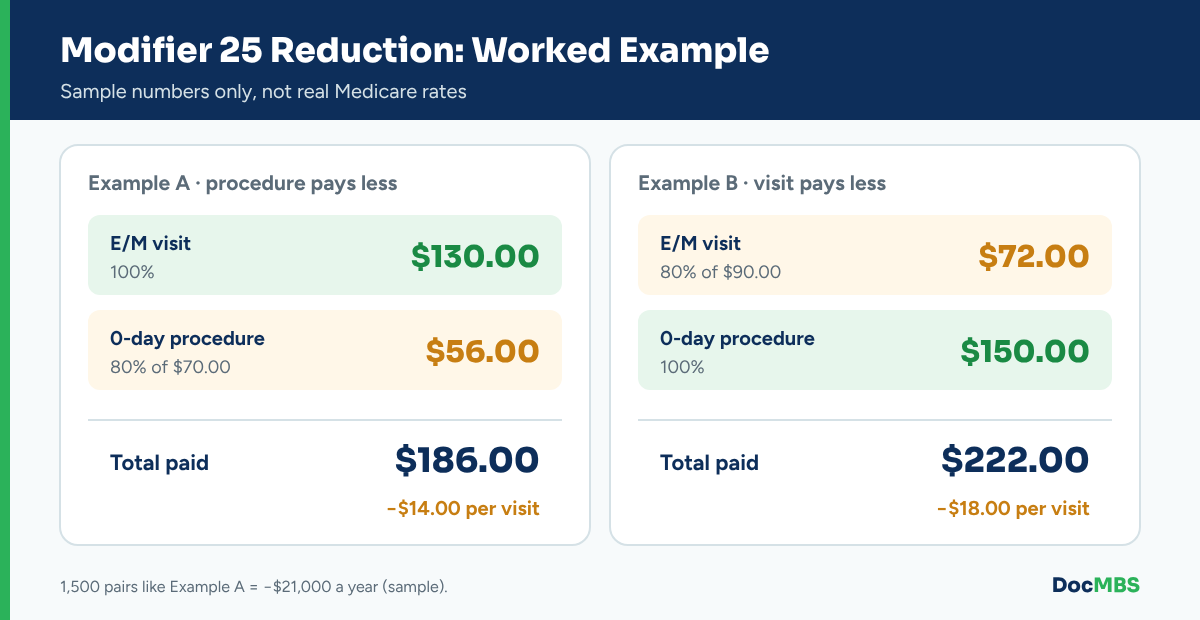
The amounts below are sample numbers to show the math. They are not real Medicare rates. Use the 2027 MPFS Look-Up Tool for your codes and locality.
| Sample visit | E/M (sample) | Procedure (sample) | Paid before | Paid with the modifier 25 reduction | Difference |
|---|---|---|---|---|---|
| Example A – procedure pays less | $130.00 (100%) | $70.00 → $56.00 (80%) | $200.00 | $186.00 | −$14.00 |
| Example B – visit pays less | $90.00 → $72.00 (80%) | $150.00 (100%) | $240.00 | $222.00 | −$18.00 |
Scale it to a year: a practice with 1,500 same-day pairs like Example A loses 1,500 × $14.00 = $21,000 a year (sample). A busy dermatology or podiatry practice could have far more same-day pairs than that.
Pro Tip: To find your own number, pull every 2026 claim with modifier 25 on an E/M and a 0-day procedure on the same date. Price the lower-paid line at 80% using the 2027 rates. That’s your estimated 2027 loss.
Worried about the modifier 25 cut on your same-day visits?
Our medical coding services audit your E/M and procedure claims, fix documentation gaps and estimate your 2027 impact.
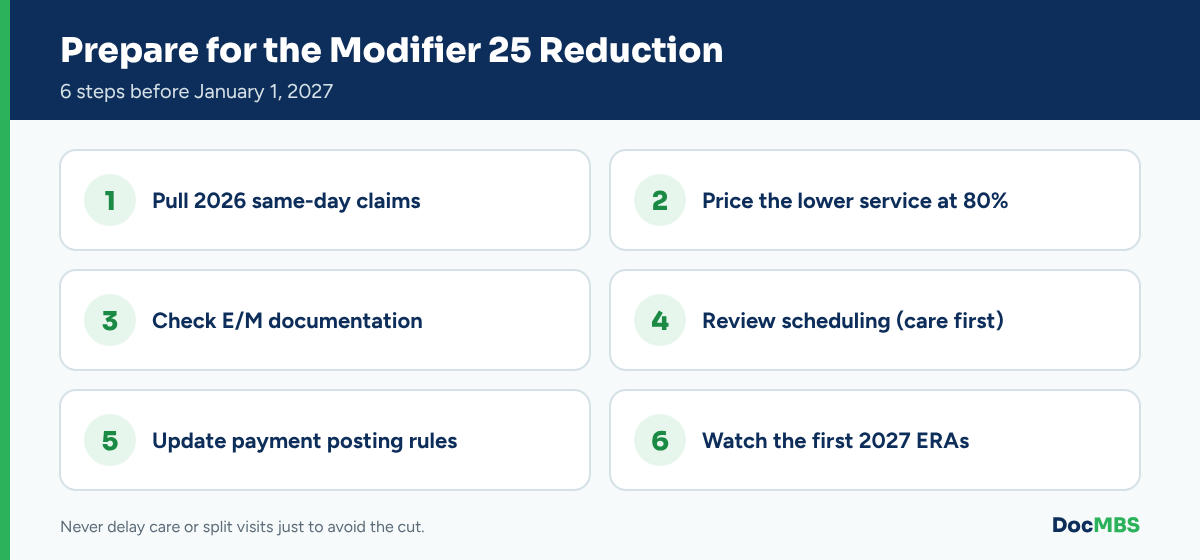
How to Prepare for the Modifier 25 Reduction: 6 Steps
- Pull your 2026 data. Run a report of claims with modifier 25 on an office/outpatient E/M and a 0-day global procedure on the same date, by the same provider or same-specialty provider in the group.
- Price the lower service at 80%. Use the 2027 MPFS rates for your locality and the 2027 conversion factor to estimate the yearly impact.
- Check your documentation. Make sure each modifier 25 visit is truly significant and separately identifiable, beyond the usual pre-procedure check. Auditors will look harder at these pairs now.
- Review scheduling, with care first. Clinical need always comes first. Never delay care, or split a visit into two days, just to avoid the modifier 25 reduction. That is a compliance risk.
- Update payment posting rules. Load the 80% rule into your expected payment and contract variance logic, so your team doesn’t flag it as an underpayment.
- Watch the first 2027 ERAs. Check which line was reduced, which adjustment code your MAC uses, and whether any secondary payers follow the same cut.
Modifier 25 Rules That Still Apply in 2027
The modifier 25 reduction changes payment, not the basic coding rules. These still apply:
- Separately identifiable: the E/M must go beyond the normal pre- and post-procedure work included in the procedure.
- Modifier 25 goes on the E/M line, never on the procedure line.
- Documentation: the note should show the separate problem or decision clearly. A separate diagnosis helps but isn’t required.
- Modifier 25 and B1: in 2027, G2211 is replaced by modifier B1 on the E/M. B1 generally isn’t paid when the E/M has modifier 25, with limited exceptions such as an AWV, vaccine administration or other Part B preventive service on the same day. See our G2211 modifier B1 guide.
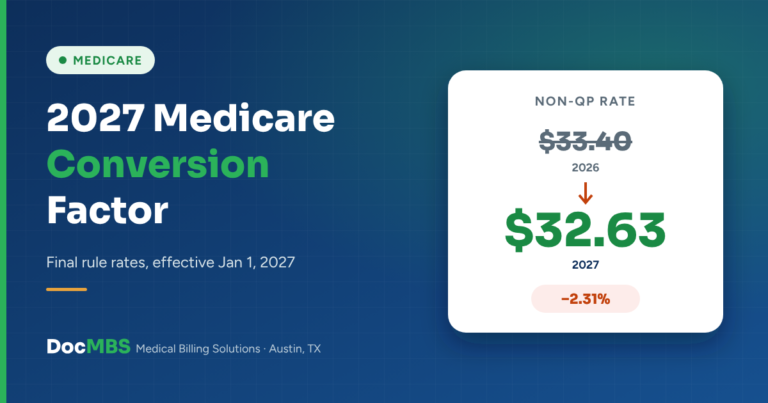
The modifier 25 reduction also comes on top of a lower 2027 conversion factor: $32.63 for most clinicians (−2.31%) and $32.95 for qualifying APM participants (−1.83%). See our 2027 Medicare conversion factor guide.
What It Means for FQHCs, Behavioral Health and SNFs
- FQHCs and RHCs: FQHC visits are paid under the FQHC PPS, not the physician fee schedule, so the modifier 25 reduction shouldn’t change the PPS encounter payment. [VERIFY: confirm FQHC/RHC treatment in CMS-1848-F] See our FQHC PPS rate guide.
- Behavioral health: psychiatric and therapy visits rarely pair an office E/M with a 0-day procedure, so most behavioral health practices will see little impact.
- SNFs and nursing facilities: physician visits in a nursing facility use the 99304–99310 codes, not office/outpatient E/M codes. [VERIFY: whether the rule reaches nursing facility E/M — CMS-1848-F]
- Primary care and urgent care: this is where the main risk sits: same-day joint injections, biopsies and other minor 0-day procedures.
Common Mistakes and Denials
These are the problems we expect on same-day claims after January 1. Codes vary by MAC, so check your own remits.
| Mistake | What you’ll see | How to fix it |
|---|---|---|
| E/M not separately identifiable | CO-97 (bundled) or audit recoupment | Document the separate problem and decision; bill the E/M only when it qualifies. |
| Modifier 25 on the procedure line | CO-4 (modifier inconsistent) | Move modifier 25 to the E/M line and send a corrected claim. |
| Missing modifier 25 | E/M bundled, CO-97 | Add modifier 25 to the E/M when the visit qualifies. |
| Appealing the 80% payment as an underpayment | Expected reduction [VERIFY: CARC/RARC your MAC uses] | Don’t appeal it. Check only that the lower-paid line was reduced. |
| Moving visits to another day without a clinical reason | Compliance and audit risk | Schedule by clinical need only. |
| Corrected claim filed too late | CO-29 | See our Medicare timely filing limit guide. |
For a full prevention plan, read how to reduce claim denials, or let our denial management services work your same-day denials.
Will Congress Delay the Modifier 25 Cut?
Maybe, but nothing has passed yet. In November 2026 the AMA asked Congress to delay the modifier 25 payment reduction for one year and to extend the 2.5% physician payment increase through 2027. Many state and specialty societies support the request. [VERIFY: number of societies on the request — AMA letter]
Until Congress acts, plan as if the modifier 25 reduction starts on January 1, 2027. We’ll update this post if Congress delays or changes it.
Texas Note: Medicare Advantage and Commercial Contracts
The modifier 25 reduction is a Medicare PFS rule. Medicare Advantage plans and commercial payers may or may not copy it. Many Texas contracts pay a percentage of the Medicare fee schedule, and some payers already have their own modifier 25 policies. [VERIFY: each payer’s 2027 modifier 25 policy — payer bulletins]
Check the 2027 policies for BCBS Texas, UnitedHealthcare, Aetna, Humana and your MA plans before January. If you need deadlines for corrected claims, see our BCBS Texas timely filing limit guide. Our Austin medical billing team can review your Texas payer contracts.
Key Takeaways
- The modifier 25 reduction starts on January 1, 2027.
- Same-day office E/M with modifier 25 + 0-day procedure: higher service 100%, lower service 80%.
- It applies to the same physician or a same-specialty physician in the same group, not different specialties.
- CMS dropped the proposed 50% cut and the 10- and 90-day globals.
- Dermatology, otolaryngology and podiatry are hit hardest.
- The AMA has asked Congress for a one-year delay; nothing has passed yet.
FAQs
What is the 2027 modifier 25 reduction?
It’s a new Medicare rule in the CY 2027 PFS final rule. When an office or outpatient E/M with modifier 25 and a 0-day global procedure are billed the same day by the same physician or a same-specialty colleague in the group, Medicare pays the higher-paid service in full and the other at 80%.
Does Medicare cut modifier 25 in 2027?
Yes, but only in one situation. Starting January 1, 2027, the lower-paid of a same-day modifier 25 E/M and a 0-day global procedure is paid at 80%. Modifier 25 visits without a same-day 0-day procedure are not affected by this rule.
Which service gets reduced, the E/M or the procedure?
Whichever pays less. If the procedure pays less than the visit, the procedure is paid at 80%. If the visit pays less, the visit is paid at 80%. The higher-paid service is always paid at 100%.
Does the modifier 25 cut apply to 10-day and 90-day globals?
No. CMS proposed including 10-day and 90-day global procedures, but the final rule limits the modifier 25 reduction to procedures with a 0-day global period. Check each code’s global days in the CMS MPFS Look-Up Tool.
Does the cut apply to different specialties in the same group?
No. The final rule applies to the same physician, or a physician of the same specialty in the same group. CMS dropped the proposal to apply it to any physician in the same practice, so a different-specialty colleague’s same-day service isn’t paired.
Which specialties are hit hardest by the modifier 25 cut?
CMS’s impact analysis shows the largest effects on dermatology, otolaryngology and podiatry. These specialties often do a visit and a minor 0-day procedure, like a biopsy or injection, on the same day. Primary care and urgent care will also feel it on same-day injections.
Will Congress delay the modifier 25 reduction?
It’s not decided. The AMA and many medical societies have asked Congress to delay the cut for one year in the year-end legislation. Nothing has passed yet, so practices should plan for January 1, 2027. We’ll update this post if Congress acts.
Get Ready for the Modifier 25 Reduction Now
The modifier 25 reduction is smaller than first proposed, but it still trims every qualifying same-day visit from January 1, 2027. Find your same-day pairs, tighten documentation and update your posting rules now. Our medical coding team reviews your same-day E/M and procedure claims before January 1 and fixes gaps before they cost you. Book a free billing review.
This article is for education only. Confirm current rules with CMS, your Medicare Administrative Contractor and each payer before you bill.
Sources
- CMS: Physician Fee Schedule (CY 2027 final rule, CMS-1848-F)
- CMS newsroom: CY 2027 Medicare Physician Fee Schedule Final Rule fact sheet (CMS-1848-F), November 4, 2026
- CMS: Physician Fee Schedule Look-Up Tool (global days and rates)
- AMA: Lame-duck session offers chance to protect Medicare patients’ access (Nov 5, 2026)
Last updated: November 2026.
Need help with revenue cycle management? Claim submission, charge entry, payment posting, denial management and collections, handled promptly so your revenue cycle runs smoothly.