In this article
- Texas Medicaid Timely Filing Limit at a Glance
- How to Count the 95 Days
- Texas Medicaid Timely Filing Rules for Special Situations
- Texas Medicaid Timely Filing for Appeals and Corrected Claims: The 120-Day Rule
- STAR Plans and Texas Medicaid Timely Filing: Whose Deadline Applies?
- How to Never Miss the Texas Medicaid Timely Filing Deadline: 7 Steps
- Common Texas Medicaid Timely Filing Mistakes and Denials (and How to Fix Them)
- Specialty Note: Behavioral Health, Home Health and FQHCs
- Key Takeaways
- FAQs
- Protect Every Claim From the 95-Day Clock
- Sources
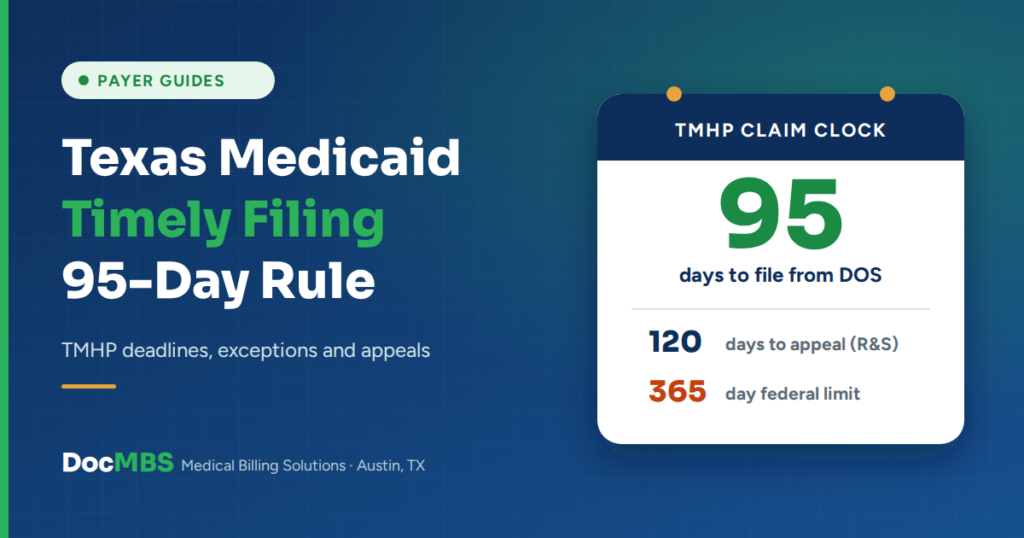
Texas Medicaid timely filing gives you one of the shortest claim windows in the country: TMHP must receive most claims within 95 days of the date of service. Miss that window by one day and the claim is usually a write-off, no matter how clean the coding was. On the Texas claims we work, missed deadlines rarely come from late billing alone. They come from rejected claims nobody re-sent, other-insurance EOBs that sat in a drawer, and STAR plan claims sent to the wrong payer.
This guide explains every Texas Medicaid timely filing deadline in plain terms: the 95-day rule, the exceptions, the 120-day appeal window, the 365-day federal limit, and how STAR managed care plans fit in.
Quick Answer
The Texas Medicaid timely filing limit is 95 days from the date of service for in-state providers and 365 days for out-of-state providers. Appeals must reach TMHP within 120 days of the R&S report date. No claim can be paid after the 365-day federal limit, even with retro eligibility. STAR plan claims follow the MCO’s deadline.
Table of Contents
- Texas Medicaid Timely Filing Limit at a Glance
- How to Count the 95 Days
- Texas Medicaid Timely Filing Rules for Special Situations
- Texas Medicaid Timely Filing for Appeals and Corrected Claims
- STAR Plans and Texas Medicaid Timely Filing
- How to Never Miss the Texas Medicaid Timely Filing Deadline: 7 Steps
- Common Texas Medicaid Timely Filing Mistakes
- Specialty Note: Behavioral Health, Home Health and FQHCs
- Key Takeaways
- FAQs
- Sources
Texas Medicaid Timely Filing Limit at a Glance
All TMHP filing rules are in the Texas Medicaid Provider Procedures Manual (TMPPM), Volume 1, Section 6, Claims Filing. The table below puts the main deadlines in one place. The key word is “received”: TMHP must have the claim in hand by the deadline, not just in your outbox.
| Situation | Deadline | Clock starts | TMPPM |
|---|---|---|---|
| In-state provider, first claim | 95 days | Each date of service | 6.1.4 |
| Inpatient hospital | 95 days | Discharge date or last date of service on the claim | 6.1.4 |
| Out-of-state provider | 365 days | Date of service | 6.1.4 |
| Other insurance billed first | 95 days | Date of the other insurer’s disposition | 6.1.4 |
| No answer from other insurance | Wait 110 days, then bill TMHP | Date you billed the other insurer | 6.1.4 |
| Medicare crossover | 95 days | Date of Medicare’s disposition | 6.1.4.6 |
| Retroactive eligibility | 95 days and within 365 days of DOS | Date eligibility was added to the TMHP file | 6.1.4 |
| Newly enrolled provider | 95 days and within 365 days of DOS | Date enrollment is complete | 6.1.4 |
| Appeal or adjustment | 120 days | Disposition date on the R&S report | 6.1.4.4 |
| Federal filing limit | 365 days (12 months) | Date of service | 42 CFR 447.45 |
| HHSC payment deadline | 24 months | Date of service or discharge | 6.1.5 |
Source: TMHP, Texas Medicaid Provider Procedures Manual, Vol. 1, Section 6 Claims Filing (June 2026). Summarized, not quoted. Applies to fee-for-service claims sent to TMHP.
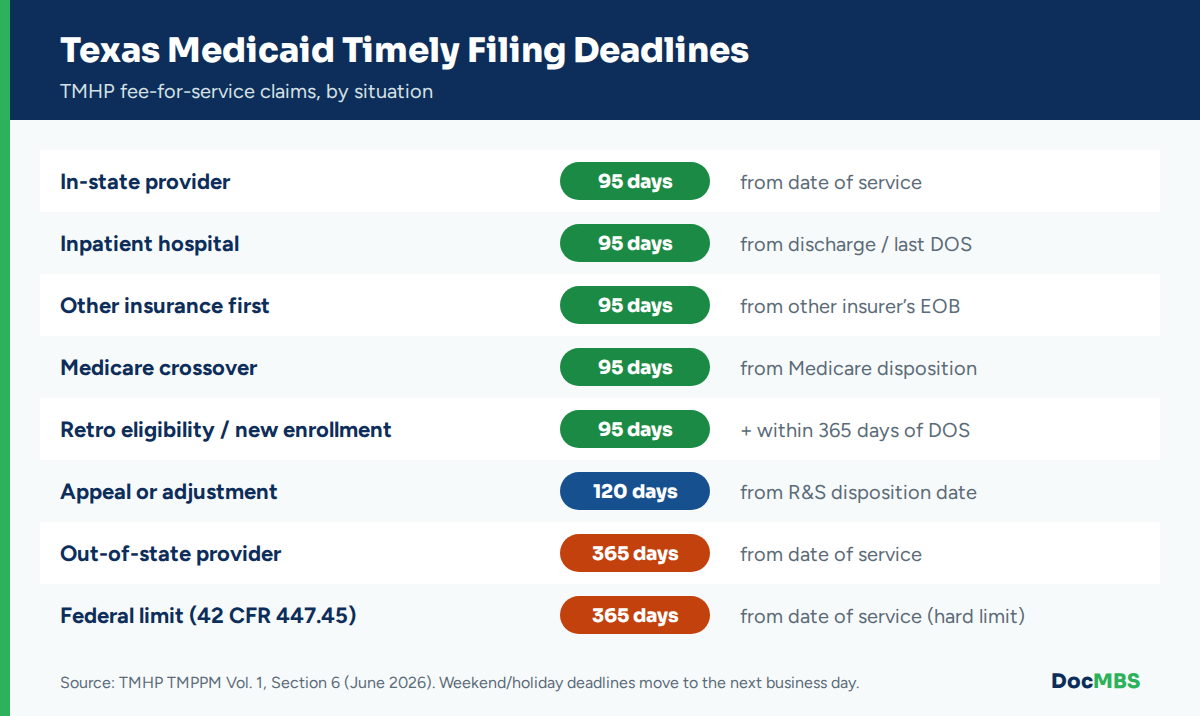
Two limits sit on top of everything else. First, the federal rule in 42 CFR 447.45 says Medicaid can’t pay a claim first submitted more than 12 months after the date of service. Second, HHSC requires TMHP to finalize and pay claims within 24 months of the date of service, so even a timely appeal can run out of road if it drags on.
How to Count the 95 Days
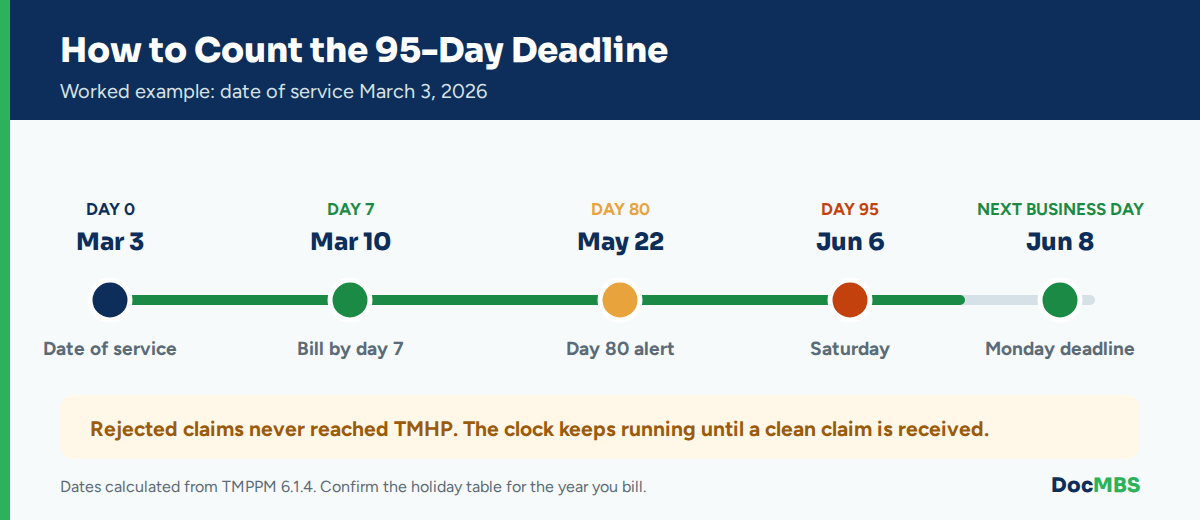
The Texas Medicaid timely filing count starts the day after the date of service. Every calendar day counts, including weekends. There is one helpful rule: if the 95th day (or the 120th day for an appeal) falls on a weekend or a holiday, the deadline moves to the next business day. The holiday list is in the current TMPPM, Section 6.1.4.
Watch Out: A clearinghouse acceptance is not a TMHP acceptance. If the claim is rejected before it reaches TMHP, the Texas Medicaid timely filing clock keeps running. Check your TMHP acceptance report, not just the clearinghouse report.
Worked Example 1: Office Visit
- Date of service: Tuesday, March 3, 2026
- Day 95: Saturday, June 6, 2026
- Actual deadline: Monday, June 8, 2026 (weekend rule)
To be safe, we treat June 5 as the real Texas Medicaid timely filing deadline for this visit. Nobody should plan to file on the weekend rule.
Worked Example 2: Other Insurance Paid First
- Date of service: May 4, 2026
- Primary insurer’s EOB (disposition) date: July 10, 2026
- Texas Medicaid deadline: 95 days from July 10 = Tuesday, October 13, 2026
The clock starts on the EOB date, not the date of service, so keep every EOB with its date. That EOB is your proof if TMHP questions the filing date.
Worked Example 3: Retroactive Eligibility
- Date of service: January 15, 2026
- Eligibility added to the TMHP file: May 20, 2026
- 95 days from May 20: Sunday, August 23, 2026, so the deadline moves to Monday, August 24, 2026
- 365 days from the date of service: January 15, 2027
- Real deadline: the earlier of the two, August 24, 2026
Dates calculated from the TMPPM rules above. Always confirm the holiday table for the year you are billing.
Texas Medicaid Timely Filing Rules for Special Situations
The Texas Medicaid timely filing rule has several variations. Each one changes when the clock starts, but none of them gets around the 365-day federal limit.
When the Patient Has Other Insurance First
Medicaid is the payer of last resort. Bill the other insurance (third party resource, or TPR) first. You then have 95 days from the other insurer’s disposition to file with TMHP, with the EOB attached or its data on the electronic claim. If the other insurer never answers, TMPPM lets you bill TMHP after 110 days have passed since you billed that insurer. Keep proof of the date you sent the claim.
Medicare Crossovers
For dual-eligible patients, file with Medicare first. Most Medicare-paid claims cross over to TMHP automatically. TMPPM 6.1.4.6 says to allow TMHP 45 days to receive a crossover. If it hasn’t arrived, file the Medicaid claim yourself, because the Texas Medicaid timely filing clock is already running. TMHP must receive it within 95 days of Medicare’s disposition.
Retroactive Eligibility
When a patient becomes eligible after the visit, you have 95 days from the date eligibility was added to the TMHP eligibility file, but the claim must also be filed within 365 days of the date of service. TMPPM is clear that retroactive eligibility is not an exception to the federal deadline. Check pending Medicaid patients every week so you see eligibility as soon as it posts.
Newly Enrolled Providers
Claims from a provider who isn’t enrolled yet are rejected. Once enrollment is complete, you have 95 days from that date to file, and still only 365 days from the date of service. Long enrollments can eat most of that year. See our Texas provider credentialing guide to keep enrollment on schedule.
Out-of-State Providers
Providers outside Texas who treat Texas Medicaid clients have 365 days from the date of service to file with TMHP. They still must be enrolled with Texas Medicaid before claims can be paid.
Losing Texas Medicaid claims to the 95-day deadline?
Rejected claims that nobody re-sent, missing EOBs and STAR plan mix-ups turn into write-offs fast. Our denial management services track every Texas Medicaid claim against its deadline and appeal what can still be saved.
Texas Medicaid Timely Filing for Appeals and Corrected Claims: The 120-Day Rule
Once TMHP processes a claim, a different clock applies. Appeals of denied claims and adjustment requests on paid claims must reach TMHP within 120 days of the disposition date on the Remittance and Status (R&S) report where the claim appears (TMPPM 6.1.4.4). The weekend and holiday rule applies here too.
- Corrected claims with new details: if you add new detail lines or change details, such as the quantity billed, those added details must meet the original 95-day Texas Medicaid timely filing deadline.
- New-day electronic resubmissions: TMPPM 6.1.4.5 allows an electronic claim to be resubmitted after 95 days as a new-day claim only if these four fields are unchanged: the NPIs, the client Medicaid number, the dates of service and the total billed amount. Change any of them and the claim is judged against the original deadline.
- Exceptions to the 95-day rule: requests for an exception don’t go to TMHP. They go to HHSC Claims Administrator Operations Management (TMPPM 6.1.4.3), with proof that the delay was outside your control.
Pro Tip: Save every R&S report as a PDF with the date in the file name. When a TMHP timely filing denial comes back, the R&S report and your clearinghouse acceptance report are the two documents that win the appeal.
STAR Plans and Texas Medicaid Timely Filing: Whose Deadline Applies?
Most Texas Medicaid clients are in managed care: STAR, STAR+PLUS, STAR Kids, STAR Health or CHIP. Their claims go to the managed care organization (MCO), not TMHP. Only carved-out services go to TMHP (TMPPM 6.1.1). Each MCO sets its own filing and appeal limits in its provider manual, so the Texas Medicaid timely filing rules above apply only to fee-for-service and carved-out claims.
| Plan | First claim | Corrected claim / appeal | Source |
|---|---|---|---|
| TMHP fee-for-service | 95 days from DOS | 120 days from R&S date | TMPPM Section 6 |
| BCBS Texas Medicaid / CHIP | 95 days from DOS | Appeals: 120 days from receipt of the remittance | BCBSTX Medicaid claims page |
| Superior HealthPlan | 95 days from DOS | 120 days from the EOP | Superior Quick Reference Guide |
| Other STAR MCOs | Check each plan’s current provider manual before you bill | Plan provider manual | |
Plan rules change. Confirm the current limits in each MCO’s provider manual.
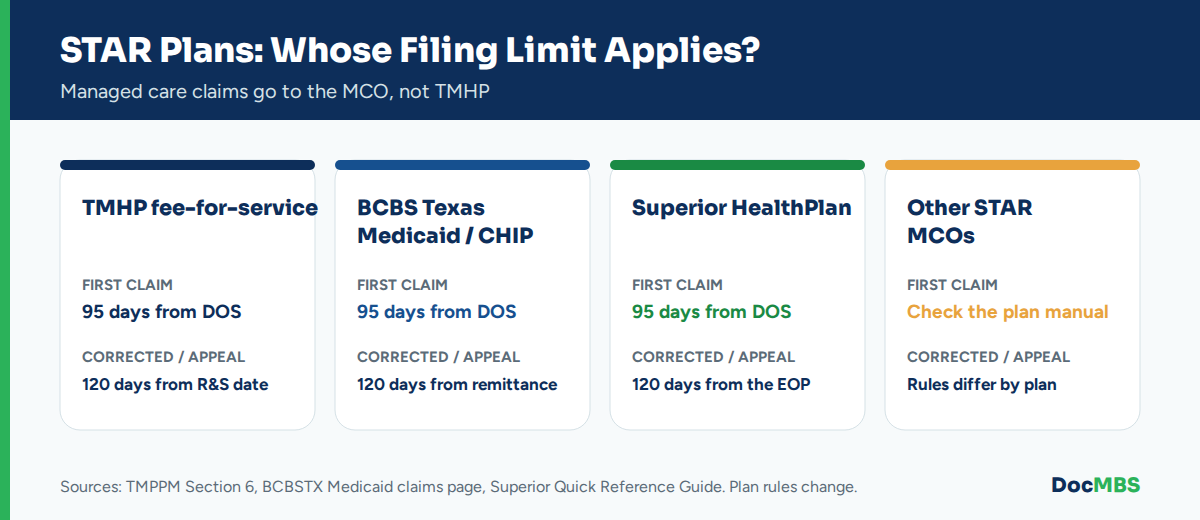
See our full BCBS Texas timely filing limit guide for every BCBS plan line. If your practice bills several STAR plans, our Austin medical billing team sets up each plan’s deadlines separately, so no claim is judged by the wrong rule.
Watch Out: Sending a STAR plan claim to TMHP doesn’t stop the MCO’s clock. When TMHP rejects it, the time is already gone. Check the member’s plan on the date of service before every visit.
How to Never Miss the Texas Medicaid Timely Filing Deadline: 7 Steps
- Verify eligibility and the plan at check-in. Confirm whether the client is fee-for-service or in a STAR plan, and which MCO, on the date of service.
- Bill within 7 to 14 days of the date of service. A short billing lag leaves time to fix rejections before day 95.
- Track every claim with a “days left” column. Your A/R report should show days remaining until the Texas Medicaid timely filing deadline, not just claim age.
- Keep proof. Save TMHP acceptance reports, R&S reports and other-insurance EOBs with their dates.
- Fix rejections the same week. A rejected claim never reached TMHP, so the Texas Medicaid timely filing clock is still running.
- Set alerts at 30, 60 and 80 days. At day 80, anything unpaid gets a status check and, if needed, a resubmission.
- Appeal within 120 days with proof. Attach the R&S report, acceptance report or EOB that shows you filed on time.
Common Texas Medicaid Timely Filing Mistakes and Denials (and How to Fix Them)
TMHP R&S reports use TMHP’s own EOB codes. On 835 electronic remittances, the matching CARC codes below are the ones you will usually see.
| Problem | Code you may see | How to fix it |
|---|---|---|
| Claim received after 95 days | CO-29 (time limit for filing has expired) | Appeal within 120 days only if you have proof of timely filing or a valid exception |
| Claim rejected for missing or invalid data | CO-16 (missing information) | Correct and resend at once; the clock never stopped |
| Other insurance on file, not billed first | CO-22 (covered by another payer) | Bill the other insurer, then file within 95 days of its EOB |
| Primary payment data missing | CO-23 (prior payer adjudication) | Add the primary EOB amounts and dates |
| Client not found or not eligible | CO-31 (patient not identified) | Check the Medicaid number and eligibility; track retro eligibility |
| Resubmitted after 95 days with changed fields | Timely filing denial | Keep NPIs, Medicaid number, DOS and billed total the same, or appeal instead |
| STAR plan claim sent to TMHP | Rejection | Send to the MCO right away and check its filing limit |
For a full prevention plan, read our guide on how to reduce claim denials.
Specialty Note: Behavioral Health, Home Health and FQHCs
For practices with a heavy Medicaid payer mix, Texas Medicaid timely filing is not a back-office detail. It decides cash flow.
- Behavioral health: many services are billed with Medicaid H-codes and need authorizations. A claim held for a missing authorization still ages toward day 95. See our guide to behavioral health H codes.
- Home health: claims often wait on signed orders. Track unsigned orders against the deadline, not just against your internal billing calendar.
- FQHCs: Medicaid managed care payments, PPS and wraparound claims each have their own timing. Our FQHC PPS rate guide explains the payment side.
Key Takeaways
- The Texas Medicaid timely filing limit is 95 days from the date of service for in-state providers and 365 days for out-of-state providers.
- Other insurance, Medicare crossovers, retro eligibility and new enrollment each restart a 95-day clock, but never past 365 days from the DOS.
- Appeals must reach TMHP within 120 days of the R&S disposition date.
- Deadlines that fall on a weekend or holiday move to the next business day.
- STAR, STAR+PLUS and STAR Kids claims follow each MCO’s filing rules, not TMHP’s.
- Rejected claims never reached TMHP, so the clock keeps running until you fix them.
FAQs
What is the timely filing limit for Texas Medicaid?
For in-state providers, TMHP must receive the claim within 95 days of each date of service. Inpatient hospital claims have 95 days from the discharge date or last date of service. Out-of-state providers have 365 days. These Texas Medicaid timely filing rules are in TMPPM Volume 1, Section 6, and apply to fee-for-service claims sent to TMHP.
How many days do I have to file a Texas Medicaid claim?
You have 95 days from the date of service in most cases. The clock can start later when other insurance or Medicare pays first, when eligibility is added retroactively, or when a provider’s enrollment is completed. In every case, the claim must still be filed within 365 days of the date of service.
What is the TMHP appeal deadline?
TMHP must receive an appeal or adjustment request within 120 days of the disposition date on the Remittance and Status (R&S) report where the claim appears. If day 120 falls on a weekend or holiday, the deadline moves to the next business day. Requests for an exception to the 95-day rule go to HHSC Claims Administrator Operations Management.
What if the patient has other insurance first?
Bill the other insurance first. You then have 95 days from the date of its disposition (the EOB date) to file with TMHP. If the other insurer doesn’t respond, TMPPM allows you to bill TMHP after 110 days have passed. Keep proof of the date you billed the other insurer.
How long do I have after retroactive eligibility?
You have 95 days from the date the client’s eligibility was added to the TMHP eligibility file. The claim must also be filed within 365 days of the date of service. Retroactive eligibility does not extend the federal 12-month limit, so long eligibility delays can still cost you the claim.
What happens if the deadline falls on a weekend?
If day 95 or day 120 falls on a weekend or a holiday listed in the TMPPM, the deadline moves to the next business day. For example, a March 3, 2026 date of service reaches day 95 on Saturday, June 6, so the deadline becomes Monday, June 8, 2026. Don’t plan around this; file early.
Does the 95-day rule apply to STAR managed care plans?
Not automatically. STAR, STAR+PLUS, STAR Kids and CHIP claims go to the member’s MCO, and each MCO sets its own limits. Many use 95 days from the date of service, such as BCBS Texas Medicaid and Superior HealthPlan, but always check the plan’s current provider manual.
Protect Every Claim From the 95-Day Clock
Texas Medicaid timely filing comes down to three numbers: 95 days to file, 120 days to appeal, and 365 days as the hard federal limit. Know which clock applies, keep proof of every filing, and fix rejections fast. If deadlines are slipping, our denial management services track every Texas Medicaid and STAR plan claim against its limit. Book a free billing review.
This article is for education only. Filing rules change. Confirm current deadlines in the TMPPM, with TMHP or with the member’s health plan before you bill.
Sources
- TMHP: Texas Medicaid Provider Procedures Manual, Vol. 1, Section 6 Claims Filing and Section 7 Appeals
- eCFR: 42 CFR 447.45, Timely claims payment
- BCBSTX: Medicaid and CHIP Claims
- Superior HealthPlan: Provider Resources and Quick Reference Guide
Last updated: October 2026.
Need help with medical billing? End-to-end medical billing for US practices: charge entry, claim submission, payment posting, denial follow-up and reporting.