In this article
- What Is a PDPM HIPPS Code?
- PDPM HIPPS Code Structure: The 5 Characters
- Nursing Group to HIPPS Letter Table
- The Assessment Indicator: 0, 1 and 6 Explained
- How to Decode a PDPM HIPPS Code: 4 Steps
- From PDPM HIPPS Code to Daily Rate
- How to Check the HIPPS Code Before You Bill: 6 Steps
- Common PDPM HIPPS Code Mistakes and Denials
- Specialty Note: HIPPS, PDPM Components and Consolidated Billing
- Key Takeaways
- FAQs
- Bill Every PDPM HIPPS Code With Confidence
- Sources
A PDPM HIPPS code is the 5-character code that tells Medicare how much to pay for every day of a skilled nursing facility (SNF) Part A stay. One wrong character changes the daily rate. A HIPPS code that doesn’t match the accepted MDS can get the whole claim returned. On the SNF claims we review, most HIPPS problems aren’t coding problems at all. They’re matching problems between the MDS, the claim and the billing calendar.
This guide shows you how to read all 5 characters, how to decode any code back to its groups, how the code drives the per diem, and how to check it before you bill.
Quick Answer
A PDPM HIPPS code has 5 characters: PT/OT group, SLP group, nursing group, NTA group and the assessment indicator (0 = IPA, 1 = 5-day, 6 = OBRA). The default code is ZZZZZ. The code on the claim must match the accepted MDS, and it is billed on revenue code 0022.
Table of Contents
- What Is a PDPM HIPPS Code?
- PDPM HIPPS Code Structure: The 5 Characters
- Nursing Group to HIPPS Letter Table
- The Assessment Indicator: 0, 1 and 6 Explained
- How to Decode a PDPM HIPPS Code: 4 Steps
- From PDPM HIPPS Code to Daily Rate
- How to Check the HIPPS Code Before You Bill: 6 Steps
- Common PDPM HIPPS Code Mistakes and Denials
- Specialty Note: HIPPS, PDPM Components and Consolidated Billing
- Key Takeaways
- FAQs
- Sources
What Is a PDPM HIPPS Code?
HIPPS stands for Health Insurance Prospective Payment System. HIPPS codes are used by several Medicare payment systems (SNF, home health, inpatient rehab) to tell the payer which payment group a patient falls into.
For SNFs, the Patient Driven Payment Model (PDPM) replaced RUG-IV on October 1, 2019. Under PDPM, the MDS assessment sorts each resident into a group for five case-mix components. The MDS software turns those groups into the HIPPS code. You then report that code on the UB-04 with revenue code 0022.
Three things to remember about the PDPM HIPPS code:
- It comes from the MDS. You don’t build it from scratch in billing.
- It must match the MDS that was submitted and accepted in the CMS system.
- It sets the case-mix part of the daily rate for every day it covers.
For the claim line itself (units, $0 charges, occurrence code 50 and the ARD), see our revenue code 0022 guide. This article focuses on reading and checking the code.
PDPM HIPPS Code Structure: The 5 Characters
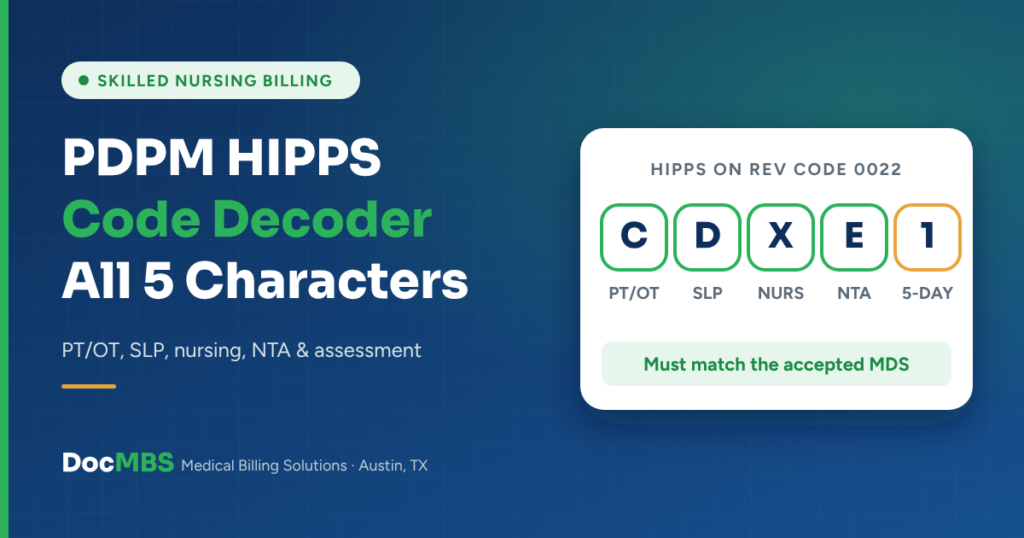
Noridian’s guidance “HIPPS Coding for PDPM” sets out the structure. Each of the first four characters is a letter that stands for one payment group. The fifth character is a number that tells Medicare which assessment produced the code.
| Position | Component | Values | Source group |
|---|---|---|---|
| 1 | PT/OT payment group | A–P | PT/OT groups TA–TP |
| 2 | SLP payment group | A–L | SLP groups SA–SL |
| 3 | Nursing payment group | A–Y | 25 nursing groups (ES3 to PA1) |
| 4 | NTA payment group | A–F | NTA groups NA–NF |
| 5 | Assessment indicator | 0, 1 or 6 | 0 = IPA, 1 = PPS 5-day, 6 = OBRA |
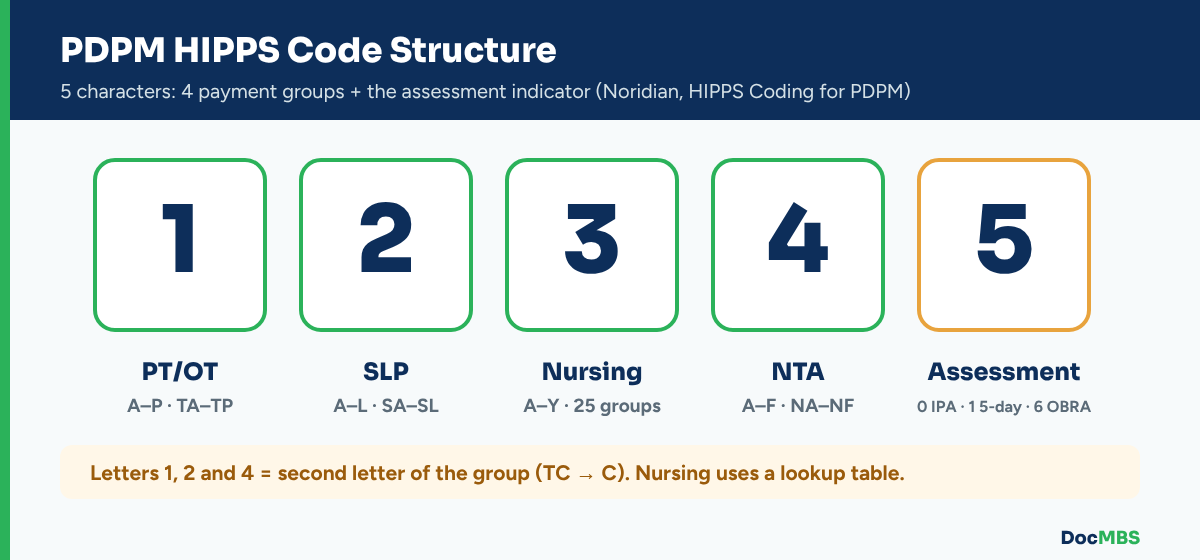
The letter is simply the second letter of the group. PT/OT group TC becomes “C”, SLP group SD becomes “D”, and NTA group NE becomes “E”. Nursing is the only component that needs a lookup table, because its group names are 3 or 4 characters long.
Pro Tip: PT and OT share one HIPPS character because they use the same group, but they are paid with separate case-mix indexes and separate base rates. One letter, two payments.
Nursing Group to HIPPS Letter Table
The third character of a PDPM HIPPS code is the nursing group. There are 25 nursing groups, so the letters run from A to Y. Use this table, from Noridian, to convert a nursing group to its letter and back.
| Nursing group | HIPPS letter | Nursing group | HIPPS letter |
|---|---|---|---|
| ES3 | A | CBC2 | N |
| ES2 | B | CA2 | O |
| ES1 | C | CBC1 | P |
| HDE2 | D | CA1 | Q |
| HDE1 | E | BAB2 | R |
| HBC2 | F | BAB1 | S |
| HBC1 | G | PDE2 | T |
| LDE2 | H | PDE1 | U |
| LDE1 | I | PBC2 | V |
| LBC2 | J | PA2 | W |
| LBC1 | K | PBC1 | X |
| CDE2 | L | PA1 | Y |
| CDE1 | M |
Watch Out: Nursing letters are not alphabetical by group name. CA2 is “O” and CBC1 is “P”, but CA1 comes after them as “Q”. Always use the table; don’t guess from the group name.
The Assessment Indicator: 0, 1 and 6 Explained
The fifth character tells Medicare which assessment created the PDPM HIPPS code:
- 1 = PPS 5-day scheduled assessment. The first Medicare assessment of the stay. It sets the HIPPS code from day 1.
- 0 = Interim Payment Assessment (IPA). An optional assessment when the resident’s condition changes. It changes the HIPPS code from the IPA’s ARD forward. [VERIFY: IPA payment starts on the ARD and does not reset the variable per diem — CMS PDPM FAQ]
- 6 = OBRA assessment. Used in specific cases when an OBRA assessment sets payment.
The default PDPM HIPPS code: ZZZZZ
Noridian states that the PDPM default code is ZZZZZ, which replaced the RUG-IV default AAA00. Providers may bill the default rate when an MDS assessment is late. The default pays a low rate, so it should only show up when the rules require it. [VERIFY: which days of a late assessment are billed at the default rate — RAI Manual Ch. 2 / your MAC]
HIPPS/MDS mismatches holding up your Part A claims?
A wrong character, a missing ARD or a late MDS can hold up a whole month of Part A days. Our skilled nursing facility billing services match every HIPPS code to the accepted MDS before the claim drops.
How to Decode a PDPM HIPPS Code: 4 Steps
- Split the code into 5 characters. Write them in a row: 1, 2, 3, 4, 5.
- Add the group prefix to characters 1, 2 and 4. Character 1 gets “T” (PT/OT), character 2 gets “S” (SLP), character 4 gets “N” (NTA).
- Look up character 3 in the nursing table above.
- Read character 5 as the assessment type: 0 IPA, 1 5-day, 6 OBRA.
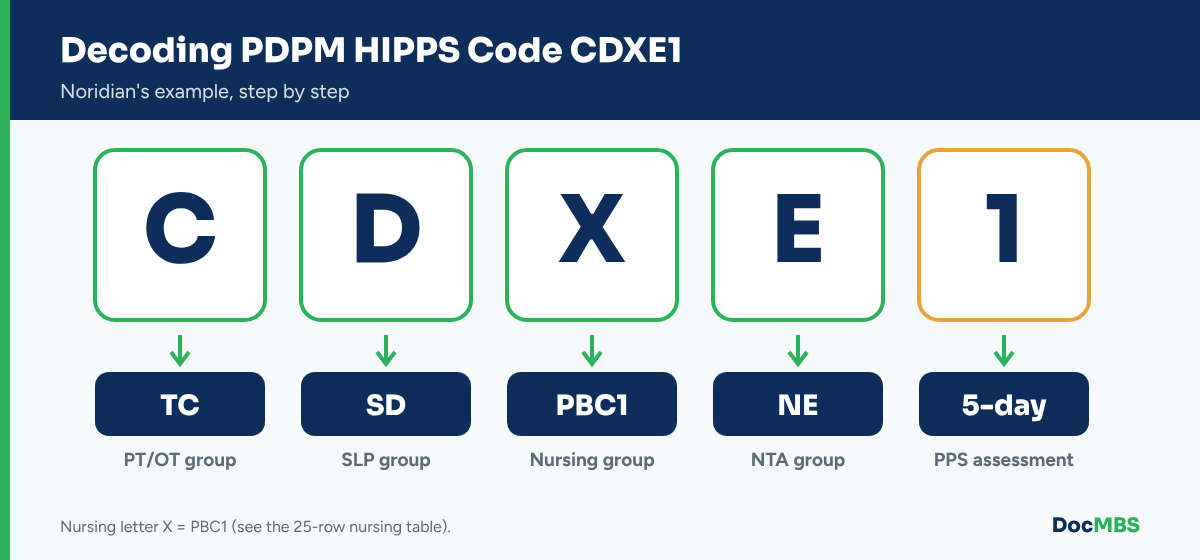
Worked Example 1: Decode CDXE1
Noridian uses the PDPM HIPPS code CDXE1 as its example. Here’s how it decodes:
| Character | Value | Component | Decoded group |
|---|---|---|---|
| 1 | C | PT/OT | TC |
| 2 | D | SLP | SD |
| 3 | X | Nursing | PBC1 |
| 4 | E | NTA | NE |
| 5 | 1 | Assessment | PPS 5-day assessment |
So CDXE1 means: PT/OT group TC, SLP group SD, nursing group PBC1, NTA group NE, from a 5-day assessment. If your MDS validation report shows these groups, the claim’s HIPPS code should read exactly CDXE1.
From PDPM HIPPS Code to Daily Rate
Each letter in a PDPM HIPPS code points to a case-mix index (CMI). Medicare multiplies each CMI by that component’s base rate, adds the non-case-mix rate, adjusts for wages, and then applies the variable per diem (VPD) schedule.
Worked Example 2: CMS’s FY 2027 example, HIPPS code NHNC1
This example comes straight from the FY 2027 SNF PPS final rule (CMS-1843-F), Tables 8–10. It’s an urban SNF in Frederick, MD (CBSA 23224), with a wage index of 0.9343. The code NHNC1 decodes to PT/OT TN, SLP SH, nursing CBC2 (letter N), NTA NC, 5-day assessment.
| Component | HIPPS letter | FY 2027 urban base | CMI | Days 1–3 amount |
|---|---|---|---|---|
| PT | N | $77.46 | 1.40 | $108.44 |
| OT | N | $72.10 | 1.42 | $102.38 |
| SLP | H | $28.93 | 2.70 | $78.11 |
| Nursing | N (CBC2) | $135.02 | 1.47 | $198.48 |
| NTA | C | $101.87 | 1.74 × 3.0 VPD | $531.75 |
| Non-case-mix | — | $120.91 | — | $120.91 |
| Case-mix adjusted per diem, days 1–3 | $1,140.07 | |||
Wage index step: 72.0% labor share × $1,140.07 = $820.85, × 0.9343 = $766.92. Add the non-labor $319.22 and the days 1–3 rate is $1,086.14.
Variable per diem: CMS’s table shows the rate dropping as the stay goes on:
- Days 1–3: $1,086.14 (NTA at 3.0)
- Days 4–20: $748.41 (NTA back to 1.0)
- Days 21–27: $744.39 (PT/OT at 0.98)
- Days 28–30: $740.38 (PT/OT at 0.96)
CMS lists the 30-day total as $23,413.26 (adding the rounded daily rates gives $23,414.26; the $1 gap is in CMS’s table). Same HIPPS code, four different daily rates. That’s why the HIPPS code and the day count on each 0022 line both matter. See our SNF Medicare daily rate guide for the full rate tables, and SNF PDPM urban vs rural rates if your facility is rural.
How to Check the HIPPS Code Before You Bill: 6 Steps
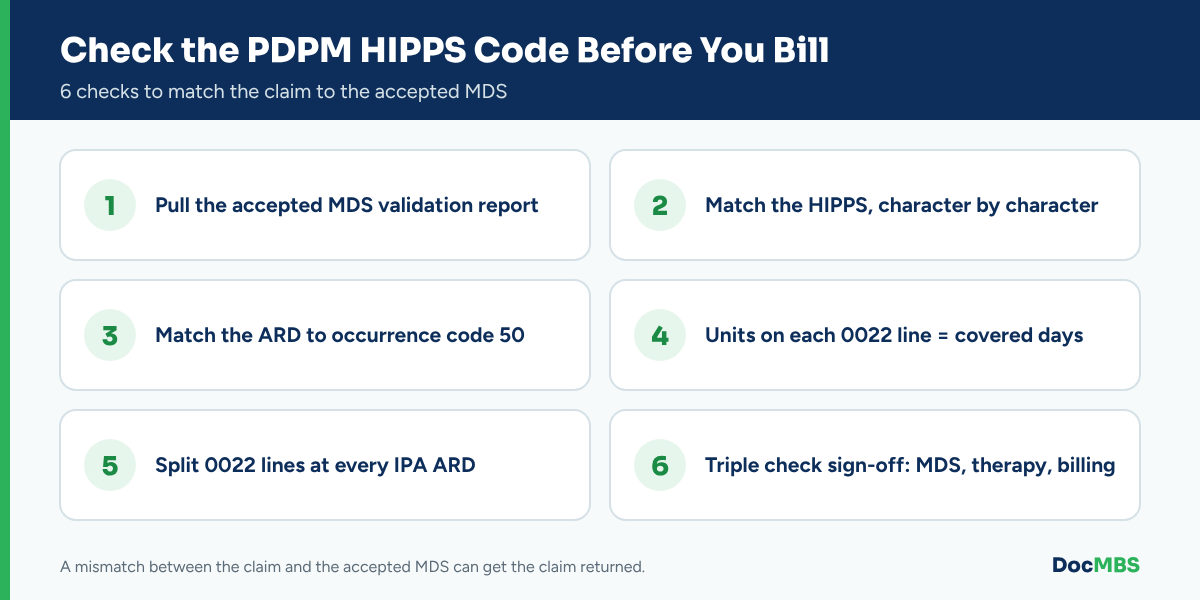
- Pull the accepted MDS validation report for every assessment that covers the billing period. Use the final validation report, not the draft in your MDS software.
- Match the PDPM HIPPS code on the claim to the HIPPS code on the validation report, character by character.
- Match the ARD to the occurrence code 50 date on each revenue code 0022 line.
- Check covered days on each 0022 line. Units must equal the days paid at that HIPPS code.
- Check IPA dates. If an IPA was done, the new HIPPS code starts on its ARD. Split the 0022 lines at that date.
- Finish with the triple check sign-off. MDS coordinator, therapy and billing confirm the codes, dates and days before the claim drops.
Common PDPM HIPPS Code Mistakes and Denials
These are the PDPM HIPPS code errors we see most on SNF Part A claims. For a wider plan, see how to reduce claim denials.
| Mistake | What you’ll see | How to fix it |
|---|---|---|
| HIPPS on the claim doesn’t match the accepted MDS | RTP or CO-16 [VERIFY: how your MAC handles a mismatch] | Copy the HIPPS from the final validation report and resubmit. |
| Missing occurrence code 50 or ARD on a 0022 line | RTP | Add occurrence code 50 with the ARD for each assessment. |
| Late MDS billed at the full HIPPS code instead of the default | Overpayment, later recouped (CO-50 possible) [VERIFY: RAI Manual Ch. 2] | Bill ZZZZZ for the days the rules require; bill the HIPPS only from the allowed date. |
| ZZZZZ billed when the MDS was on time | Underpayment (no denial) | Adjust the claim to the correct PDPM HIPPS code. |
| Units don’t equal covered days | RTP | Recount days per HIPPS line and match the total to the covered days on the claim. |
| Wrong assessment indicator (e.g. 1 instead of 0 for an IPA) | RTP or mismatch | Check the assessment type on the validation report. |
Specialty Note: HIPPS, PDPM Components and Consolidated Billing
The NTA character of the PDPM HIPPS code covers non-therapy ancillaries such as drugs and supplies. Under SNF consolidated billing, the SNF must pay outside vendors for most of these services during a Part A stay, and that cost is meant to be covered by the NTA and other components. A high NTA letter (A or B) usually means a costly resident, so check that outside lab, pharmacy and supply claims aren’t being billed to Part B by mistake. Our SNF consolidated billing guide covers the exclusions.
The FY 2027 final rule made no substantive changes to the PDPM ICD-10 mappings, only non-substantive updates. So the way the MDS builds the code is the same as last year, but every letter now pays at the FY 2027 rates (a 2.4% update from October 1, 2026).
Key Takeaways
- A PDPM HIPPS code has 5 characters: PT/OT, SLP, nursing, NTA and the assessment indicator.
- Characters 1, 2 and 4 are the second letter of the group (TC = C); nursing needs the 25-row lookup table.
- Assessment indicator: 0 = IPA, 1 = 5-day, 6 = OBRA. The default code is ZZZZZ.
- The code on the claim must match the accepted MDS and is billed on revenue code 0022.
- One HIPPS code pays different daily rates across the stay because of the variable per diem.
FAQs
What is a PDPM HIPPS code?
A PDPM HIPPS code is the 5-character code a skilled nursing facility reports on Medicare Part A claims under the Patient Driven Payment Model. It shows the resident’s PT/OT, SLP, nursing and NTA payment groups plus the assessment type. The MDS creates it, and it sets the case-mix part of the daily rate.
What does each character in a HIPPS code mean?
Character 1 is the PT/OT group (A–P), character 2 the SLP group (A–L), character 3 the nursing group (A–Y), character 4 the NTA group (A–F), and character 5 the assessment indicator (0, 1 or 6). For example, CDXE1 means PT/OT TC, SLP SD, nursing PBC1, NTA NE, from a 5-day assessment.
What is the default HIPPS code under PDPM?
The PDPM default HIPPS code is ZZZZZ. It replaced the RUG-IV default AAA00 when PDPM started on October 1, 2019. Providers may bill the default rate when an MDS assessment is late, and it pays less than a normal PDPM HIPPS code.
What is the HIPPS assessment indicator 0 vs 1 vs 6?
The fifth character shows which assessment set the code. 1 is the PPS 5-day scheduled assessment, which sets payment from day 1. 0 is the Interim Payment Assessment (IPA), used when the resident’s condition changes. 6 is an OBRA assessment used for payment in specific cases.
How is the PDPM nursing group mapped to a letter?
Each of the 25 nursing groups has its own letter, from ES3 = A to PA1 = Y. The order follows CMS’s nursing group list, not the alphabet, so CA2 = O, CBC1 = P and CA1 = Q. Always use a lookup table, such as Noridian’s, rather than guessing.
What happens if the HIPPS code doesn’t match the MDS?
The HIPPS code on the claim must match the MDS that was submitted and accepted. A mismatch can get the claim returned to provider or paid incorrectly, depending on your MAC’s edits. Fix it by copying the HIPPS from the final MDS validation report and resubmitting.
How do you calculate the PDPM per diem from a HIPPS code?
Turn each letter into its case-mix index, multiply by that component’s base rate, and add the non-case-mix rate. Apply the wage index to the 72.0% labor share, then apply the variable per diem for the day of the stay. CMS’s FY 2027 example, NHNC1, pays $1,086.14 for days 1–3.
Bill Every PDPM HIPPS Code With Confidence
The PDPM HIPPS code is only 5 characters, but each one moves money. Decode it, match it to the accepted MDS, split your 0022 lines at every IPA, and keep ZZZZZ for the days the rules require. If HIPPS and MDS mismatches keep holding up your Part A claims, our skilled nursing facility billing services team runs the triple check with you every month. Book a free billing review.
This article is for education only. PDPM rules and rates change. Confirm current requirements with CMS, the RAI Manual and your Medicare Administrative Contractor before you bill.
Sources
- Noridian JE Part A: HIPPS Coding for PDPM
- Federal Register: FY 2027 SNF PPS Final Rule (CMS-1843-F), Tables 3–4 and 8–10
- CMS: CMS-1843-F regulation page
- CMS: Patient Driven Payment Model (PDPM)
- CMS: Transmittal R2366OTN, PDPM implementation
Last updated: October 2026.
Need help with skilled nursing facility billing? Medicare Part A and B, Medicaid and managed care billing for skilled nursing facilities, with PDPM, MDS and consolidated billing rules checked before claims go out.