In this article
- 2027 Home Health Rates at a Glance
- 2027 Home Health Per-Visit and LUPA Rates
- Why the 2027 Home Health Rate Moved Less Than 2.4%
- Proposed vs Final 2027 Home Health Rates
- How to Calculate a PDGM Payment With the 2027 Home Health Rates
- What the 2027 Home Health Rates Mean for Your Revenue
- Other 2027 Home Health Rule Changes
- Texas Note: Wage Index and Medicare Advantage Contracts
- Common Mistakes With the 2027 Home Health Rates
- Your January 1 Checklist
- Key Takeaways
- FAQs
- Get Ready for the 2027 Home Health Rates Now
- Sources
The 2027 home health rates are final, and they start on January 1, 2027. CMS says aggregate home health payments go up 2.4%. That headline doesn’t tell an agency what to load into its billing system, though. The real number for your claims is the 30-day base rate after the 3% temporary cut, plus the new per-visit and LUPA amounts and the recalibrated case-mix weights. On the home health claims we review, January underpayments almost always come from old rates or old weights still sitting in the system.
This guide gives you the official 2027 numbers, explains why the base rate moved the way it did, and shows the math to check your own PDGM payments.
Quick Answer
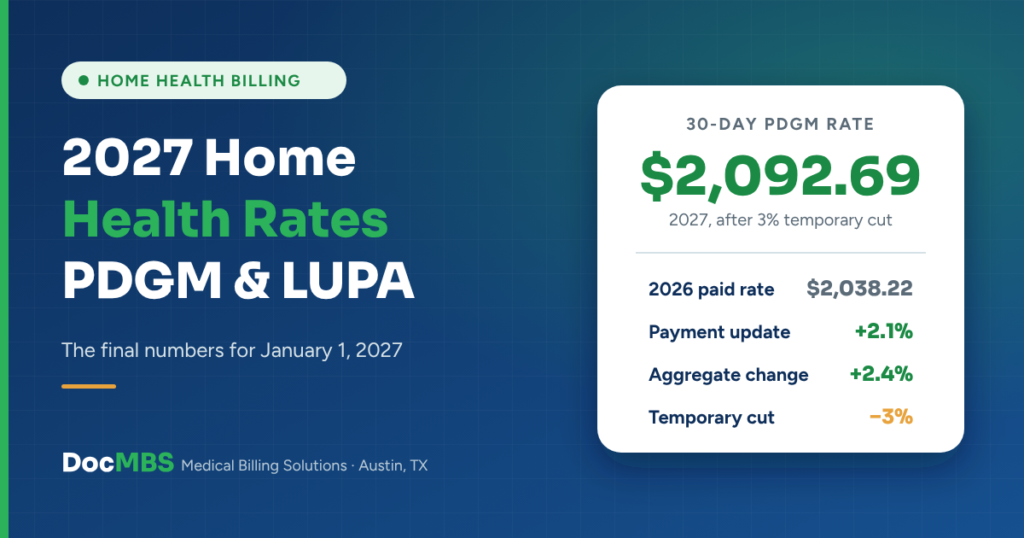
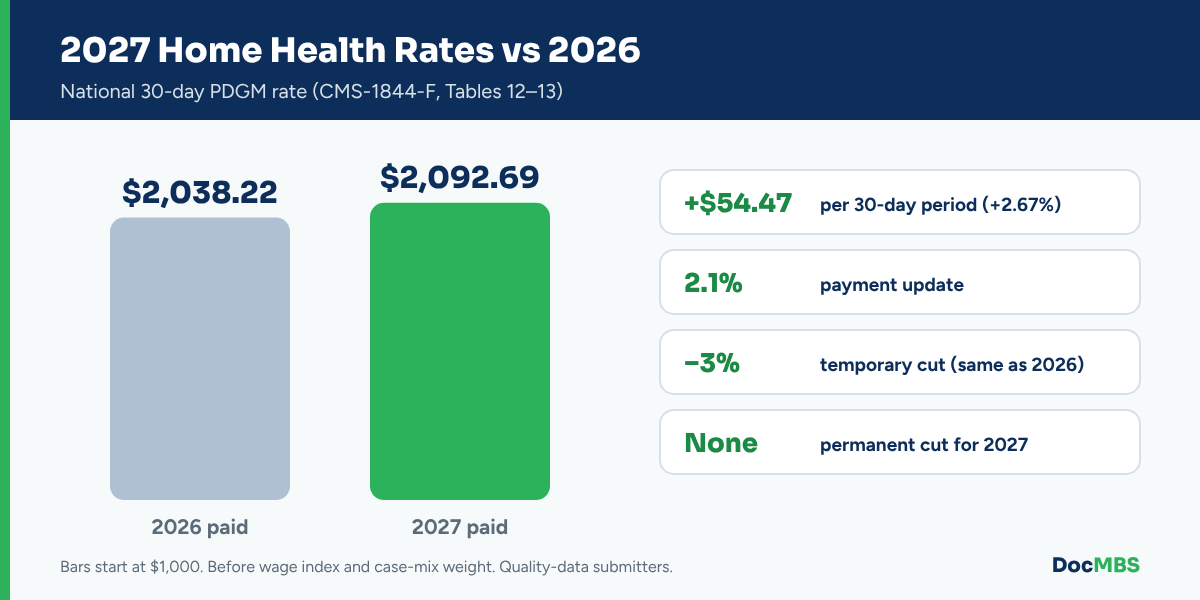
The 2027 national 30-day PDGM rate is $2,092.69 after a 3% temporary adjustment (up from $2,038.22 in 2026). Per-visit and LUPA rates rise about 2.1%. CMS estimates +2.4% in total payments, with no new permanent cut. The rates apply from January 1, 2027.
Table of Contents
- 2027 Home Health Rates at a Glance
- 2027 Home Health Per-Visit and LUPA Rates
- Why the 2027 Home Health Rate Moved Less Than 2.4%
- Proposed vs Final 2027 Home Health Rates
- How to Calculate a PDGM Payment With the 2027 Home Health Rates
- What the 2027 Home Health Rates Mean for Your Revenue
- Other 2027 Home Health Rule Changes
- Texas Note: Wage Index and Medicare Advantage Contracts
- Common Mistakes With the 2027 Home Health Rates
- Your January 1 Checklist
- Key Takeaways
- FAQs
- Sources
2027 Home Health Rates at a Glance
All figures below come from the CY 2027 Home Health Prospective Payment System final rule (CMS-1844-F), Tables 12–17 in the Federal Register document, and the CMS fact sheet released November 4, 2026.
| Item | 2026 | 2027 | Change |
|---|---|---|---|
| 30-day rate paid (with temporary adjustment) | $2,038.22 | $2,092.69 | +$54.47 (+2.67%) |
| 30-day rate before the temporary adjustment | $2,101.26 | $2,157.41 | +$56.15 |
| Temporary adjustment factor | 0.9700 (−3%) | 0.9700 (−3%) | Same size |
| Home health payment update | — | 2.1% | 3.1% market basket − 1.0 point productivity |
| Aggregate payment change (CMS estimate) | — | +2.4% (about $415 million) | 2.1% update + 0.3% from the outlier change |
| 30-day rate for agencies that don’t submit quality data | — | $2,051.70 | 0.1% update (2.1% − 2 points) |
| Permanent behavioral adjustment | — | None | — |
Watch Out: Compare like with like. CMS’s tables start from the 2026 rate without the temporary adjustment ($2,101.26). What agencies were actually paid in 2026 was $2,038.22. The 2027 paid rate of $2,092.69 is the number to load into your system.
2027 Home Health Per-Visit and LUPA Rates
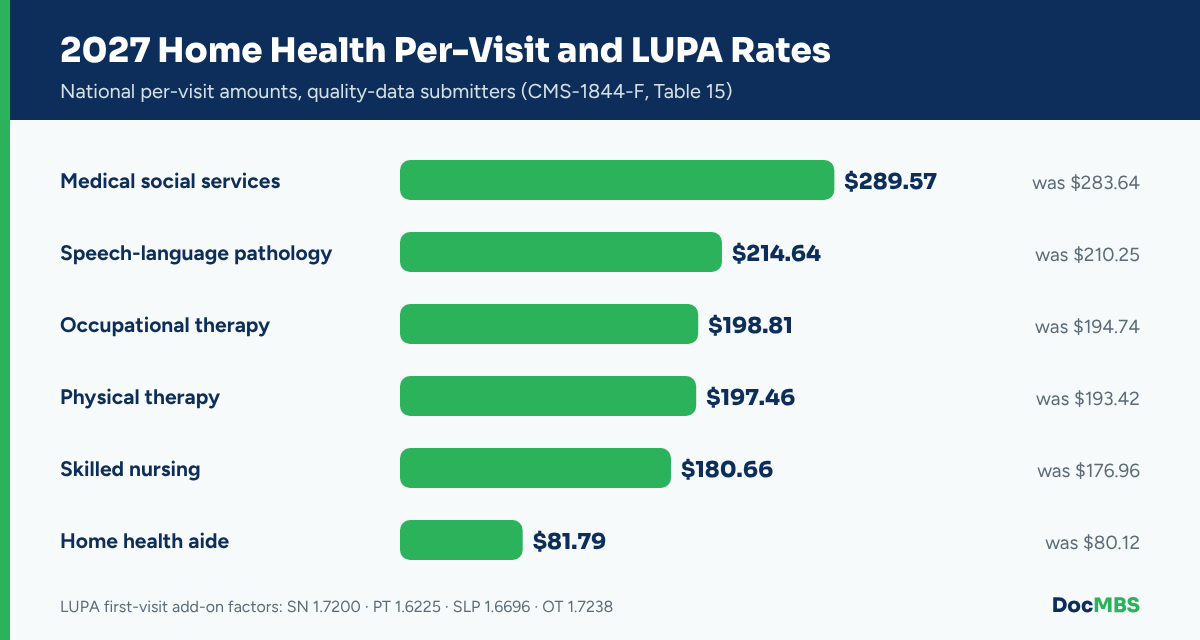
When a 30-day period has fewer visits than the LUPA threshold for its case-mix group, Medicare pays per visit instead of the full period rate. These are the national per-visit amounts for agencies that submit quality data (Table 15), before the wage index.
| Discipline | 2026 | 2027 | Change |
|---|---|---|---|
| Home health aide | $80.12 | $81.79 | +$1.67 |
| Medical social services | $283.64 | $289.57 | +$5.93 |
| Occupational therapy | $194.74 | $198.81 | +$4.07 |
| Physical therapy | $193.42 | $197.46 | +$4.04 |
| Skilled nursing | $176.96 | $180.66 | +$3.70 |
| Speech-language pathology | $210.25 | $214.64 | +$4.39 |
LUPA add-on factors (Table 17): skilled nursing 1.7200, physical therapy 1.6225, speech-language pathology 1.6696 and occupational therapy 1.7238. These raise the payment for the first visit of a LUPA period that is the only period, or the first in a sequence of adjacent periods.
LUPA thresholds: CMS recalibrated the thresholds with CY 2025 claims. In the final rule, thresholds go down by one visit for 10 case-mix groups. The full list is in Table 11 of the rule. Load the new thresholds with the new case-mix weights.
Why the 2027 Home Health Rate Moved Less Than 2.4%
The 2027 home health rates come from a few moving parts:
- 2.1% payment update: a 3.1% market basket minus a 1.0 percentage point productivity adjustment.
- Budget neutrality factors: 1.0047 for the case-mix recalibration and 1.0009 for the wage index (0.9999 on per-visit rates).
- 3% temporary adjustment: CMS kept the 0.9700 factor. The fact sheet says it continues to recoup overpayments from CYs 2020 through 2025, when CMS says agencies were paid more under PDGM than the budget-neutral amount.
- No permanent cut for 2027: CMS didn’t propose or finalize a new permanent adjustment and will keep studying CY 2026 claims.
The +2.4% aggregate figure includes the 0.3% effect of the new outlier fixed-dollar loss (FDL) ratio of 0.29%. That money only reaches agencies with outlier periods, which is why the base 30-day rate rises about 2.7% instead.
Proposed vs Final 2027 Home Health Rates
In the July 2026 proposed rule, CMS listed a 30-day rate of $2,092.27 [VERIFY: proposed CY 2027 30-day rate — CMS-1844-P, Federal Register July 2026]. The final 2027 home health rates came in slightly higher at $2,092.69. The size of the temporary adjustment (3%) and the decision not to apply a permanent cut stayed the same from proposed to final.
What does change between the two rules is the data. The final 2027 home health rates use updated case-mix weights, LUPA thresholds and wage index values. If your team built a 2027 budget from the proposed numbers, replace them with the final files before you set expected payments.
| Part of the rule | Proposed (July 2026) | Final (November 2026) |
|---|---|---|
| 30-day rate after the temporary adjustment | $2,092.27 [VERIFY] | $2,092.69 |
| Temporary adjustment | −3% | −3% |
| Permanent adjustment | None | None |
| Aggregate payment change | +2.4% | +2.4% |
How to Calculate a PDGM Payment With the 2027 Home Health Rates
- Find the case-mix weight for the period’s HIPPS code in the 2027 case-mix weight file.
- Multiply by the 2027 30-day rate ($2,092.69 for quality-data submitters).
- Split the result into the labor share (74.9%) and non-labor share (25.1%).
- Apply your CBSA wage index to the labor share only, then add the non-labor share back.
- Check the LUPA threshold for that case-mix group. If visits are below it, pay per visit instead.
- Check for outlier eligibility if the period’s estimated cost is well above the payment.
Worked Example 1: Full 30-Day Period (Sample Numbers)
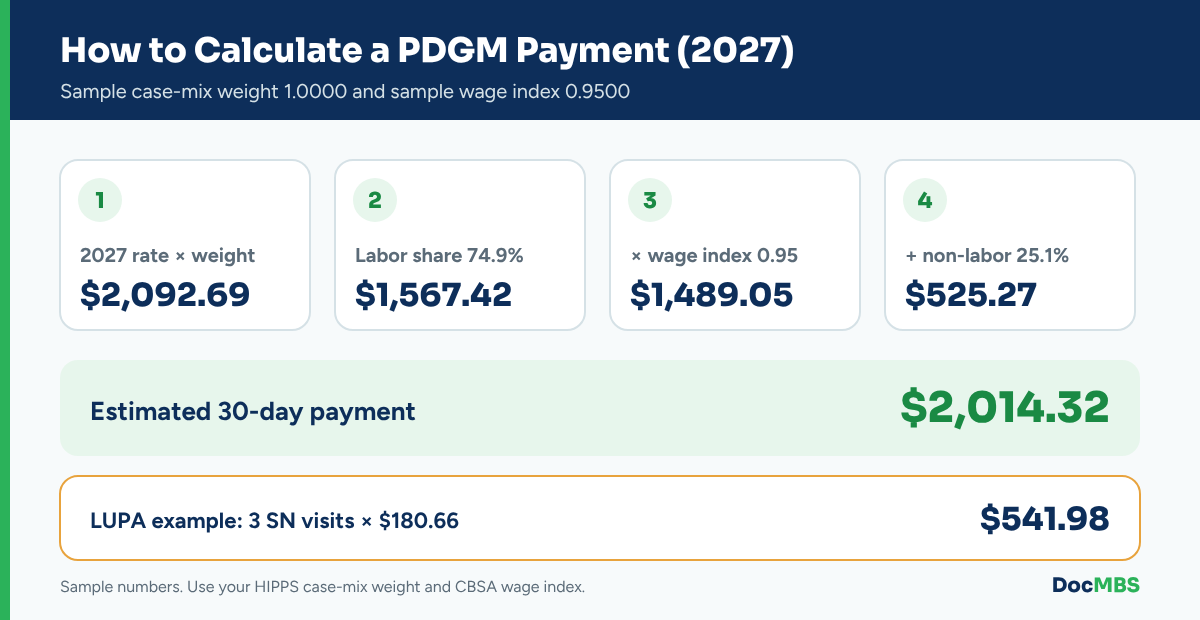
The case-mix weight and wage index below are samples. Use your real HIPPS weight and CBSA wage index.
| Step | Amount |
|---|---|
| 2027 30-day rate × sample case-mix weight 1.0000 | $2,092.69 |
| Labor share (74.9%) | $1,567.42 |
| × sample wage index 0.9500 | $1,489.05 |
| + non-labor share (25.1%) | $525.27 |
| Estimated 30-day payment | $2,014.32 |
Worked Example 2: LUPA Period
A period with 3 skilled nursing visits falls below its LUPA threshold. Before the wage index, that’s 3 × $180.66 = $541.98. If it were the only period, or the first in a sequence, the first visit would be multiplied by the SN add-on factor of 1.7200 (180.66 × 1.72 = $310.74 for that visit).
For 2027 home health rates in your own CBSA, use the CMS CY 2027 HH PPS rate and wage index files. [VERIFY: your CBSA’s CY 2027 home health wage index — CMS HH PPS wage index file]
What the 2027 Home Health Rates Mean for Your Revenue
A 2.7% higher base rate sounds small, but it adds up over a year. Here’s a simple way to estimate what the 2027 home health rates mean for your agency. Again, these are sample numbers, not a forecast.
| Sample agency | Using 2026 paid rate | Using 2027 paid rate |
|---|---|---|
| Base rate per 30-day period | $2,038.22 | $2,092.69 |
| × 100 full periods a month (sample weight 1.0000, before wage index) | $203,822.00 | $209,269.00 |
| Difference per month | $5,447.00 | |
| Difference over 12 months | $65,364.00 | |
That is money an agency loses if nobody notices a payer still paying the old rate. On the remits we review, missed rate updates often show up as small “write-offs” that nobody questions. Checking the first January payments against the 2027 home health rates catches them early.
Pro Tip: Build a short “expected payment” check in your billing system. If a paid 30-day claim is more than a few dollars off the 2027 home health rates calculation, flag it for review before posting the adjustment.
Not sure your 2027 PDGM rates are loaded right?
Our home health billing services load the 2027 rates, case-mix weights and LUPA thresholds, and check every 30-day period before it goes out.
Other 2027 Home Health Rule Changes
- Case-mix recalibration: all 432 PDGM payment groups get new case-mix weights, functional levels, comorbidity subgroups and LUPA thresholds, based on CY 2025 data.
- Wage index cap: a CBSA’s wage index can’t fall more than 5% below its prior-year value.
- Outlier: the FDL ratio is 0.29%, and outlier payments stay capped at 2.5% of total payments.
- Change in majority ownership: home health agencies, hospices and DMEPOS suppliers must re-enroll as new providers, with a survey or accreditation, after certain ownership changes. CHAP’s summary notes a 36-month window.
- Revocations: revocations can now take effect back to the date noncompliance began, and the grounds expand to cover owners and managing employees. [VERIFY: effective date of the enrollment provisions — Federal Register CMS-1844-F, Dates section] If your agency has had any ownership change, our provider credentialing services can check your Medicare enrollment.
- Home infusion pumps: from April 1, 2027, expanded DME infusion pump coverage applies to certain drugs given at least 12 times a year.
- Quality reporting: the Home Health Quality Reporting Program changes in the rule also take effect January 1, 2027. Agencies that don’t submit quality data get the 2-point lower update.
Texas Note: Wage Index and Medicare Advantage Contracts
The national 2027 home health rates are only the starting point for Texas agencies. Texas agencies are paid based on their CBSA wage index, which varies across Austin, Houston, Dallas–Fort Worth, San Antonio and rural Texas. [VERIFY: CY 2027 HH wage index for Austin-Round Rock and other Texas CBSAs — CMS wage index file]
Many Texas agencies also hold Medicare Advantage contracts that pay a percentage of the Medicare home health rate, or a per-visit rate. Check which year’s rates each contract uses, and when the plan updates. Our Austin medical billing team can compare your MA contracts with the 2027 rates.
Common Mistakes With the 2027 Home Health Rates
These are the problems we expect when the 2027 home health rates go live in January. Remark and reason codes vary by MAC, so check your own remits.
| Mistake | What you’ll see | How to fix it |
|---|---|---|
| Expected payments still based on 2026 rates or weights | Posting errors; real underpayments missed | Load the 2027 rate, case-mix weights and LUPA thresholds before January claims. |
| NOA not filed within 5 calendar days | Non-timely NOA payment reduction [VERIFY: CARC on your remit] | See our home health NOA guide. |
| Visits below the LUPA threshold | Paid per visit (expected) | Check the new 2027 thresholds; some groups went down by one visit. |
| HIPPS on the claim doesn’t match OASIS | RTP or CO-16 [VERIFY] | Confirm the OASIS was accepted and resubmit with the right HIPPS. |
| Ownership change not reported | Enrollment revocation; claims denied (e.g. CO-B7) [VERIFY] | Report ownership changes on time and re-enroll if required. |
| Claim filed more than 12 months after the period | CO-29 | See our Medicare timely filing limit guide. |
Your January 1 Checklist
- Load the 2027 home health rates: the $2,092.69 30-day rate and the new per-visit amounts.
- Load the new case-mix weights, LUPA thresholds and your CBSA wage index.
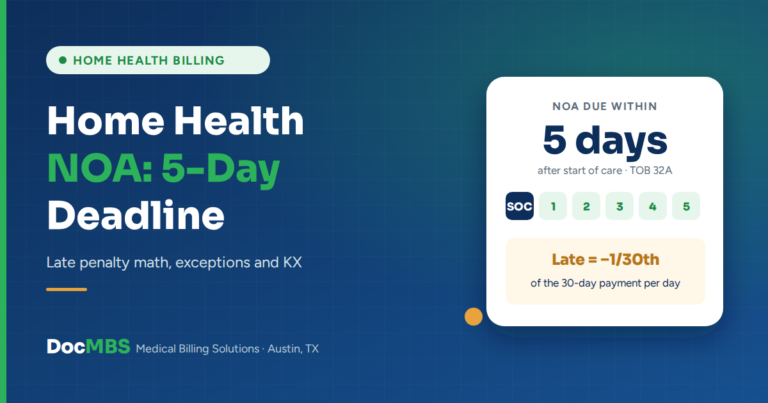
- Remind intake that the NOA is due within 5 calendar days of the start of care.
- Check that every OASIS is submitted and accepted before the claim drops.
- Review ownership records and enrollment for any change in majority ownership.
- Watch the first January remits for underpayments.
Physicians who certify home health care are paid under a separate fee schedule. For their 2027 rates, see our [INTERNAL LINK: 2027 Medicare conversion factor] guide.
Key Takeaways
- The 2027 national 30-day PDGM rate is $2,092.69, up from $2,038.22 in 2026.
- CMS kept the 3% temporary adjustment and added no permanent cut.
- Per-visit rates rise about 2.1%; skilled nursing is $180.66.
- The +2.4% aggregate includes a 0.3% outlier effect.
- New case-mix weights and LUPA thresholds start January 1, 2027.
- A change in majority ownership can now require re-enrollment as a new provider.
FAQs
What is the 2027 home health 30-day payment rate?
The CY 2027 national standardized 30-day period payment is $2,092.69 for agencies that submit quality data, after the 3% temporary adjustment (Table 13 of the final rule). Before that adjustment it is $2,157.41. Your actual payment depends on the case-mix weight and your CBSA wage index.
How much are home health payments increasing in 2027?
CMS estimates aggregate payments rise 2.4%, or about $415 million: a 2.1% payment update plus 0.3% from the new outlier threshold. The 30-day rate agencies are paid rises from $2,038.22 to $2,092.69, about 2.7%, because the 3% temporary adjustment stays the same size.
What are the 2027 LUPA per-visit rates?
For agencies that submit quality data, the 2027 national per-visit amounts are: home health aide $81.79, medical social services $289.57, occupational therapy $198.81, physical therapy $197.46, skilled nursing $180.66 and speech-language pathology $214.64. They are adjusted by your wage index.
Is there a PDGM cut in 2027?
There is no new permanent cut. CMS didn’t propose or finalize a permanent behavioral adjustment for 2027. It did keep a 3% temporary adjustment to recoup past overpayments, but the base rate still rises because the 2026 rate already had the same 3% adjustment.
What is the temporary adjustment in the 2027 home health rule?
It’s a one-year 3% reduction (factor 0.9700) to the 30-day rate. CMS says it continues recouping overpayments for CYs 2020 through 2025. CMS removes the prior year’s temporary factor before applying the new one.
Did LUPA thresholds change in 2027?
Yes. CMS recalibrated the LUPA thresholds with CY 2025 claims. In the final rule, thresholds go down by one visit for 10 case-mix groups. Check Table 11 of the final rule or the CMS case-mix weight file for each HIPPS code’s threshold.
How do I calculate a PDGM payment?
Multiply the 2027 30-day rate by the case-mix weight, split the result into the 74.9% labor share and 25.1% non-labor share, apply your wage index to the labor share, and add them back. With a sample weight of 1.0000 and wage index of 0.9500, the payment is $2,014.32.
Get Ready for the 2027 Home Health Rates Now
The 2027 home health rates bring a $2,092.69 base rate, higher per-visit amounts and new case-mix weights and LUPA thresholds, all starting January 1. Load them before your first January claims, and check every remit against them. Our home health billing team loads the 2027 rates and checks every PDGM payment for you. Book a free billing review.
This article is for education only. Confirm current rates and rules with CMS and your Medicare Administrative Contractor before you bill.
Sources
- Federal Register: CY 2027 Home Health PPS Final Rule (CMS-1844-F), document 2026-22750, Tables 12–17
- CMS: Home Health Prospective Payment System (rate files, case-mix weights, wage index)
- CMS newsroom: CY 2027 Home Health PPS Final Rule fact sheet (CMS-1844-F), November 2026
Last updated: November 2026.
Need help with medical billing? End-to-end medical billing for US practices: charge entry, claim submission, payment posting, denial follow-up and reporting.