In this article
- What Is the FQHC PPS Rate?
- FQHC PPS Rate 2026: The Official Numbers
- FQHC G-Codes G0466 to G0470 Explained
- How Medicare Calculates the FQHC PPS Rate on a Claim
- Worked Example: 4 FQHC Claims With Real Math
- Same-Day Visits: When You Can Bill Two Encounters
- How to Bill an FQHC PPS Claim: 7 Steps
- Common Mistakes and Denials (and How to Fix Them)
- FQHC PPS Rate for Behavioral Health Visits
- Texas Note: Texas Medicaid FQHC Billing Uses T1015
- Key Takeaways
- FAQs
- Get the Full FQHC PPS Rate on Every Visit
- Sources
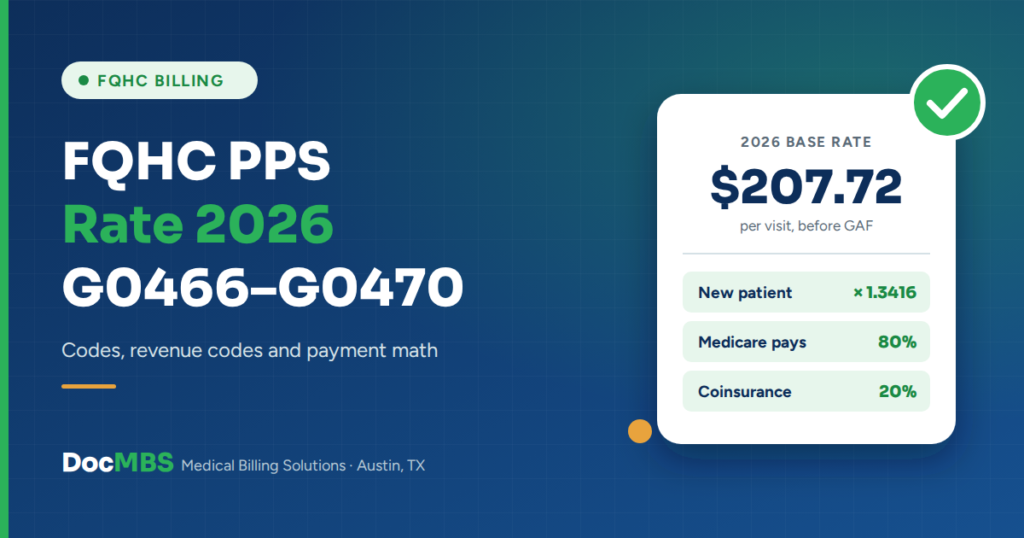
The FQHC PPS rate for 2026 is the amount Medicare pays a federally qualified health center for each qualifying visit, and small mistakes can cut that payment without a single denial. A wrong G-code, a missing qualifying service line, or a charge set below the FQHC PPS rate can each leave money on the table on every visit.
This guide gives you the official 2026 numbers from CMS, explains codes G0466 to G0470 in plain English, shows how Medicare calculates the payment, and walks through four real claims so you can check your own.
Quick Answer
The 2026 FQHC PPS base rate is $207.72 per visit (CMS MM14309), adjusted by each center’s geographic adjustment factor. New patients and visits with an IPPE or AWV get a 1.3416 adjustment. Medicare pays 80% of the lesser of your charge or the adjusted rate. You bill the visit with G-codes G0466–G0470.
Table of Contents
- What Is the FQHC PPS Rate?
- FQHC PPS Rate 2026: The Official Numbers
- FQHC G-Codes G0466 to G0470 Explained
- How Medicare Calculates the FQHC PPS Rate on a Claim
- Worked Example: 4 FQHC Claims With Real Math
- Same-Day Visits: When You Can Bill Two Encounters
- How to Bill an FQHC PPS Claim: 7 Steps
- Common Mistakes and Denials (and How to Fix Them)
- FQHC PPS Rate for Behavioral Health Visits
- Texas Note: Texas Medicaid FQHC Billing Uses T1015
- Key Takeaways
- FAQs
- Sources
What Is the FQHC PPS Rate?
The FQHC PPS rate is the per-visit payment Medicare uses for federally qualified health centers under the prospective payment system. Instead of paying each service separately, Medicare pays one rate per qualifying encounter. Four pieces decide the final amount:
- The national base rate. CMS sets one FQHC PPS rate each calendar year. For 2026 it is $207.72 (CMS MLN Matters MM14309).
- The geographic adjustment factor (GAF). CMS adjusts the base rate for each FQHC’s location, using the Physician Fee Schedule GPCIs.
- The 1.3416 adjustment. Medicare raises the rate by a factor of 1.3416 when the patient is new to the FQHC, or when the visit includes an initial preventive physical exam (IPPE) or annual wellness visit (AWV) (Medicare Claims Processing Manual, Chapter 9). Only one adjustment applies per day.
- The lesser-of rule. Medicare pays based on the lesser of your actual charge or the FQHC PPS rate. If your charge is lower than the rate, you get paid on your charge.
Medicare then pays 80% of that amount, and the patient owes 20% coinsurance. The Part B deductible does not apply to FQHC services (Claims Processing Manual, Chapter 9, Section 40.1).
FQHC PPS Rate 2026: The Official Numbers
| Item | 2026 amount | Source |
|---|---|---|
| FQHC PPS base rate | $207.72 per visit | CMS MM14309 (CR 14309), effective Jan 1, 2026 |
| 2025 base rate | $202.65 | CMS MM14309 |
| Increase | 2.5% (FQHC market basket) | CMS MM14309 |
| New patient / IPPE / AWV adjustment | × 1.3416 (one per day) | Claims Processing Manual, Ch. 9 |
| Geographic adjustment | Your FQHC’s GAF | CMS FQHC PPS page (GAF file) |
| FQHC IOP, 3 or fewer services per day | $319.38 | CMS MM14309 |
| FQHC IOP, 4 or more services per day | $418.45 | CMS MM14309 |
| Distant site telehealth | $97.53 per service | CMS FQHC/RHC News & Announcements |
| Medicare share / patient coinsurance | 80% / 20% | Claims Processing Manual, Ch. 9 |
| Part B deductible | Does not apply | Claims Processing Manual, Ch. 9, Sec. 40.1 |
Watch Out: $207.72 is the base rate before your GAF. Your real FQHC PPS rate depends on where your center is. Download the 2026 FQHC GAF file from the CMS FQHC PPS page and load your own number into your billing system.
What Is Not Paid at the FQHC PPS Rate?
Two common FQHC services are paid outside the PPS rate:
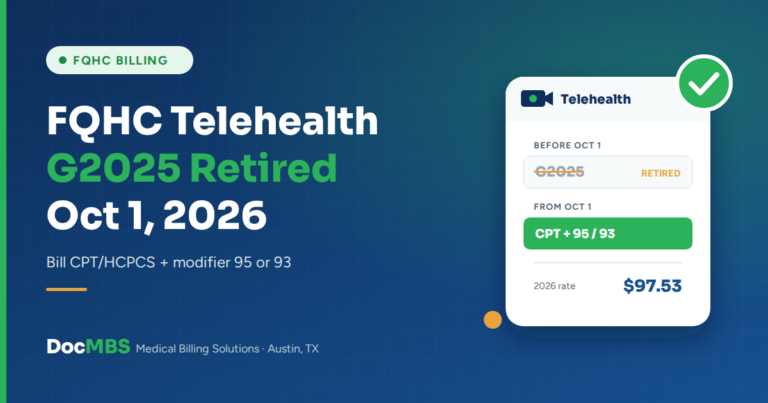
- Distant site telehealth is paid at $97.53 for 2026. Since October 1, 2026, FQHCs bill the actual CPT or HCPCS code with modifier 95 or 93 instead of G2025. See our guide to FQHC telehealth billing after G2025. Mental health telehealth stays different: CMS says the in-person visit requirement won’t take effect until after January 1, 2028.
- Intensive outpatient program (IOP) services are paid at the hospital IOP rates above, not the FQHC PPS rate.
FQHC G-Codes G0466 to G0470 Explained
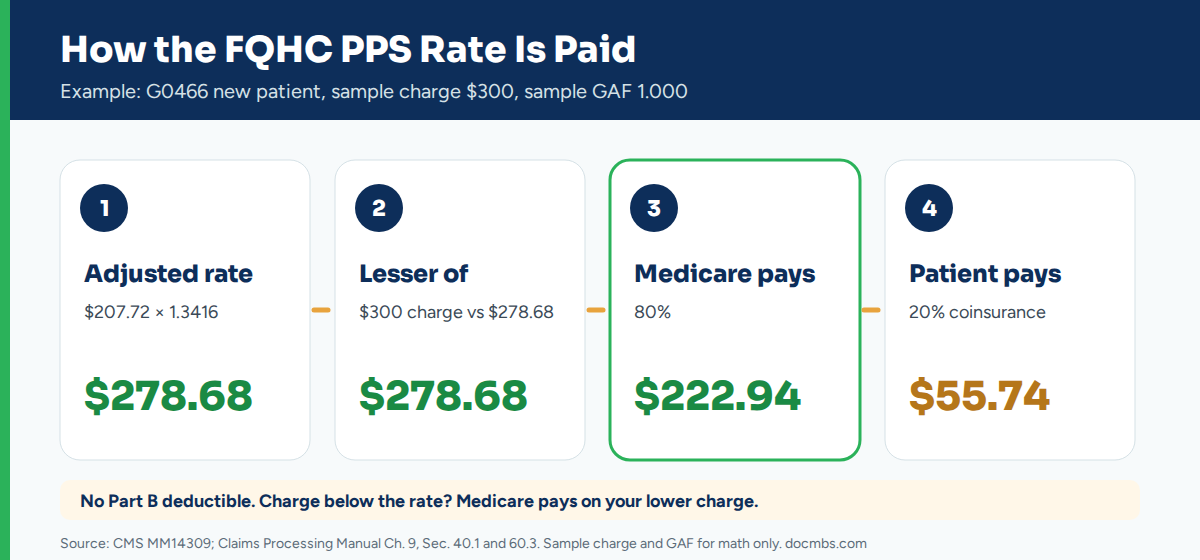
Every FQHC PPS claim uses one of five FQHC payment codes. The G-code tells Medicare which rate to apply, and it must be followed by a line with the qualifying visit’s CPT or HCPCS code.
| G-code | What it means | Revenue code | Qualifying visit examples | Rate applied |
|---|---|---|---|---|
| G0466 | Medical visit, new patient | 052X | New patient office visit (E/M) | PPS rate × 1.3416 |
| G0467 | Medical visit, established patient | 052X | Established patient office visit (E/M) | PPS rate |
| G0468 | Visit with an IPPE or AWV | 052X | IPPE or annual wellness visit | PPS rate × 1.3416 |
| G0469 | Mental health visit, new patient | 0900 | 90791, 90792 | PPS rate × 1.3416 |
| G0470 | Mental health visit, established patient | 0900 | 90832, 90834, 90837, 90839, 90845 | PPS rate |
Sources: CMS FQHC PPS Specific Payment Codes; Medicare Claims Processing Manual, Ch. 9, Sec. 60.2. Revenue code 0519 replaces 052X/0900 on Medicare Advantage supplemental claims only. Check the CMS list for the full set of qualifying codes for each G-code.
Pro Tip: “New patient” means new to the whole FQHC organization, not just one site or one provider. The manual defines it as a patient who has not been a patient at any site of the FQHC organization within the previous 3 years (Claims Processing Manual, Ch. 9, Sec. 30.2). A patient who moved from your north clinic to your south clinic is established.
When G0466 and G0468 are billed on the same day, the 1.3416 adjustment applies to G0468, because only one adjustment is allowed per day.
How Medicare Calculates the FQHC PPS Rate on a Claim
The Claims Processing Manual, Chapter 9, Section 60.3 lays out the payment steps. In plain terms:
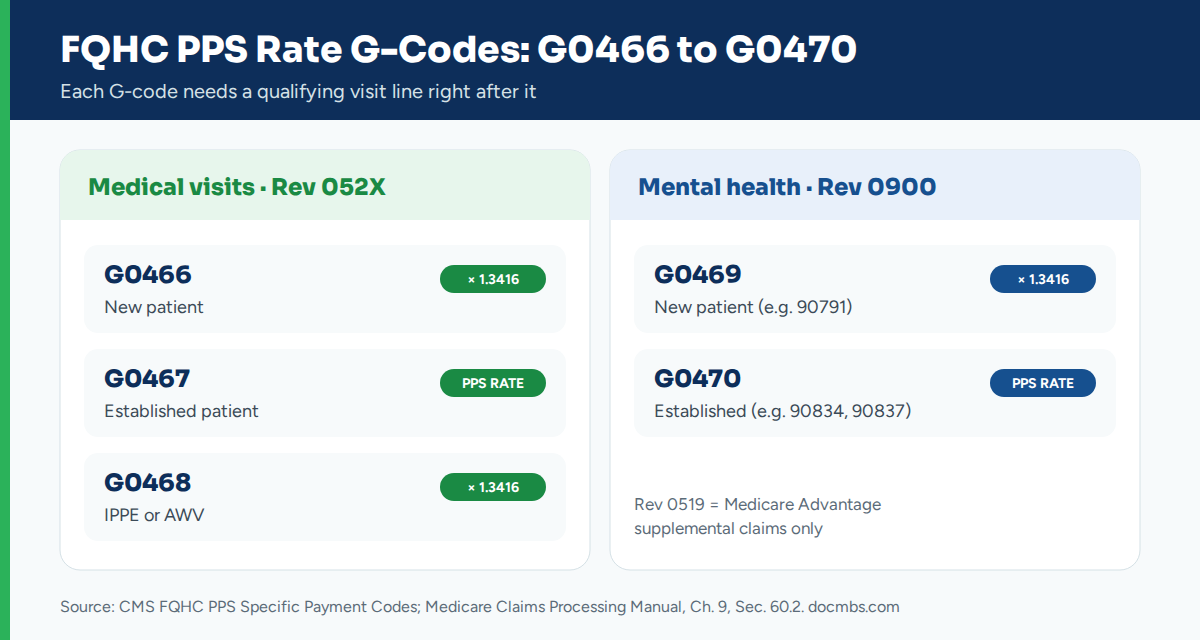
- Find the lesser amount. Compare your total charges for the G-code line with the fully adjusted FQHC PPS rate (base × GAF, × 1.3416 if it applies). Medicare uses the lower one.
- Take out approved preventive services. Charges for preventive services where coinsurance is waived are removed from that amount.
- Medicare pays 80% of what’s left.
- The patient owes 20% coinsurance on the same amount. No Part B deductible applies.
- Add back approved preventive services, paid in full with no coinsurance (for example, USPSTF-based preventive services).
Is your FQHC leaving PPS money on the table?
DocMBS checks your charge master against your adjusted FQHC PPS rate, fixes G-code and qualifying-line errors and clears RTPs before they age.
See our FQHC billing services for full support with PPS claims, G-codes, telehealth and Medicare Advantage wrap payments.
Worked Example: 4 FQHC Claims With Real Math
These examples use the 2026 base FQHC PPS rate of $207.72 and a sample GAF of 1.000 to keep the math simple. The charges are sample numbers, not recommendations. Use your own GAF and charge master.
| Claim | Sample charge | FQHC PPS rate used | Paid on (lesser of) | Medicare 80% | Patient 20% |
|---|---|---|---|---|---|
| A. G0467, established | $250.00 | $207.72 | $207.72 | $166.18 | $41.54 |
| B. G0466, new patient | $300.00 | $278.68 ($207.72 × 1.3416) | $278.68 | $222.94 | $55.74 |
| C. G0467, charge too low | $180.00 | $207.72 | $180.00 | $144.00 | $36.00 |
| D. G0467 + G0470, same day | $250.00 each | $207.72 × 2 | $415.44 | $332.35 | $83.09 |
What Claim C costs you: the charge of $180.00 is $27.72 below the FQHC PPS rate, so the center loses $27.72 in total payment per visit (Medicare plus patient share). At 3,000 established visits a year, that’s 3,000 × $27.72 = $83,160 lost, with no denial to warn you. On the FQHC claims we review, a charge master that was never updated after the rate went up is one of the most common silent leaks.
Claim D shows two separate encounters on one day: a medical visit and a mental health visit, each with its own G-code and qualifying line. Each one is paid at the full rate.
Same-Day Visits: When You Can Bill Two Encounters
Normally, all services on the same day count as one FQHC visit. There are two exceptions in the Claims Processing Manual, Chapter 9:
- Medical visit plus mental health visit. Bill the medical G-code (G0466, G0467 or G0468) on revenue code 052X and the mental health G-code (G0469 or G0470) on revenue code 0900. Each needs its own qualifying service line. Medicare totals them separately as two encounters.
- New illness or injury later the same day. If the patient comes back after the first visit with an unrelated problem, bill G0467 with modifier 59 for the second visit, plus its qualifying service line. Modifier 59 is only valid with G0467 on FQHC PPS claims.
Watch Out: A new patient with a medical visit and a same-day mental health visit is billed G0466 + G0470, not G0469. Only one 1.3416 adjustment is allowed per day, and it goes with the medical visit (CMS FQHC PPS Specific Payment Codes).
How to Bill an FQHC PPS Claim: 7 Steps
- Use the institutional claim. Bill on the 837I (UB-04) with type of bill 77X.
- Check new vs established. Look at the patient’s history across every site of your FQHC for the past 3 years.
- Pick the G-code. G0466, G0467 or G0468 for medical visits; G0469 or G0470 for mental health visits.
- Use the right revenue code. 052X for G0466–G0468, 0900 for G0469–G0470. Use 0519 only on Medicare Advantage supplemental claims.
- Add the qualifying service line. Right after the G-code line, report the CPT or HCPCS code of the qualifying visit (for example, 99213 or 90834) on the same revenue code.
- Check your charges. Make sure the G-code line charge is at or above your adjusted FQHC PPS rate, or you will be paid on the lower charge.
- Add modifiers only where needed. Modifier 59 on G0467 for a later, unrelated same-day visit. Telehealth modifiers (95 or 93) go on distant site telehealth claims, which aren’t paid at the PPS rate.
Medicare Advantage Patients: The Supplemental (Wrap) Payment
When a patient is in a Medicare Advantage plan, the plan pays the FQHC under its contract. If that payment is less than what the FQHC would get under the FQHC PPS rate, Medicare pays the difference as a supplemental (wrap) payment. The FQHC files a separate claim with its MAC for this, using revenue code 0519 (Claims Processing Manual, Ch. 9). Track these claims separately so the difference doesn’t get written off.
Common Mistakes and Denials (and How to Fix Them)
Many FQHC PPS problems show up as returns to provider (RTPs) in your MAC’s system before they become denials. Work the RTP list every day.
| Code / result | Common cause | Fix |
|---|---|---|
| CO-16 (missing or invalid information) | No qualifying service line after the G-code, or the wrong revenue code (e.g., G0470 on 052X) | Add the qualifying CPT/HCPCS line and match the revenue code (052X or 0900), then resubmit. |
| CO-97 (included in another service) | A non-qualifying service (lab, injection, supply) billed as if it were its own visit | Report it as part of the qualifying visit. It’s included in the visit payment. |
| CO-18 (duplicate) | A second medical visit on the same day without modifier 59 | If the second visit was for a new, unrelated problem at a separate time, bill G0467-59 with documentation. Otherwise it’s one visit. |
| CO-50 (not medically necessary) | Diagnosis doesn’t support the qualifying service | Check the documentation and diagnosis coding. Appeal with records if the visit was needed. |
| Overpayment recoupment | G0466 or G0469 billed for a patient seen at another site of the FQHC within 3 years | Check history across all sites before choosing a new-patient code. Correct and refund if needed. |
| No denial, lower payment | Charge below the adjusted FQHC PPS rate | Update the charge master every January when the new rate comes out. |
For a full prevention process, see how to reduce claim denials, or let our denial management team work your RTP and denial backlog.
FQHC PPS Rate for Behavioral Health Visits
Behavioral health is where FQHCs most often lose a second encounter. When a patient sees a medical provider and a mental health provider on the same day, you can bill both, each at the PPS rate, as long as each has its own G-code and qualifying line.
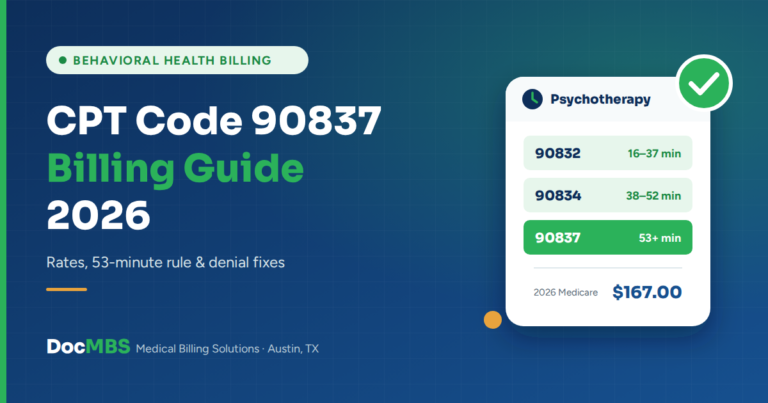
- Psychotherapy visits such as 90834 or 90837 are qualifying lines for G0470. See our guide to CPT code 90837 for documentation and time rules.
- Diagnostic evaluations such as 90791 qualify for G0469 when the patient is new to the FQHC.
- Mental health telehealth is paid at the $97.53 distant site rate, not the PPS rate. Check whether the visit was in person or virtual before you pick the code.
- IOP for mental health or substance use is paid at the IOP rates ($319.38 or $418.45 per day), not the PPS rate.
Texas Note: Texas Medicaid FQHC Billing Uses T1015
Texas Medicaid works differently from Medicare. According to the TMHP Texas Medicaid Provider Procedures Manual (Clinics and Other Outpatient Facility Services Handbook):
- Texas FQHCs are paid a provider-specific PPS encounter rate, not the Medicare FQHC PPS rate.
- Most encounter services are billed with T1015 plus a health-care professional modifier (AH, AJ, AM, SA, TD, TE, U1, U2 or U7).
- Same-day encounters count as one visit, except for a new illness or injury, or a medical visit plus a separate visit such as mental health.
- Family planning, Texas Health Steps and some other services are billed separately.
- STAR and STAR+PLUS managed care plans follow the Texas Medicaid Managed Care Handbook and their own contracts. [VERIFY: STAR/STAR+PLUS FQHC encounter and wrap rules in the Texas Medicaid Managed Care Handbook]
If your health center is in Texas, our Austin medical billing team handles both Medicare G-code claims and Texas Medicaid T1015 encounters.
Key Takeaways
- The 2026 FQHC PPS rate is $207.72 per visit, up 2.5% from $202.65, before your GAF.
- New patients and IPPE/AWV visits get a 1.3416 adjustment, one per day.
- Medicare pays 80% of the lesser of your charge or the adjusted rate, with no Part B deductible.
- G0466–G0468 go on revenue code 052X; G0469–G0470 on 0900; 0519 is for MA supplemental claims only.
- Every G-code needs a qualifying service line right after it.
- A charge below the FQHC PPS rate cuts your payment silently. Update your charge master every January.
FAQs
What is the FQHC PPS rate for 2026?
The 2026 FQHC PPS base rate is $207.72 per visit, according to CMS MLN Matters MM14309, effective January 1, 2026. That’s a 2.5% increase from $202.65 in 2025. CMS adjusts the base rate by each FQHC’s geographic adjustment factor, and by 1.3416 for new patients and IPPE or AWV visits.
What is the difference between G0466 and G0467?
G0466 is an FQHC medical visit for a new patient, and G0467 is a medical visit for an established patient. G0466 gets the 1.3416 adjustment, so it pays more. A patient is new only if they haven’t been seen at any site of the FQHC organization within the previous 3 years.
Can an FQHC bill two visits on the same day?
Yes, in two cases. A medical visit and a mental health visit on the same day are billed as two encounters, each with its own G-code. A new, unrelated illness or injury later the same day is billed as G0467 with modifier 59. Otherwise, same-day services count as one visit.
Does the Part B deductible apply to FQHC visits?
No. The Medicare Claims Processing Manual, Chapter 9, Section 40.1 says the Part B deductible does not apply to FQHC services. The patient still owes 20% coinsurance on the lesser of the charge or the FQHC PPS rate, except for approved preventive services where coinsurance is waived.
What revenue code goes with G0470?
G0470, the established patient mental health visit, is reported on revenue code 0900, the same as G0469. Medical visit codes G0466, G0467 and G0468 go on revenue code 052X. Revenue code 0519 is used only on Medicare Advantage supplemental claims.
Is FQHC telehealth paid at the PPS rate?
No. Distant site telehealth from FQHCs is paid at $97.53 per service for 2026, not the FQHC PPS rate. Since October 1, 2026, FQHCs bill the actual CPT or HCPCS code with modifier 95 or 93 instead of G2025.
How is the FQHC PPS rate calculated?
Medicare starts with the national base rate ($207.72 in 2026), applies your FQHC’s geographic adjustment factor, and multiplies by 1.3416 for new patients or IPPE/AWV visits. It then compares that amount with your charge, takes the lesser, and pays 80%. The patient owes 20% coinsurance.
Get the Full FQHC PPS Rate on Every Visit
The FQHC PPS rate only pays in full when the G-code, revenue code, qualifying line and charge are all right. Check your GAF, update your charges, and bill same-day medical and mental health visits as separate encounters.
DocMBS manages Medicare PPS claims, G-codes, telehealth and MA wrap payments for health centers. See our FQHC billing services or book a free billing review.
This article is for education only. Rates and rules change every year. Confirm with your Medicare Administrative Contractor, Texas Medicaid (TMHP) or your health plan before billing.
Sources
- CMS: MLN Matters MM14309: FQHC and IOP Payment Rates, CY 2026 Update
- CMS: Medicare Claims Processing Manual, Chapter 9: RHC/FQHC
- CMS: FQHC Information Center (FQHC PPS rates and GAF file)
- CMS (via HHS Guidance Portal): FQHC PPS Specific Payment Codes
- CMS: FQHC/RHC News & Announcements
- TMHP: Texas Medicaid Provider Procedures Manual, Clinics and Other Outpatient Facility Services Handbook
Last updated: October 2026.
Need help with medical billing? End-to-end medical billing for US practices: charge entry, claim submission, payment posting, denial follow-up and reporting.