In this article
- What Is Home Health Consolidated Billing?
- What Is Included and What Is Excluded
- The October 2026 Update: 19 New Supply Codes
- How Medicare Enforces Consolidated Billing
- Step-by-Step: Avoiding Consolidated Billing Denials
- Worked Example: Outside Therapy During a Home Health Period
- Common Denials and How to Fix Them
- Home Health vs SNF Consolidated Billing
- Texas Note
- Key Takeaways
- FAQs
- Keep Home Health Claims Inside the Rules
- Sources
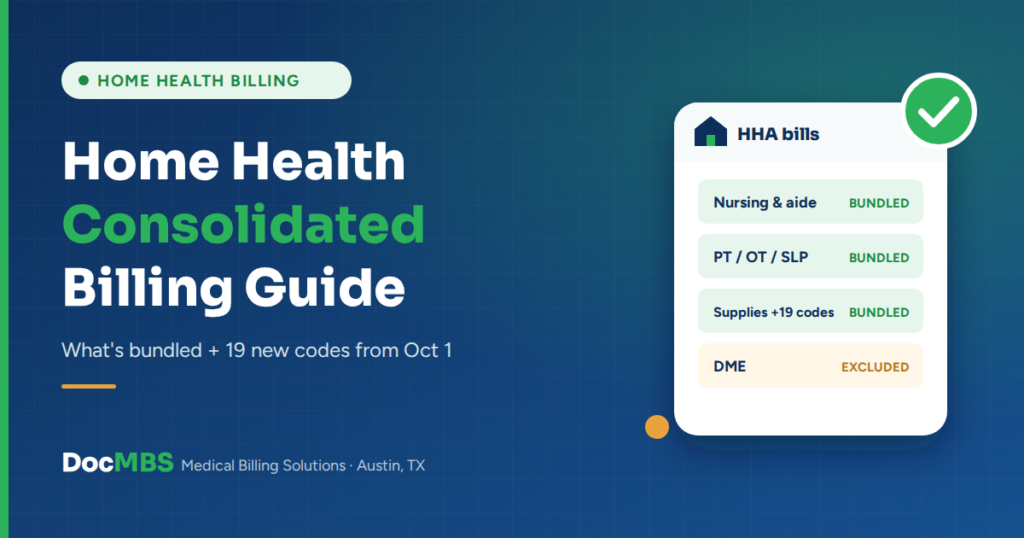
Home health consolidated billing means one thing for your claims: while a Medicare patient is under a home health plan of care, the home health agency is paid for nearly all of their home health services, and almost no one else can bill Medicare for them. Outside therapists, suppliers and agencies that miss an open home health period get denials, and the agency can end up paying for care it didn’t know about.
On October 1, 2026, CMS added 19 supply codes to the consolidated billing list. This guide explains what is bundled, what changed, and how to avoid the denials.
Quick Answer
Under home health consolidated billing, Medicare pays the primary home health agency for nursing, therapy, aide, medical social services and routine and non-routine supplies during a home health period. Other providers’ claims for those services are denied. DME is excluded. From October 1, 2026, 19 more supply codes are on the list (CMS CR 14510).
Table of Contents
- What Is Home Health Consolidated Billing?
- What Is Included and What Is Excluded
- The October 2026 Update: 19 New Supply Codes
- How Medicare Enforces Consolidated Billing
- Step-by-Step: Avoiding Consolidated Billing Denials
- Worked Example: Outside Therapy During a Home Health Period
- Common Denials and How to Fix Them
- Home Health vs SNF Consolidated Billing
- Texas Note
- Key Takeaways
- FAQs
- Sources
What Is Home Health Consolidated Billing?
Section 1842(b)(6)(F) of the Social Security Act requires consolidated billing of all home health services. In plain words, when a Medicare patient is under a home health plan of care, the primary home health agency (HHA), the one that opened the period, is the only provider Medicare pays for the services on the consolidated billing list.
- The HHA is paid whether it provides the service itself or under arrangement with another provider.
- Another provider that furnishes a bundled service must be paid by the HHA, not by Medicare.
- An HHA isn’t responsible for another provider’s services if it had no prior knowledge of them.
The rules are in the Medicare Claims Processing Manual, Chapter 10, Section 20.
What Is Included and What Is Excluded
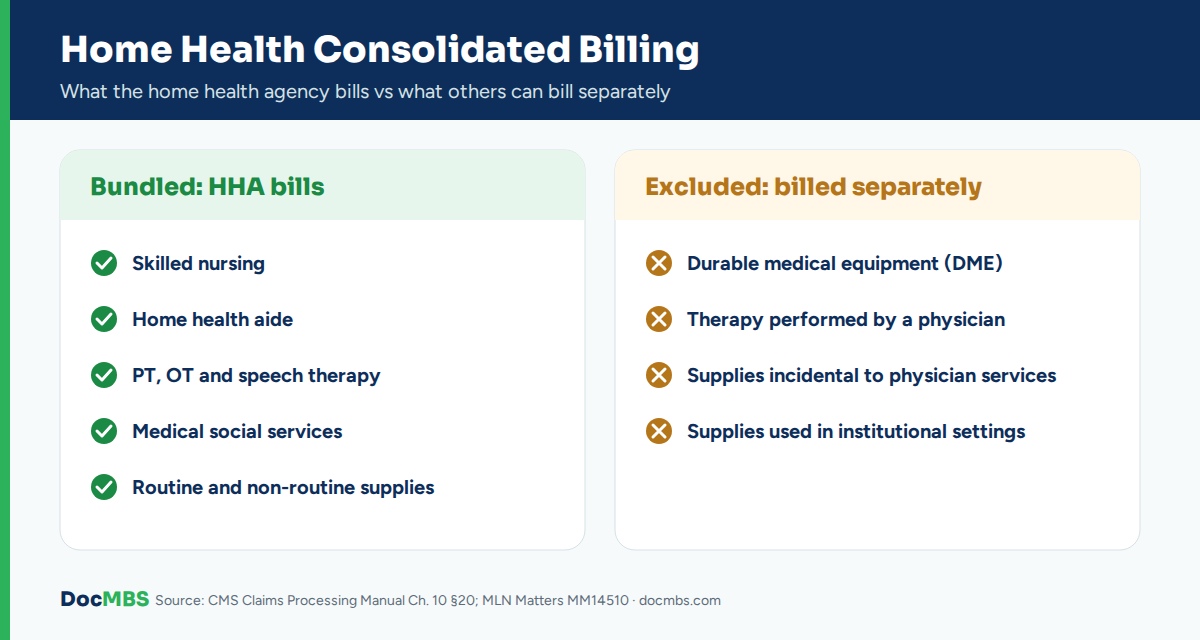
| Included in home health consolidated billing | Excluded (billed separately) |
|---|---|
| Skilled nursing | Durable medical equipment (DME), excluded by law |
| Home health aide services | Therapy performed by a physician |
| Physical therapy, occupational therapy and speech-language pathology | Supplies incidental to physician services |
| Medical social services | Supplies used in institutional settings |
| Routine and non-routine medical supplies | Physician services (billed by the physician) |
| Certain intern or resident services at an affiliated hospital | |
| Care that needs equipment too cumbersome to bring to the home |
Sources: CMS Claims Processing Manual, Chapter 10, Section 20; CMS MLN Matters MM14510.
Watch Out: Osteoporosis drugs given by an HHA are paid outside the home health payment rate, but CMS still treats them as subject to consolidated billing. Only the primary HHA can bill them during a home health period.
The October 2026 Update: 19 New Supply Codes
CMS Change Request 14510 (Transmittal R13794CP, MLN Matters MM14510) added 19 HCPCS codes to the home health consolidated billing non-routine supply list.
- Released: July 8, 2026
- Effective: October 1, 2026
- Implemented by MACs: October 5, 2026
| Supply group | HCPCS codes added |
|---|---|
| Syringes, needles and injection supplies | A4206, A4207, A4208, A4209, A4210, A4211 |
| Sterile saline or water dispenser | A4218 |
| Urinary and incontinence supplies | A4318, A4336, A4337, A4341, A4342 |
| Ostomy and irrigation supplies | A4397, A4398, A4399, A4400, A4453 |
| Tape | A4450, A4452 |
Code groups are our summary. See MM14510 for each code’s full description.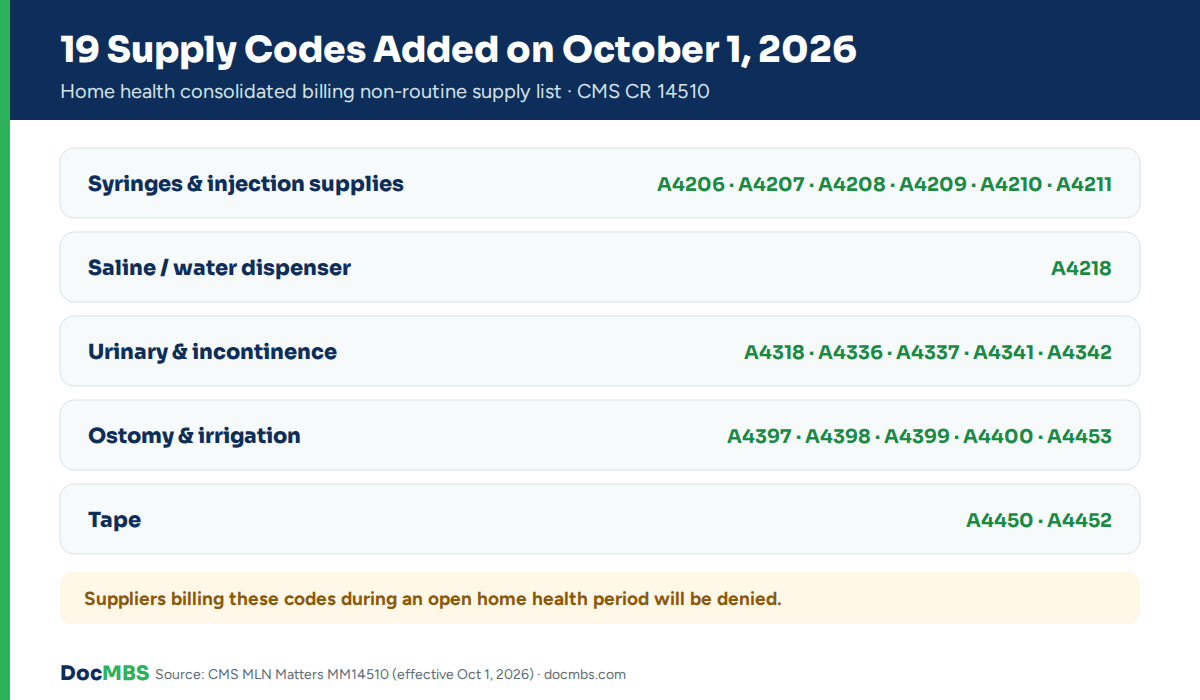
What this means: from October 1, 2026, a supplier who bills Medicare for one of these 19 codes while the patient is in a home health period will get a denial. The HHA is responsible for providing these supplies as part of its payment.
Losing money to consolidated billing denials?
DocMBS checks every home health patient’s open periods, sets up the right vendor arrangements and keeps your supply billing in line with the October 2026 code list.
See our home health billing services for full support with PDGM claims, NOAs and consolidated billing.
How Medicare Enforces Consolidated Billing
Medicare’s Common Working File (CWF) tracks each patient’s home health periods. When another provider’s claim lands inside an open period:
- If the HHA’s claim is already on file, the outside claim’s lines are rejected or denied before payment.
- If the outside claim was paid first, CWF triggers a post-payment rejection or denial when the HHA’s claim arrives. Institutional claims are recovered automatically, and professional claims go through overpayment recovery.
- If only the Notice of Admission (NOA) is on file, the outside claim may pay with remark code N88, which warns it may be taken back later.
- Denials show group code CO, reason code 97 and remark code N390.
The edits apply from the period start date through the last billable service date if the patient was discharged.
Step-by-Step: Avoiding Consolidated Billing Denials
For outside providers and suppliers
- Check eligibility before the service. A 270/271 eligibility check shows whether the patient has an open home health period, and which HHA opened it.
- Ask the patient whether a nurse or therapist is coming to their home. Many patients don’t think of home health as “insurance.”
- If a period is open, call the HHA before you provide a bundled service or supply.
- Set up a written arrangement with the HHA before the service, so the HHA pays you.
- Bill the HHA, not Medicare, for bundled services under that arrangement.
For home health agencies
- Submit the NOA on time so the period shows in CWF and outside claims are stopped.
- Update your supply list with the 19 codes added on October 1, 2026.
- Track outside services your patients receive, and put arrangements in place for any you know about.
- Review N390 denials sent by vendors, and decide case by case who owes whom.
Worked Example: Outside Therapy During a Home Health Period
Example only. The patient, providers and amounts are illustrative.
A Medicare patient starts a 30-day home health period on October 6, 2026 with Agency A, which files its NOA on time. On October 13, the patient also starts outpatient physical therapy at a nearby clinic. The clinic doesn’t check for a home health period and bills Medicare for four visits.
| What happens | Result |
|---|---|
| Clinic bills 4 PT visits (illustrative charges: $480) | Dates fall inside Agency A’s open period |
| CWF matches the dates to the home health period | Denied: CO-97 with N390 |
| Was there an arrangement with Agency A? | No |
| Did Agency A know about the outside therapy? | No, so it isn’t responsible for the clinic’s services |
| Outcome | The clinic can’t get the $480 from Medicare, and liability depends on the arrangement and any notice given to the patient |
The fix: one eligibility check on October 13 would have shown the open period. The clinic could then have arranged the therapy with Agency A and billed the agency, or the agency could have covered the therapy in the patient’s plan of care.
Pro Tip: On the home health claims we work, most consolidated billing disputes start with a late NOA. When the NOA isn’t on file, outside claims get paid first and are recovered later, which creates disputes weeks after the care. File the NOA on time and outside claims stop at the front door.
Common Denials and How to Fix Them
| Denial | What it means | How to fix it |
|---|---|---|
| CO-97 + N390 | Service is bundled into the home health payment | Bill the primary HHA under an arrangement; don’t rebill Medicare |
| N88 on a paid claim | Paid, but may be recovered later (only an NOA was on file) | Contact the HHA now and set up an arrangement before the recovery |
| Post-payment recovery | Claim paid first, then taken back when the HHA claim arrived | Check whether the HHA knew about the service and had an arrangement |
| CO-16 | Claim missing information (for example, wrong place of service or missing details) | Correct the claim; if the service is bundled, it still goes to the HHA |
| Supply claim denied after Oct 1, 2026 | Code is now on the non-routine supply list | Check the code against MM14510; supply it through the HHA |
If these denials keep coming back, our denial management services can sort out who should bill what. DME suppliers can also see our DME billing services, since DME is excluded from home health consolidated billing.
Home Health vs SNF Consolidated Billing
Both are called “consolidated billing,” but they work differently:
| Item | Home health | Skilled nursing facility |
|---|---|---|
| Who bills Medicare | The primary HHA | The SNF, for residents in a covered Part A stay |
| What is bundled | The home health services and supplies on the list | Almost all services during the Part A stay, with set exclusions |
| DME | Excluded | Generally included in the SNF payment |
| Payment unit | 30-day period under PDGM | Per diem under PDPM |
For SNF billing, see our guides to revenue code 0022 and FY 2027 SNF Medicare daily rates.
Texas Note
Consolidated billing is a Medicare rule. Texas Medicaid pays for home health services under its own benefit rules, prior authorization requirements and procedure codes, published by TMHP in the Texas Medicaid Provider Procedures Manual. For patients with both Medicare and Texas Medicaid, bill Medicare first under the consolidated billing rules, then follow Texas Medicaid’s rules for anything Medicaid covers. Texas Medicaid claims generally have a 95-day filing window.
Key Takeaways
- Home health consolidated billing makes the primary HHA the only provider Medicare pays for bundled home health services during a period.
- Bundled services include nursing, aide, therapy, medical social services and routine and non-routine supplies. DME is excluded.
- 19 supply codes joined the list on October 1, 2026 (CR 14510).
- Outside claims deny with CO-97 and N390. Check eligibility for an open period first.
- Outside providers get paid through a written arrangement with the HHA, made before the service.
FAQs
What is home health consolidated billing?
It is the Medicare rule that makes the primary home health agency responsible for billing all home health services on the consolidated billing list while a patient is under a home health plan of care. Other providers can’t bill Medicare for those services. They must be paid by the agency under an arrangement.
What services are included in home health consolidated billing?
Skilled nursing, home health aide services, physical therapy, occupational therapy, speech-language pathology, medical social services, and routine and non-routine medical supplies are included. So are certain intern or resident services and care that needs equipment too cumbersome to bring to the home.
Is DME included in home health consolidated billing?
No. Durable medical equipment is excluded from home health consolidated billing by law. DME suppliers can bill Medicare directly for DME, even while the patient is in a home health period.
What changed in October 2026?
CMS Change Request 14510 added 19 HCPCS codes to the home health consolidated billing non-routine supply list, effective October 1, 2026. They include syringe and injection supplies, urinary and incontinence supplies, ostomy irrigation supplies and tape. Suppliers billing these codes during a home health period will be denied.
What does denial code N390 mean?
Remark code N390 appears with group code CO and reason code 97 when a service is denied because it is bundled into a home health period under consolidated billing. The fix is to bill the primary home health agency under an arrangement, not to rebill Medicare.
Can therapy be billed separately during a home health period?
Therapy services are subject to home health consolidated billing, so outside therapy providers can’t bill Medicare for them during an open period. The exception is therapy performed by a physician, which is not subject to home health consolidated billing.
How can a provider check for an open home health period?
Run a 270/271 eligibility check through your MAC’s eligibility system or your clearinghouse before the service. It shows whether the patient has an open home health period and which agency opened it. Then contact that agency before providing a bundled service.
Keep Home Health Claims Inside the Rules
Home health consolidated billing protects the agency’s payment, but it only works when everyone checks for open periods and sets up arrangements first. With 19 new supply codes added on October 1, 2026, now is the time to update your supply lists and vendor agreements.
DocMBS manages PDGM claims, NOAs and consolidated billing for home health agencies. See our home health billing services or book a free billing review.
Sources
- CMS: MLN Matters MM14510: HCPCS Codes Used for Home Health Consolidated Billing Enforcement, October 2026 Update
- CMS: Transmittal R13794CP (CR 14510)
- CMS: Medicare Claims Processing Manual, Chapter 10: Home Health Agency Billing
Last updated: October 2026. This article is for education only. Confirm billing rules with your Medicare Administrative Contractor before submitting claims.
Need help with home health billing? Billing for home health agencies under PDGM, with notices of admission, OASIS and face-to-face documentation checked so 30-day periods are paid on time.