In this article
- What Is a LUPA Threshold in Home Health?
- What Changed in the LUPA Threshold 2027 Update
- 2027 LUPA Per-Visit Rates
- How to Check a Period Against Its LUPA Threshold: 5 Steps
- LUPA Threshold 2027 Worked Example
- The LUPA Add-On Payment
- How to Avoid Unplanned LUPAs
- LUPA, NOA and Timely Filing
- LUPA Threshold 2027 Mistakes and How to Fix Them
- Texas Note: Medicare Advantage and Texas Medicaid
- Key Takeaways
- FAQs
- Check Every Period Before You Bill
- Sources
The LUPA threshold 2027 list sets the minimum number of visits each home health 30-day period needs before Medicare pays the full period amount. Miss it by one visit and the period is paid per visit instead. One cancelled skilled nursing visit can turn a full PDGM payment into a few hundred dollars. And for 2027, CMS has changed the thresholds again.
This guide explains how the visit threshold works, what changed in the CY 2027 final rule, the 2027 per-visit rates, the LUPA add-on, and how to stop unplanned LUPAs before they reach your remits.
Quick Answer
The LUPA threshold 2027 is the minimum number of visits for each PDGM payment group: the 10th percentile of visits or 2, whichever is higher. A 30-day period with fewer visits is paid per visit. For 2027, 10 case-mix groups dropped by one visit, and HIPPS 4LC11 was corrected to 3 visits.
Table of Contents
- What Is a LUPA Threshold in Home Health?
- What Changed in the LUPA Threshold 2027 Update
- 2027 LUPA Per-Visit Rates
- How to Check a Period Against Its LUPA Threshold: 5 Steps
- LUPA Threshold 2027 Worked Example
- The LUPA Add-On Payment
- How to Avoid Unplanned LUPAs
- LUPA, NOA and Timely Filing
- LUPA Threshold 2027 Mistakes and How to Fix Them
- Texas Note: Medicare Advantage and Texas Medicaid
- Key Takeaways
- FAQs
- Sources
What Is a LUPA Threshold in Home Health?
LUPA stands for Low-Utilization Payment Adjustment. Under the Patient-Driven Groupings Model (PDGM), Medicare pays home health in 30-day periods. Each period falls into one of 432 payment groups, shown by a HIPPS code. Each group has its own visit threshold.
- How it’s set: the threshold is the 10th percentile of visits for that payment group, or 2 visits, whichever is higher.
- Met the threshold: the period gets the full case-mix and wage-adjusted 30-day payment.
- Below the threshold: the period is a LUPA. Medicare pays a national per-visit rate for each discipline, adjusted by the wage index.
A LUPA isn’t a denial. The claim pays, just on a per-visit basis. That’s why LUPAs are easy to miss: there’s no rejection to flag them, only a smaller payment.
CMS updates the thresholds every year with the newest claims data. So the LUPA threshold 2027 for a group can be different from its 2026 number, even if your patient mix hasn’t changed.
What Changed in the LUPA Threshold 2027 Update
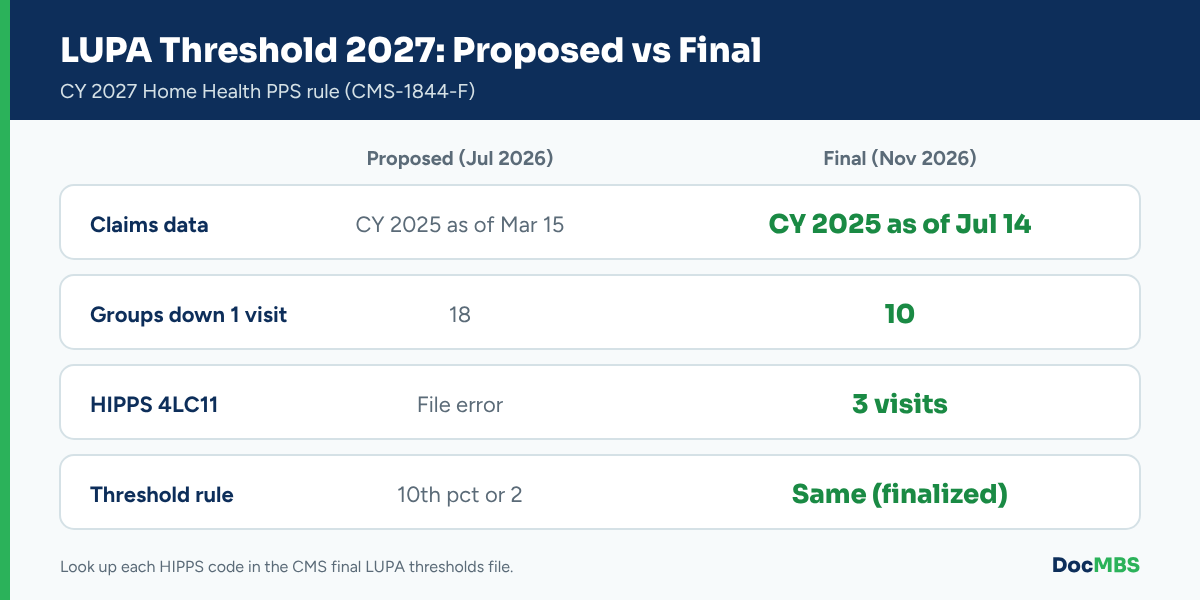
CMS released the CY 2027 Home Health PPS final rule (CMS-1844-F) on November 4, 2026. It was published in the Federal Register on November 9, 2026 (document 2026-22750). The rule recalibrates the PDGM case-mix weights and updates the thresholds, functional impairment levels and comorbidity subgroups. The new values apply to periods starting January 1, 2027.
| Item | Proposed rule (July 2026) | Final rule (Nov 2026) |
|---|---|---|
| Claims data used | CY 2025 claims as of March 15, 2026 | CY 2025 claims as of July 14, 2026 |
| Groups with a one-visit decrease | 18 | 10 (8 of the 18 shifted with fuller data) |
| Groups with a one-visit increase | [VERIFY: Table 11 of the proposed rule] | [VERIFY: Table 11 of the final rule] |
| HIPPS 4LC11 | Error in the proposed technical file | 3 visits (CMS corrected the technical files) |
| Threshold rule | 10th percentile or 2 visits, whichever is higher | Same, finalized as proposed |
The full LUPA threshold 2027 list, by HIPPS code, is in Table 11 of the final rule and in the CMS file “CY 2027 Final HH PDGM Case Mix Weights and LUPA Thresholds” on the CMS-1844-F page.
Watch Out: Don’t build your LUPA threshold 2027 table from the proposed rule. Eight groups that were set to drop in July did not drop in the final rule, and the 4LC11 value was wrong in the proposed file.
2027 LUPA Per-Visit Rates
When a period falls below its threshold, Medicare pays per visit. These are the national per-visit amounts for agencies that submit quality data, from CMS Change Request 14031 (Table 3). They’re before the wage index.
| Discipline | CY 2026 | CY 2027 |
|---|---|---|
| Home health aide | $80.12 | $81.79 |
| Medical social services | $283.64 | $289.57 |
| Occupational therapy | $194.74 | $198.81 |
| Physical therapy | $193.42 | $197.46 |
| Skilled nursing | $176.96 | $180.66 |
| Speech-language pathology | $210.25 | $214.64 |
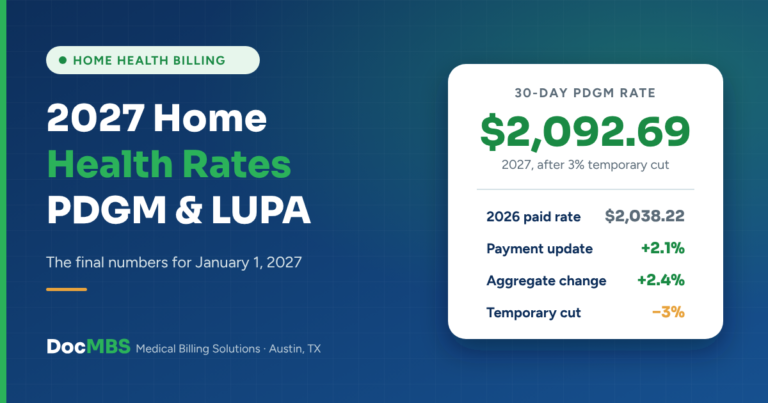
CMS applies a wage index budget neutrality factor of 0.9999 to LUPA per-visit payments. For the full 30-day rate ($2,092.69 for 2027) and the rest of the update, see our 2027 home health rates guide.
How to Check a Period Against Its LUPA Threshold: 5 Steps
- Find the HIPPS code. Take it from the grouper output for the 30-day period. It reflects admission source, timing, clinical group, functional level and comorbidity.
- Look up the LUPA threshold 2027 value. Open the CMS “CY 2027 Final HH PDGM Case Mix Weights and LUPA Thresholds” file and find that HIPPS code. Make sure your billing software loaded the final file, not the proposed one.
- Count the visits in the 30-day period. Count visits from all six disciplines that fall inside the period dates. [VERIFY: which visits count toward the threshold — CY 2027 final rule / Claims Processing Manual Ch. 10]
- Compare. If visits are at or above the threshold, it’s a full period. If they’re below, it’s a LUPA.
- Bill and set the right expected payment. Bill the final claim either way. For a LUPA, expect per-visit pay, and check whether the period qualifies for the LUPA add-on.
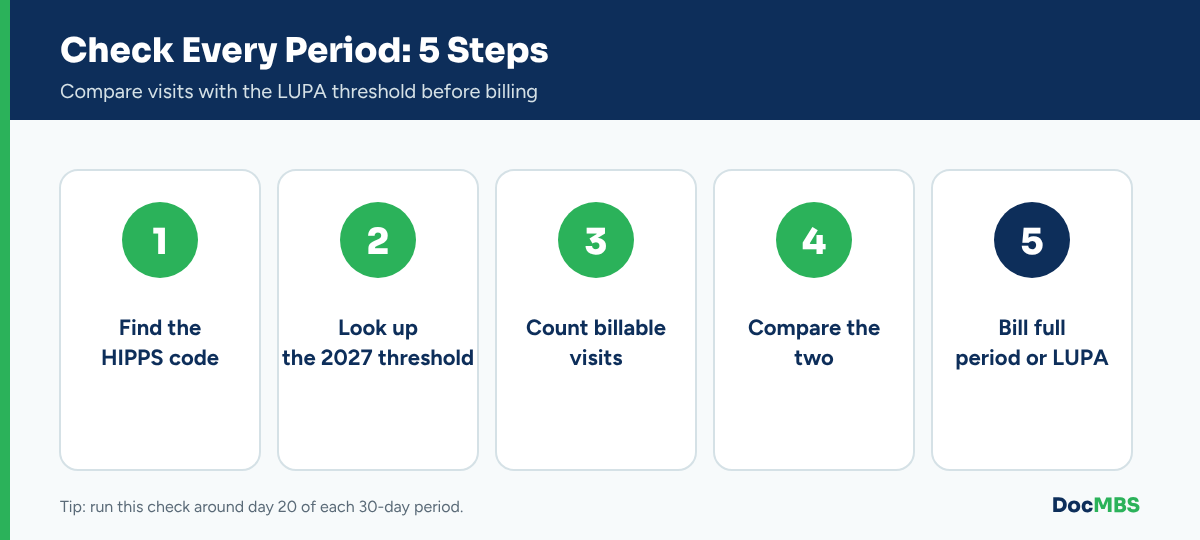
Pro Tip: Run this check around day 20 of each period, not after it closes. If a patient is one visit short, there may still be time to schedule a visit the physician ordered and the patient needs.
LUPA Threshold 2027 Worked Example
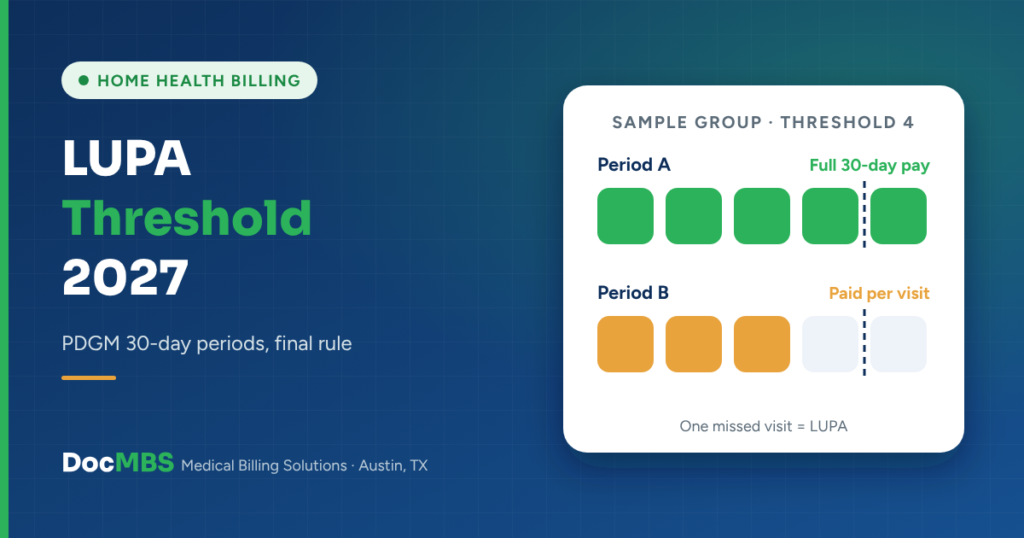
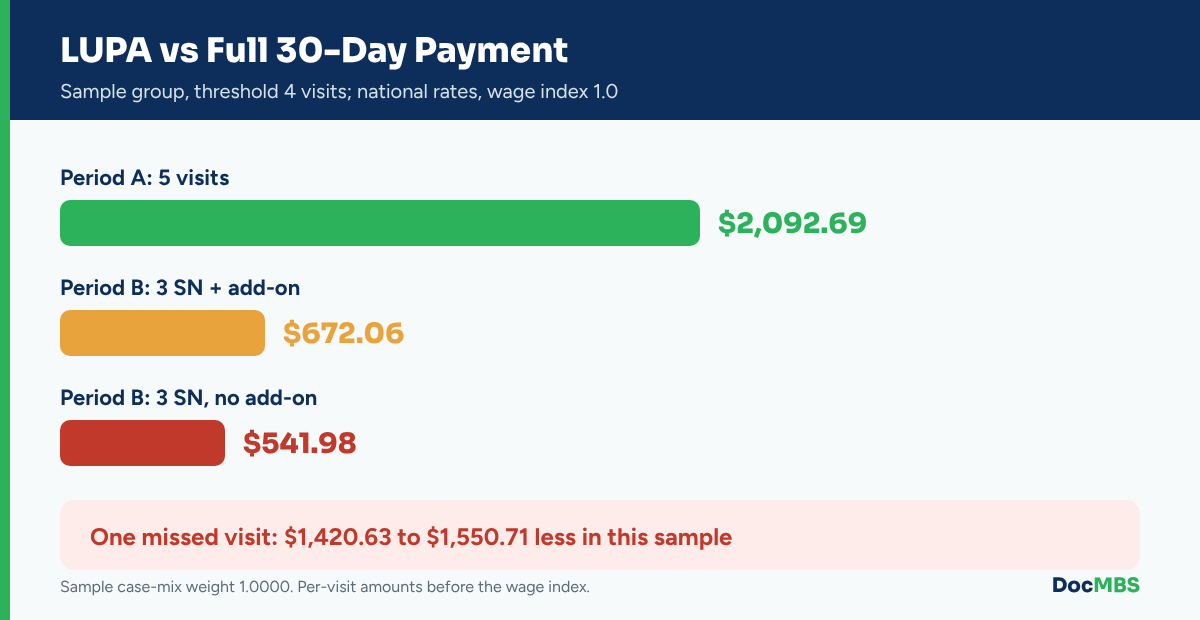
This example uses a sample payment group with a threshold of 4 visits, a sample case-mix weight of 1.0000 and a wage index of 1.0000. Real weights and thresholds come from the CMS file. Per-visit amounts are national, before the wage index.
| Period | Visits | Meets threshold of 4? | Payment math | Payment |
|---|---|---|---|---|
| Period A | 5 visits | Yes | $2,092.69 × 1.0000 (sample weight) × 1.0000 | $2,092.69 |
| Period B (no add-on) | 3 SN visits | No (LUPA) | 3 × $180.66 | $541.98 |
| Period B (with SN add-on) | 3 SN visits | No (LUPA) | ($180.66 × 1.7200) + (2 × $180.66) = $310.74 + $361.32 | $672.06 |
The gap: Period B is paid $1,550.71 less than Period A without the add-on, or $1,420.63 less if it’s the first or only period and gets the add-on. All because of one visit.
Losing money to unplanned LUPAs?
Our home health billing services check every period against its 2027 LUPA threshold before the claim goes out.
The LUPA Add-On Payment
The first visit in some LUPA periods costs more to provide, because it includes the start-of-care work. So CMS pays more for it. According to CMS Change Request 14031, the per-visit amount for the first SN, PT or SLP visit is multiplied by an add-on factor when the LUPA period is the only period of care, or the first 30-day period in a sequence of adjacent periods. For OT, the factor applies when OT is the first skilled visit in that kind of period.
| Discipline | CY 2027 LUPA add-on factor | First visit paid (national, before wage index) |
|---|---|---|
| Skilled nursing | 1.7200 | $180.66 × 1.7200 = $310.74 |
| Physical therapy | 1.6225 | $197.46 × 1.6225 = $320.38 |
| Speech-language pathology | 1.6696 | $214.64 × 1.6696 = $358.36 |
| Occupational therapy | 1.7238 | $198.81 × 1.7238 = $342.71 |
Source: CMS Change Request 14031, Table 7. Older files with different factors are from earlier years, so don’t use them for 2027 claims.
How to Avoid Unplanned LUPAs
Some LUPAs are clinically right. A patient who needs two visits shouldn’t get four. The goal is to stop the unplanned ones: periods that fall short because of a missed visit, not because of the care plan.
- Track missed visits daily. Every missed visit needs a reason, a physician notice and a reschedule attempt. A missed visit isn’t billable and doesn’t count as a visit.
- Match frequency orders to the LUPA threshold 2027 value. If the ordered frequency is right at the threshold, one cancellation creates a LUPA. Clinicians should know that number.
- Watch the second period. Second 30-day periods often have fewer visits. Plan the visit pattern across both periods, not just the first.
- Talk to intake. Late referrals, hospital readmissions and delayed starts of care shorten the time left to reach the threshold.
- Review weekly. A short report of periods near or below their threshold lets the clinical manager act while there’s still time.
On the home health claims we work, most unplanned LUPAs trace back to a missed visit that nobody rescheduled. Find them while the period is still open.
LUPA, NOA and Timely Filing
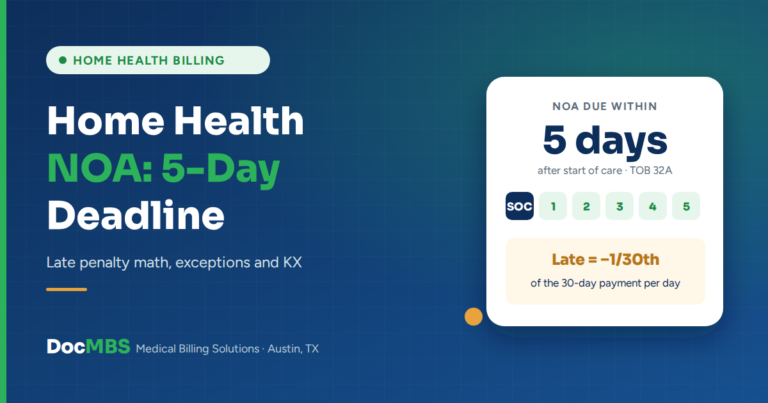
A LUPA period still needs a timely Notice of Admission. The NOA must be accepted within 5 calendar days after the start of care. According to CMS MM12256, when an NOA is late in a LUPA period, Medicare doesn’t pay the LUPA visits that fall on days before the NOA was submitted. [VERIFY: exact wording for LUPA periods — CMS MM12256 / 42 CFR 484.205] Read our home health NOA guide for the 1/30th reduction and exceptions.
Final claims for LUPA periods follow the same Medicare filing limit as any claim: 12 months from the date of service. See our Medicare timely filing limit guide.
LUPA Threshold 2027 Mistakes and How to Fix Them
These are the LUPA problems we expect most often in 2027. Remark and reason codes vary by MAC, so check your own remits.
| Mistake | What you’ll see | How to fix it |
|---|---|---|
| Using 2026 thresholds after Jan 1, 2027 | Wrong expected payment; underpayments missed | Load the final LUPA threshold 2027 file before January claims. |
| Counting non-billable visits (missed visits, supervisory-only visits) | Period billed as full when it’s really a LUPA; overpayment risk | Count only billable visits on the claim. |
| Missed visits never rescheduled | Unplanned LUPA, per-visit pay | Daily missed-visit report; reschedule when ordered. |
| HIPPS code doesn’t match the OASIS | RTP or CO-16 [VERIFY: MAC remark codes] | Confirm the OASIS was accepted; correct the HIPPS and rebill. |
| Late NOA | Non-timely NOA reduction; LUPA visits before the NOA unpaid [VERIFY: CARC on your remit] | File and confirm the NOA within 5 days. |
| Final claim sent before the period ends | RTP | Bill only after the 30-day period ends and all visits are posted. |
For more prevention steps, read how to reduce claim denials.
Texas Note: Medicare Advantage and Texas Medicaid
The LUPA threshold 2027 rules come from traditional Medicare. Many Texas home health patients are in Medicare Advantage plans or Texas Medicaid managed care (STAR+PLUS, STAR Kids). Those plans pay by contract. Some pay per visit, some pay a percentage of the Medicare rate, and some follow PDGM rules, including LUPAs. [VERIFY: each payer contract]
Check which rules each contract uses before you set expected payments. Our Austin medical billing team can review Texas MA and Medicaid home health contracts.
Key Takeaways
- Each group’s threshold is the 10th percentile of visits or 2 visits, whichever is higher.
- A 30-day period below its threshold is paid per visit, not denied.
- For 2027, 10 case-mix groups dropped by one visit; HIPPS 4LC11 = 3 visits.
- 2027 per-visit rates rise; skilled nursing is $180.66 before the wage index.
- LUPA add-on factors: SN 1.7200, PT 1.6225, SLP 1.6696, OT 1.7238.
- Check each period around day 20 and reschedule missed visits.
FAQs
What is a LUPA in home health?
A LUPA, or Low-Utilization Payment Adjustment, happens when a 30-day home health period has fewer visits than the threshold for its PDGM payment group. Instead of the full 30-day payment, Medicare pays a national per-visit rate for each visit, adjusted by the wage index. It’s a payment change, not a denial.
How is the LUPA threshold set?
CMS sets each PDGM payment group’s threshold at the 10th percentile of visits for that group, or 2 visits, whichever is higher. It updates the thresholds every year with the latest claims data. For 2027, CMS used CY 2025 home health claims as of July 14, 2026.
What are the 2027 LUPA thresholds?
The LUPA threshold 2027 values are listed by HIPPS code in Table 11 of the CY 2027 Home Health final rule and in the CMS file “CY 2027 Final HH PDGM Case Mix Weights and LUPA Thresholds.” There are 432 groups, so look up each HIPPS code rather than using a single number.
Did LUPA thresholds change in 2027?
Yes. In the final rule, 10 case-mix groups have a threshold one visit lower than in 2026. The proposed rule had 18 groups dropping, but fuller claims data changed 8 of them. CMS also corrected the threshold for HIPPS 4LC11 to 3 visits.
How is a LUPA period paid?
Each visit is paid at the national per-visit rate for its discipline, adjusted by the wage index. For 2027, skilled nursing is $180.66 and physical therapy is $197.46 before the wage index. If the period qualifies, the first SN, PT, SLP or OT visit gets an add-on factor.
What is the LUPA add-on payment?
It raises the payment for the first skilled visit in a LUPA period that is the only period of care, or the first period in a sequence of adjacent periods. For 2027, the factors are 1.7200 for SN, 1.6225 for PT, 1.6696 for SLP and 1.7238 for OT, according to CMS Change Request 14031.
How do I avoid unplanned LUPAs?
Track missed visits every day, reschedule them when they’re ordered, and check each period against its threshold around day 20. Make sure clinicians know the threshold for their patients, and plan visits across both 30-day periods of the 60-day plan of care.
Check Every Period Before You Bill
The LUPA threshold 2027 changes are small on paper, but one missed visit cost more than $1,400 in our sample period. Load the final CMS file, check each period while it’s open, and reschedule missed visits. Our home health billing team checks every 30-day period against its LUPA threshold before billing. Book a free billing review.
This article is for education only. Confirm current rules with CMS and your MAC before you bill.
Sources
- Federal Register: CY 2027 Home Health PPS final rule (document 2026-22750)
- CMS: CMS-1844-F page (final case-mix weights and thresholds file)
- CMS: Change Request 14031: HH PPS Rate Update for CY 2027
- CMS: Medicare Claims Processing Manual, Chapter 10 (Home Health)
- CMS: Home Health Agency Center
Last updated: November 2026.
Need help with home health billing? Billing for home health agencies under PDGM, with notices of admission, OASIS and face-to-face documentation checked so 30-day periods are paid on time.