In this article
- What Is G2211 Modifier B1?
- G2211 vs Modifier B1 vs Modifier B2
- Which Visits Can Use G2211 Modifier B1?
- How Much Does Modifier B1 Pay?
- How to Bill G2211 Modifier B1: 6 Steps
- Modifier B1 With Modifier 25 and Same-Day Procedures
- Specialty Angle: Mental Health and Behavioral Health
- Common G2211 Modifier B1 Mistakes and Denials
- Texas Note: Medicare Advantage and Commercial Plans
- Your January 1 Checklist
- Key Takeaways
- FAQs
- Get Ready for G2211 Modifier B1 Before January 1
- Sources
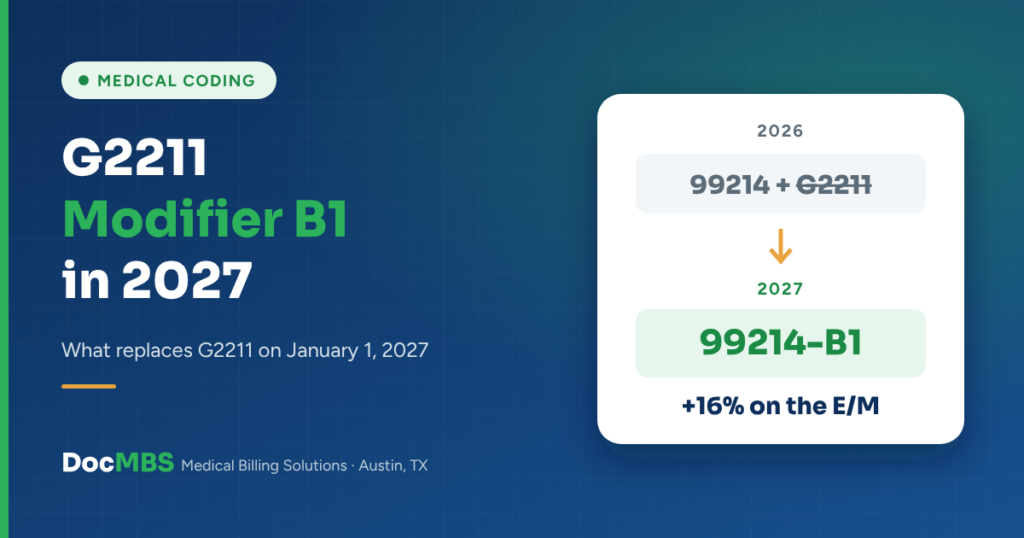
G2211 modifier B1 is the change every Medicare practice billing office and outpatient visits needs to plan for: starting January 1, 2027, the G2211 add-on code is replaced by modifier B1 on the E/M code itself. Since 2024, many practices built a habit of adding G2211 to their established-patient visits. After January 1, a claim coded the old way can lose that extra payment, or come back denied. On the E/M claims we work, the safest fix is simple: update templates and scrubber rules before the first January visit.
This guide explains what G2211 modifier B1 is, how much it pays, who can use B2, how to bill it and the mistakes to avoid.
Quick Answer
On January 1, 2027, add-on code G2211 is replaced by modifier B1. You append B1 to the office/outpatient E/M code, with no separate add-on line. B1 adds 16% to the E/M payment. Clinicians in a Shared Savings Program ACO or a LEAD Model participant can use B2, which adds 32%.
Table of Contents
- What Is G2211 Modifier B1?
- G2211 vs Modifier B1 vs Modifier B2
- Which Visits Can Use G2211 Modifier B1?
- How Much Does Modifier B1 Pay?
- How to Bill G2211 Modifier B1: 6 Steps
- Modifier B1 With Modifier 25 and Same-Day Procedures
- Specialty Angle: Mental Health and Behavioral Health
- Common G2211 Modifier B1 Mistakes and Denials
- Texas Note: Medicare Advantage and Commercial Plans
- Your January 1 Checklist
- Key Takeaways
- FAQs
- Sources
What Is G2211 Modifier B1?
G2211 is the office/outpatient E/M visit complexity add-on code that Medicare has paid since January 1, 2024. It recognizes the extra work of being a patient’s ongoing point of care. CMS’s MLN article MM13473 describes it as care where the practitioner is the continuing focal point for all needed services, or gives ongoing care for a single serious or complex condition.
In the CY 2027 Physician Fee Schedule final rule, released November 4, 2026, CMS changed how that work is paid. According to the CMS fact sheet:
- G2211 is replaced by modifier B1, which increases the payment for the associated E/M visit by 16%.
- Modifier B2 is for practitioners in a Medicare Shared Savings Program ACO or a LEAD Model participant provider, and increases the E/M payment by 32%.
- The change applies to services on or after January 1, 2027.
So G2211 modifier B1 isn’t a new kind of service. It’s the same longitudinal-care add-on, now billed as a modifier and paid as a percentage instead of a separate line. For the rest of the 2027 rule, including the new conversion factor, see our [INTERNAL LINK: 2027 Medicare conversion factor] guide.
G2211 vs Modifier B1 vs Modifier B2
This table puts the old G2211 code and G2211 modifier B1 (plus B2) side by side.
| G2211 (2024–2026) | Modifier B1 (2027) | Modifier B2 (2027) | |
|---|---|---|---|
| How it’s billed | Separate add-on code line | Modifier on the E/M code | Modifier on the E/M code |
| Payment | Flat amount from its own RVUs | +16% of the E/M payment | +32% of the E/M payment |
| Who can use it | Practitioners with a longitudinal care relationship | Same situations as G2211 | Shared Savings Program ACO and LEAD Model participant providers |
| Which visits | Office/outpatient E/M | Office/outpatient E/M [VERIFY: final code list] | Office/outpatient E/M [VERIFY: final code list] |
| Modifier 25 rule | Not paid with modifier 25, except with an AWV, vaccine administration or Part B preventive service | [VERIFY: expected to carry over] | [VERIFY: expected to carry over] |
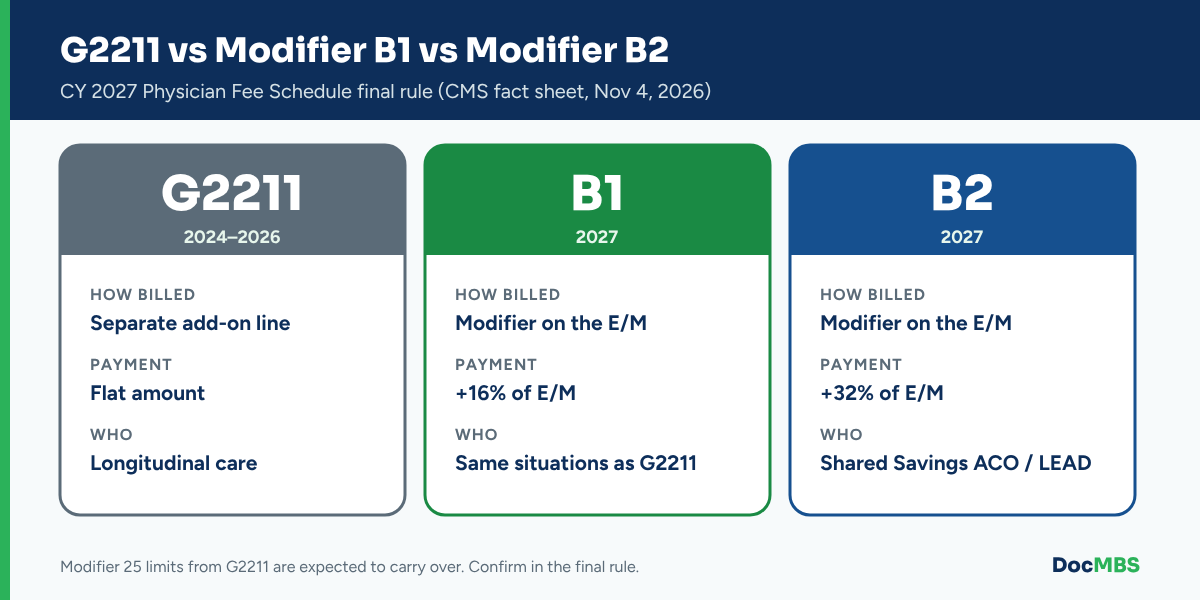
Medical Economics reports that B1 adds the same 16% at every E/M level, and that B2 is voluntary and can be used for any Medicare fee-for-service patient those ACO clinicians see, not only ACO-assigned patients. CMS expects the overall spending effect to be small, because the G2211 volume simply moves to the modifier.
Which Visits Can Use G2211 Modifier B1?
G2211 modifier B1 follows the same idea as G2211: it pays for the ongoing relationship, not for the visit being hard. Use it when the practitioner is:
- The continuing focal point for all of the patient’s needed health care services (for example, a primary care practitioner), or
- Giving ongoing care for a single serious or complex condition (for example, a psychiatrist managing a patient’s long-term mental illness).
Codes: Before you add G2211 modifier B1 to a template, check the code list. G2211 was billed with office/outpatient E/M codes (99202–99205 and 99211–99215). Reports on the final rule say B1 applies to those codes and may also apply to home or residence visits (99341–99350). [VERIFY: final list of E/M codes for B1 and B2 — CY 2027 PFS final rule / CMS-1848-F files]
Who can’t use it:
- FQHCs and RHCs paid under their own systems don’t bill G2211 separately today, so B1 isn’t expected to change their encounter payment. [VERIFY: CMS FQHC/RHC guidance for 2027]
- Visits where the relationship is one-time or short-term, such as a single urgent care visit or a one-off consult.
Watch Out: Your note must show the longitudinal relationship. “Patient seen for ongoing management of…” plus a plan for follow-up is much stronger than a generic visit note. If an auditor can’t see the relationship, the 16% is at risk.
How Much Does Modifier B1 Pay?
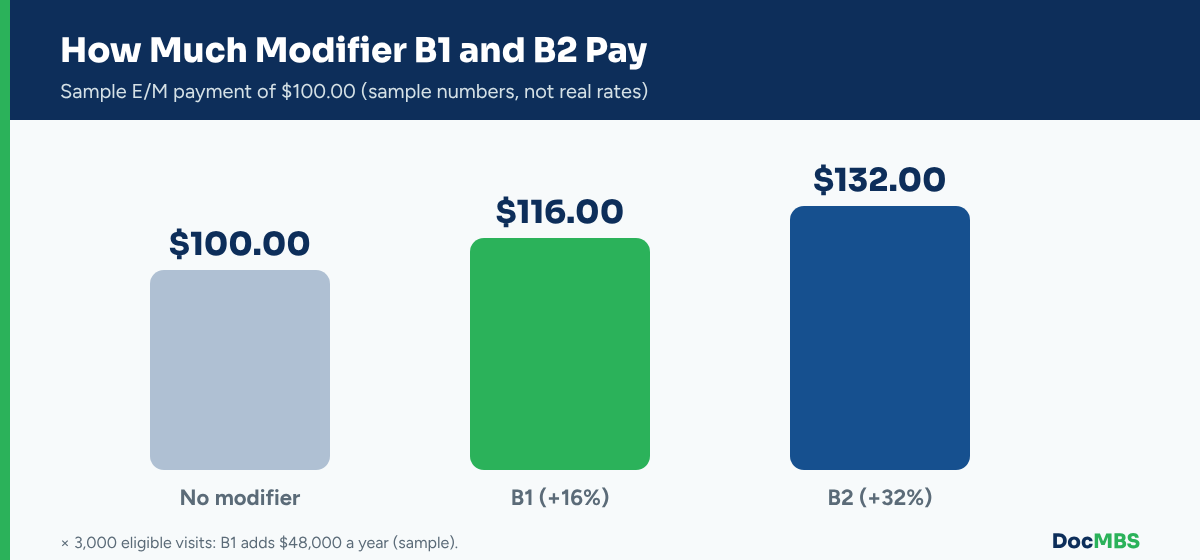
Because G2211 modifier B1 is a percentage, the dollar amount depends on the E/M code and your location. The numbers below are samples to show the math. Real E/M payments come from the 2027 CMS Physician Fee Schedule Look-Up Tool. [VERIFY: actual 2027 E/M payments for your locality, and whether the 16% applies to the full E/M payment or only the work RVUs — CY 2027 PFS final rule / your MAC’s 2027 fee schedule]
Worked Example (Sample Numbers)
| Item | No modifier | With B1 (+16%) | With B2 (+32%) |
|---|---|---|---|
| Sample E/M payment | $100.00 | $100.00 | $100.00 |
| Add-on from the modifier | $0.00 | $16.00 | $32.00 |
| Total per visit | $100.00 | $116.00 | $132.00 |
| × 3,000 eligible visits a year (sample) | — | +$48,000 | +$96,000 |
That $48,000 is money a practice can lose in 2027 if its templates still add the old G2211 line instead of G2211 modifier B1. The patient’s 20% Part B coinsurance applies to the higher payment too. [VERIFY: exact cost-sharing treatment — CY 2027 PFS final rule]
Still coding G2211 on your templates?
From January 1, 2027, a G2211 line won’t pay for Medicare. Our medical coding services update your E/M workflow for modifier B1 before January 1, so no add-on payment slips away.
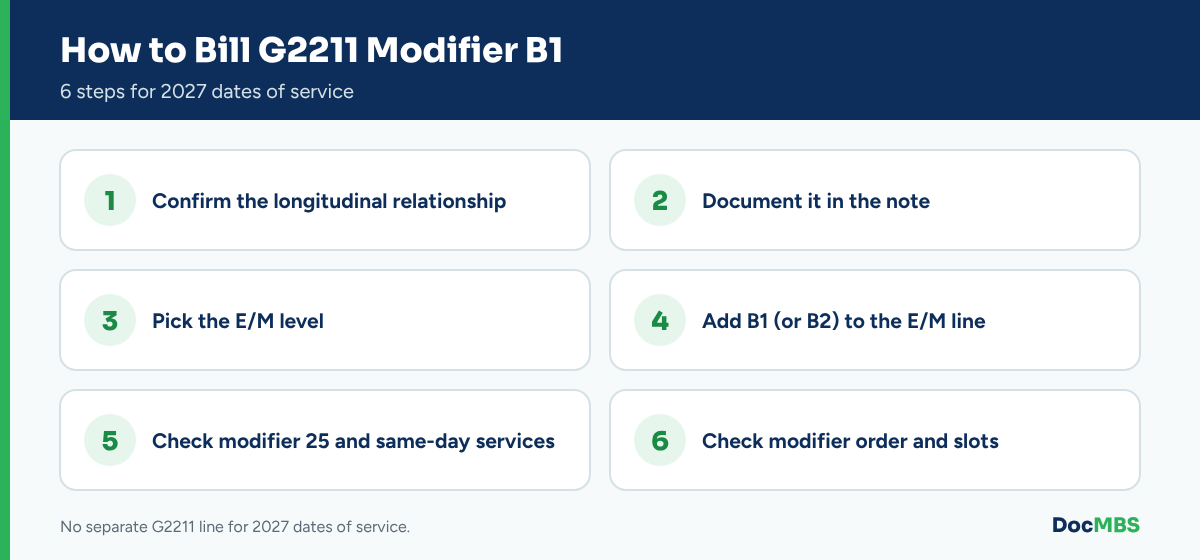
How to Bill G2211 Modifier B1: 6 Steps
- Confirm the longitudinal relationship. G2211 modifier B1 only applies to ongoing care. Is the practitioner the patient’s ongoing focal point, or managing a serious or complex condition over time?
- Document it in the note. Auditors will look for it on every G2211 modifier B1 claim. Show the ongoing relationship and the plan for continued care.
- Pick the E/M level based on medical decision making or total time, as usual.
- Add B1 to the E/M line, or B2 if the practitioner’s TIN/NPI is in a Shared Savings Program ACO or a LEAD Model. Don’t add a G2211 line for 2027 dates of service.
- Check same-day services. If the E/M has modifier 25, confirm whether the other service is an AWV, vaccine administration or Part B preventive service. [VERIFY: B1 modifier 25 exception]
- Check modifier order and slots. Put payment modifiers (like 25) and B1 in the order your MAC and clearinghouse expect, and make sure the claim has room for all of them. [VERIFY: MAC guidance on modifier order]
Modifier B1 With Modifier 25 and Same-Day Procedures
Under the G2211 rules, CMS transmittal R13015OTN (effective January 1, 2025) allowed G2211 with a modifier 25 E/M only when the same-day service was an annual wellness visit, vaccine administration or another Medicare Part B preventive service. Coverage of the final rule says this restriction carries over to G2211 modifier B1 and to B2. [VERIFY: B1/B2 modifier 25 exceptions in the final rule or MLN article]
The 2027 rule also changes same-day payment. When a separately identifiable office/outpatient E/M (modifier 25) is billed on the same day as a 0-day global procedure, the CMS fact sheet says the highest-paid service is paid at 100% and the others at 80%. CMS’s proposal had also covered 10- and 90-day globals at 50%; the final rule dropped that.
Pro Tip: For a same-day E/M + minor procedure, don’t expect B1 to pay. Bill the E/M with modifier 25, expect the 80% rule, and save B1 for visits where it clearly applies.
Specialty Angle: Mental Health and Behavioral Health
Psychiatrists and psychiatric nurse practitioners often bill an E/M (such as 99213 or 99214) with a psychotherapy add-on. These are exactly the long-term, complex-condition relationships G2211 was built for. In 2027, G2211 modifier B1 goes on the E/M line, not on the psychotherapy add-on. Our mental health billing services team can review your psychiatry templates, and our CPT code 90837 guide covers the psychotherapy side.
FQHC note: FQHCs bill Medicare mental health visits as PPS encounters (G0469/G0470 on revenue code 0900), not with E/M add-ons, so B1 isn’t expected to apply. [VERIFY: CMS FQHC guidance for 2027] See our FQHC PPS rate guide.
Common G2211 Modifier B1 Mistakes and Denials
These are the G2211 modifier B1 errors we expect on January claims. Exact codes will depend on your MAC’s edits. For a wider plan, see how to reduce claim denials.
| Mistake | Likely result | How to fix it |
|---|---|---|
| Billing G2211 on a 2027 date of service | Line denied, e.g. CO-181 or CO-4 [VERIFY] | Remove G2211; add B1 to the E/M code. |
| B1 on a code that isn’t eligible | CO-4 | Use B1 only on the eligible E/M codes. |
| B1 + modifier 25 with a procedure | CO-97 or CO-4 [VERIFY] | Drop B1 unless the same-day service is an AWV, vaccine or preventive service. |
| B2 billed by a clinician not in an eligible ACO or LEAD | CO-4 or CO-16 [VERIFY]; compliance risk | Check ACO/LEAD participation at the TIN and NPI level first. |
| No documentation of the longitudinal relationship | Audit risk; recoupment (CO-50) | Add a clear relationship statement to the note template. |
| MA or commercial payer still expects G2211 | CO-4 on the B1 line | Check each payer’s 2027 policy and bill to their rule. |
Texas Note: Medicare Advantage and Commercial Plans
G2211 modifier B1 is a Medicare fee-for-service rule. Medicare Advantage plans and commercial payers in Texas, such as BCBS Texas or the MA plans from large Texas carriers, set their own coding policies. Some may keep G2211, some may adopt B1, and some may not pay either. [VERIFY: 2027 G2211/B1 policies for your top Texas payers — each payer’s provider bulletin] Set payer-specific rules in your scrubber before January 1. If you bill BCBS Texas, our BCBS Texas timely filing guide covers their deadlines for fixing rejected claims.
Your January 1 Checklist
- Remove G2211 from EHR order sets and charge capture for 2027 dates of service.
- Add G2211 modifier B1 (and B2, if eligible) to E/M templates and the charge master.
- Update claim scrubber edits: no G2211 after 12/31/2026, and payer-specific rules for MA and commercial plans.
- Train providers on documenting the longitudinal relationship.
- Watch the first January ERAs for B1 payments and denials.
Key Takeaways
- G2211 modifier B1 replaces the G2211 add-on code on January 1, 2027.
- B1 adds 16% to the E/M payment; B2 adds 32% for Shared Savings ACO and LEAD Model clinicians.
- Bill it as a modifier on the E/M line, with no separate add-on line.
- Use it only for an ongoing, longitudinal care relationship, and document it.
- The modifier 25 limits from G2211 are expected to carry over.
- MA and commercial payers may follow different rules in 2027.
FAQs
Is G2211 going away in 2027?
For Medicare fee-for-service, yes, and G2211 modifier B1 takes its place. The CY 2027 Physician Fee Schedule final rule replaces G2211 with modifier B1 for services on or after January 1, 2027. The longitudinal care add-on continues, but you report it as a modifier on the E/M code instead of a separate add-on line.
What is modifier B1?
Modifier B1 is the 2027 replacement for G2211. You append it to an office/outpatient E/M code when the practitioner has an ongoing, longitudinal care relationship with the patient. According to the CMS fact sheet, it increases the payment for that E/M visit by 16%.
How much does modifier B1 pay?
B1 adds 16% to the associated E/M payment. For a sample E/M payment of $100.00, G2211 modifier B1 would add $16.00, for a total of $116.00. The real amount depends on the E/M code and your locality, so check the 2027 Physician Fee Schedule Look-Up Tool for your rates.
What is the difference between modifier B1 and B2?
B1 adds 16% to the E/M payment and is for the same situations as G2211. B2 adds 32% and is only for practitioners in a Medicare Shared Savings Program ACO or a LEAD Model participant provider. B2 is voluntary and can be used for any Medicare patient those clinicians see.
Can modifier B1 be billed with modifier 25?
Under the G2211 rules, the add-on wasn’t paid on a modifier 25 E/M unless the same-day service was an annual wellness visit, vaccine administration or a Part B preventive service. Reports on the final rule say B1 carries the same limit. Check the final rule or MLN guidance before relying on it.
Which E/M codes can use modifier B1?
G2211 was used with office/outpatient E/M codes 99202–99205 and 99211–99215. Reports on the final rule say B1 applies to those codes and may include home or residence visits. Confirm the final list in the CY 2027 PFS final rule files before you update templates.
What happens if I bill G2211 after January 1, 2027?
For Medicare fee-for-service, a G2211 line on a 2027 date of service is expected to deny, and you’d lose the add-on payment until you correct the claim with modifier B1. The exact denial code will depend on your MAC. Medicare Advantage and commercial payers may have different rules.
Get Ready for G2211 Modifier B1 Before January 1
G2211 modifier B1 keeps the longitudinal care add-on alive in 2027, but only for practices that change their templates, scrubber rules and payer settings in time. Replace G2211 with B1, use B2 only if you’re eligible, and document the ongoing relationship on every visit. Our medical coding team updates your E/M templates for modifier B1 before January 1. Book a free billing review.
This article is for education only. Confirm current rules with CMS, your Medicare Administrative Contractor and each payer before you bill.
Sources
- CMS: Calendar Year (CY) 2027 Medicare Physician Fee Schedule Final Rule fact sheet (November 4, 2026)
- CMS: Transmittal R13015OTN, G2211 with modifier 25 (effective January 1, 2025)
- CMS MLN Matters: MM13473, How to Use the Office and Outpatient E/M Visit Complexity Add-on Code G2211
- CMS: Physician Fee Schedule Look-Up Tool
Last updated: November 2026.
Need help with medical billing? End-to-end medical billing for US practices: charge entry, claim submission, payment posting, denial follow-up and reporting.