In this article
- What Is SNF Consolidated Billing?
- SNF Consolidated Billing: Who Bills What
- The SNF Consolidated Billing Exclusions List (Major Categories)
- October 2026 Update: CR 14561
- How the CMS Code Files Work
- Step-by-Step: Check a Code Before You Bill
- Worked Example: Mobile X-Ray During a Part A Stay
- SNF Consolidated Billing Denials and How to Fix Them
- SNF Consolidated Billing Vendor Agreement Checklist
- Texas Note
- Key Takeaways
- FAQs
- Keep SNF Consolidated Billing Under Control
- Sources
SNF consolidated billing decides who gets paid when a Medicare patient in a covered Part A skilled nursing facility stay needs labs, X-rays, therapy, supplies or a trip to the hospital. Get it wrong and the outside vendor’s Part B claim is denied, and the SNF ends up paying the bill out of its daily rate.
The rules also just changed. On October 1, 2026, CMS Change Request 14561 fixed the code lists that Medicare uses to enforce SNF consolidated billing, and 45 therapy-related codes can no longer be billed to Part B during a Part A stay. This guide explains who bills what, what changed and how to stop the denials.
Quick Answer
Under SNF consolidated billing, the SNF is responsible for almost every service a resident gets during a covered Part A stay, including labs, imaging, supplies and therapy. Outside providers can bill Part B only for excluded services, such as physician professional services, CT and MRI at a hospital, chemotherapy and dialysis. CMS publishes the exclusion lists every year and updates them every quarter.
What Is SNF Consolidated Billing?
SNF consolidated billing is the Medicare rule, in Section 1888(e) of the Social Security Act, that makes the skilled nursing facility the only provider Medicare pays for most services its residents receive during a covered Part A stay. The SNF’s PDPM daily rate is meant to cover those services, so Medicare won’t pay a second time on a Part B claim from someone else.
- During a covered Part A stay: nearly all services are bundled. The SNF provides them itself or buys them under arrangement from outside vendors and pays those vendors directly.
- During a non-covered stay (Part B resident): SNF consolidated billing applies only to physical therapy, occupational therapy and speech-language pathology. The SNF must bill those therapy services to Part B itself, even if an outside therapy group provides them.
- Excluded services are outside the bundle. The provider that furnishes them bills Medicare directly.
Medicare’s Common Working File knows when a patient is in a SNF stay. When an outside provider’s Part B claim lands on a date inside that stay for a code that isn’t excluded, the claim is denied.
Watch Out: SNF consolidated billing is a traditional Medicare rule. Medicare Advantage plans set their own rules in their contracts and provider manuals, so check the plan before you assume a service is bundled or billable.
SNF Consolidated Billing: Who Bills What
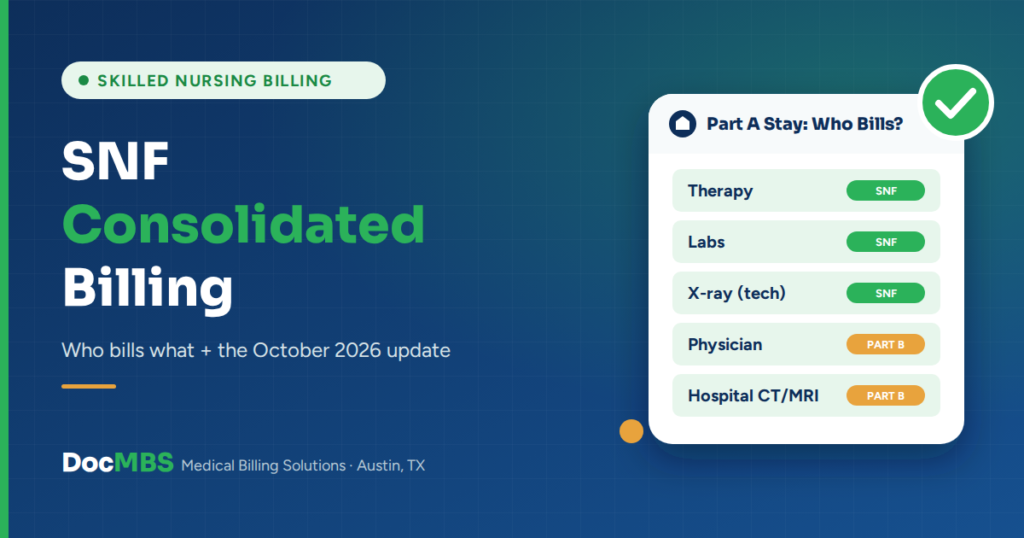
This is the question we get most from labs, imaging companies, ambulance providers and therapy groups. Here is the short answer for a resident in a covered Part A stay:
| Service | Who bills Medicare? | Notes |
|---|---|---|
| PT, OT and speech therapy | SNF | Bundled in Part A and Part B stays. Outside therapists are paid by the SNF. |
| Clinical lab tests | SNF | The lab bills the SNF under its agreement, not Part B. |
| X-rays and most imaging (technical part) | SNF | The reading physician bills Part B with modifier 26. |
| Drugs, supplies and DME | SNF | Except excluded drugs such as certain chemotherapy agents. |
| Physician and practitioner professional services | Physician / practitioner | Excluded by law: physicians, NPs, PAs, clinical nurse specialists, certified nurse-midwives, qualified psychologists and CRNAs. |
| CT, MRI, cardiac cath, radiation therapy, angiography at a hospital | Hospital | Major Category I. Excluded only when a hospital (or CAH) provides them on an outpatient basis. |
| Emergency room visits | Hospital | Major Category I.G. Hospitals add modifier ET to follow-up lines on later dates. |
| Ambulance | Depends on the trip | Excluded when tied to an excluded service (e.g., ER, CT, dialysis). Most other trips, including SNF-to-SNF (NN modifier), are bundled. |
| Dialysis for ESRD patients | Dialysis facility | Major Category II.A. |
| Hospice care for the terminal illness | Hospice | Major Category II.B. |
| Chemotherapy, radioisotopes, customized prosthetics | Provider that furnishes it (not a SNF) | Major Category III. Only codes on the CMS list. |
| Certain preventive services and vaccines | Part B | Major Category IV. The SNF bills them on type of bill 22X. |
Summary of CMS’s 2026 General Explanation of the Major Categories and the Medicare Claims Processing Manual, Chapter 6. Always check the specific code in the current CMS file.
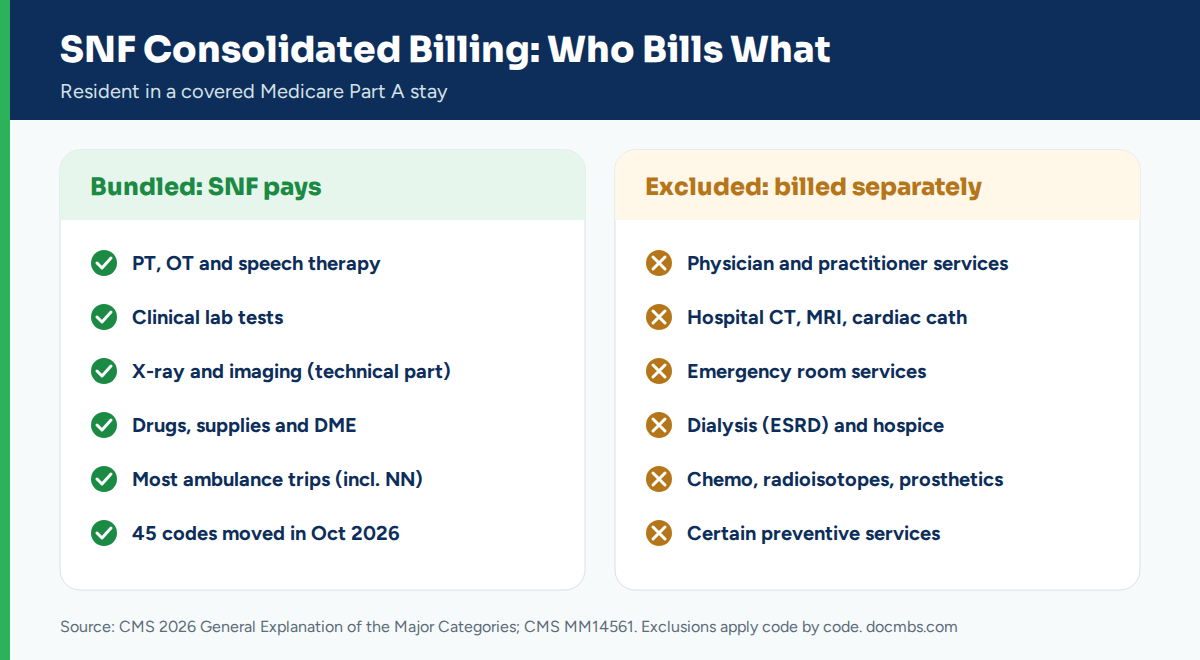
Pro Tip: Category names are a starting point, not an answer. SNF consolidated billing exclusions work code by code. A CT scan is excluded only if its HCPCS code is on the list and a hospital provides it.
The SNF Consolidated Billing Exclusions List (Major Categories)
CMS groups the SNF consolidated billing exclusions into four Major Categories. Each one works a little differently:
| Major Category | What it covers | Who can bill it |
|---|---|---|
| I. Services beyond the scope of a SNF | CT, cardiac catheterization, MRI, radiation therapy, angiography and related procedures, certain outpatient surgery, emergency services, related ambulance trips, additional surgery codes | Hospitals and CAHs, on an outpatient basis |
| II. Services for specific patients | Dialysis and related services for ESRD patients; hospice care for the terminal illness | Dialysis facilities; hospices |
| III. Excluded services by certified providers | Chemotherapy and its administration, radioisotopes, customized prosthetic devices, certain blood clotting factors | Any Medicare provider other than a SNF |
| IV. Preventive and screening services | Mammography, certain vaccines and their administration, screening Pap and pelvic exams, colorectal, prostate, glaucoma, diabetes, cardiovascular and AAA screening, the initial preventive physical exam | Part B; the SNF bills on type of bill 22X |
Two more rules from CMS matter on real claims:
- Same-day related services. When a hospital provides an excluded Category I service, directly related services on the same date and claim are generally excluded too.
- Chemo administration. Some chemotherapy administration codes are bundled when billed alone, but they become excluded when billed on the same date as an excluded chemotherapy drug.
CMS also updated the annual list on January 1, 2026. It added cardiac catheterization codes C7568–C7571, chemotherapy codes C9308, J9184, J9282 and J9326, and radioisotope code C9176, and terminated several chemotherapy and customized prosthetic codes (CMS 2026 Part A MAC Update).
Paying vendors twice or losing money to consolidated billing denials?
DocMBS checks every SNF consolidated billing code against the current CMS files, matches vendor invoices to Part A stays and keeps your PDPM claims clean.
See our skilled nursing facility billing services for full support with PDPM claims, triple check and SNF consolidated billing.
October 2026 Update: CR 14561
CMS Change Request 14561 is the October 2026 quarterly update to the SNF consolidated billing code files (Transmittals R13881CP and R13943CP; MLN Matters MM14561). It took effect October 1, 2026, and MACs implemented it on October 5, 2026.
What changed in October 2026
- 45 codes removed from Part B File #1, kept on File #4. CMS says these codes were on both files by mistake. They include biofeedback (90901, 90912, 90913), cognitive function intervention (97129, 97130), caregiver training (97550–97552), wound care and negative pressure wound therapy (97597, 97598, 97605–97608, 97610), remote therapeutic monitoring codes and several G-codes.
- New exclusions added (effective July 1, 2026): 1027T (Category I.E), C1609, 1050T and 1051T (Category I.I), vaccines 90616 and 90639 (Category IV.B) and 1036T (Category IV.I).
- Other file changes: 98978 added to Part B File #1 (effective January 1, 2026) and terminated from File #4; 92618 added to File #4 (effective June 17, 2026).
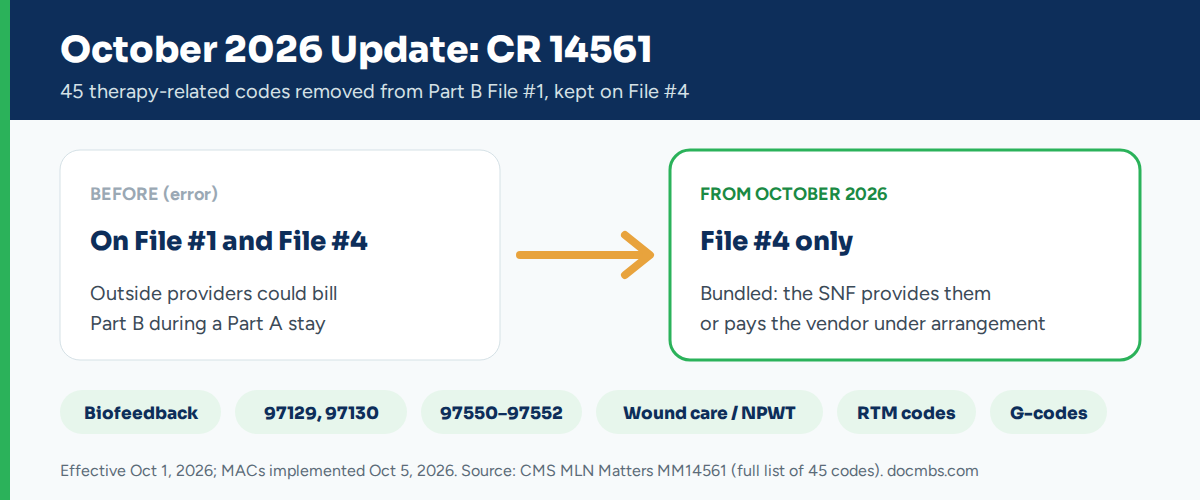
What the File #1 removal means: File #1 lists codes an outside provider can bill to Part B during a Part A stay. Taking these 45 codes off File #1 means outside therapists and wound care providers can no longer bill Part B for them while the patient is in a covered Part A stay. They are now part of SNF consolidated billing, so the SNF must provide them or pay the vendor under arrangement. Because they stay on File #4, the SNF also bills them for Part B residents, like other therapy services.
Lookback: CMS says MACs won’t search for claims paid incorrectly under the old lists, but they will reopen and reprocess claims you bring to their attention.
Watch Out: Wound care and therapy vendors that billed codes like 97597 or 97129 to Part B during Part A stays will now get denials. SNFs should expect new invoices from those vendors and update their arrangements. [VERIFY: whether the File #1 removal applies by date of service on or after October 1 or by claims processed on or after October 5, 2026, in MM14561]
How the CMS Code Files Work
CMS publishes separate code files for SNFs (Part A MAC) and for outside providers (Part B MAC). For outside providers, the Part B files decide whether a claim is paid during a SNF stay:
- Files #1 and #2: codes that can be billed separately to the Part B MAC during a covered Part A stay. If a code is in neither file, it is subject to SNF consolidated billing and the provider must look to the SNF for payment.
- File #3: ambulance codes. Trips billed with the NN origin/destination modifier (SNF to SNF) are bundled. Other modifiers are separately payable.
- File #4: therapy codes that are subject to SNF consolidated billing during a Part B (non-covered) stay. The Part B MAC won’t pay outside providers for them.
Most MACs also publish a lookup tool or matrix, such as the CGS consolidated billing tool and the Noridian SNF CB matrix, so you can check a single code quickly.
Step-by-Step: Check a Code Before You Bill
- Check for an open SNF stay. Run an eligibility check (270/271 or your MAC portal) for the date of service. If the patient is in a covered Part A stay, SNF consolidated billing applies.
- Look up the code. Use the current CMS annual file plus the latest quarterly update, or your MAC’s lookup tool. Ask: is the code on Part B File #1 or #2?
- Check who provided it and where. Category I services are excluded only when a hospital provides them. Category II depends on the patient (ESRD or hospice).
- Split professional and technical. The reading physician bills the professional component with modifier 26 to Part B. The technical component of bundled imaging goes to the SNF.
- Bill the right payer. If the code is bundled, invoice the SNF under your written agreement. If it is excluded, bill Part B and keep proof of the exclusion with the claim notes.
Pro Tip: On the SNF claims we work, the biggest leak isn’t the denial itself. It’s the vendor invoice that shows up three months later with no agreement behind it. Track every outside service against the resident’s Part A dates at the time of the order.
Worked Example: Mobile X-Ray During a Part A Stay
A resident is on day 12 of a covered Part A stay. A mobile imaging company takes a two-view chest X-ray (CPT 71046) at the facility, and a radiologist reads it.
The vendor price below is a sample number for the math only. It is not a Medicare rate.
| Part of the service | Wrong way | Right way |
|---|---|---|
| Technical component (the X-ray itself) | Imaging company bills 71046-TC to Part B → denied CO-109 / N538 | Imaging company invoices the SNF at the contract price, e.g. $60.00 (sample) |
| Professional component (the reading) | Radiologist waits for the SNF to pay | Radiologist bills 71046-26 to Part B (excluded professional service) |
| SNF claim | X-ray left off; no record of cost | SNF reports the service on its Part A claim (radiology revenue code) and pays the $60 out of its PDPM payment |
The money: If the imaging company has no agreement and the X-ray happens 4 times during the stay, that’s 4 × $60 = $240 (sample) the SNF still owes, plus four denied Part B claims the vendor has to chase. With an agreement in place, the vendor invoices once a month and nobody waits on a denial.
SNF Consolidated Billing Denials and How to Fix Them
| Code | What it means | Typical SNF consolidated billing cause | Fix |
|---|---|---|---|
| CO-109 + N538 | Not covered by this payer; the facility is responsible for paying outside providers | Outside lab, imaging, supply or therapy vendor billed Part B during a Part A stay | Confirm the stay dates and that the code isn’t on File #1/#2. Then invoice the SNF. Don’t rebill Part B. |
| CO-109 + N193 | Another program or payer may cover the service | Same situation, alternate remark code | Same fix: bill the SNF under your agreement. |
| CO-109 on an excluded code | Denied even though the service should be excluded | Wrong code, missing modifier 26, wrong ambulance modifier, or an ER line missing modifier ET | Reopen and correct the code or modifier. If it’s on File #2, a code or modifier fix is usually all it needs. |
| CO-16 | Missing or invalid information | Missing modifier, origin/destination code, or SNF claim data | Add the missing data and resubmit. |
| SNF-side denial | SNF bills an excluded service on its Part A claim | SNF lists a hospital CT or chemo drug it didn’t provide | Remove the excluded line. That service belongs to the provider who furnished it. |
Reason and remark codes from Noridian JE Part B SNF reason code guidance. Your MAC may use different remark codes.
Need help clearing a backlog? Our denial management team works SNF and vendor denials every day, and our guide on how to reduce claim denials covers the prevention side.
SNF Consolidated Billing Vendor Agreement Checklist
Every outside vendor that serves Part A residents needs a written agreement with the SNF before the first service. At a minimum, it should cover:
- Services and codes covered (lab, imaging, pharmacy, therapy, wound care, ambulance), including the 45 codes that moved in October 2026.
- Price per service or per code, and who pays for supplies.
- How the vendor checks stay status before billing Part B, and who tells whom when a resident is admitted or discharged.
- Invoice timing and format: resident name, date of service, HCPCS code and order.
- Who bills the professional component (modifier 26) and who bills the technical part.
- What happens on a denial: the vendor doesn’t bill the resident, and the SNF pays per the agreement.
- Records: orders, results and notes the SNF needs for its MDS and its Part A claim.
Texas Note
SNF consolidated billing is a Medicare rule. Texas Medicaid pays nursing facility services under its own rules, and most Texas Medicaid nursing facility residents are in STAR+PLUS managed care. For a dual-eligible resident in a covered Medicare Part A stay, Medicare’s SNF consolidated billing rules decide who bills Medicare first. Texas Medicaid’s crossover and coinsurance rules apply after that. Check the Texas Medicaid Provider Procedures Manual and your STAR+PLUS plan for Medicaid-side billing. If you run a Texas facility, our Austin medical billing team works with both Medicare and Texas Medicaid.
Key Takeaways
- SNF consolidated billing makes the SNF responsible for almost all services during a covered Part A stay, and for therapy during Part B stays too.
- Outside providers can bill Part B only for excluded codes on Part B Files #1 and #2.
- Exclusions fall into four Major Categories, plus physician and practitioner professional services.
- CR 14561 (October 2026) removed 45 therapy-related codes from File #1, so outside providers can’t bill them to Part B during a Part A stay.
- Denials show up as CO-109 with N538. The fix is a vendor invoice to the SNF, not a Part B rebill.
- Put every vendor arrangement in writing before the first service.
FAQs
What is SNF consolidated billing?
SNF consolidated billing is the Medicare rule that makes a skilled nursing facility responsible for billing almost all services its residents receive during a covered Part A stay. Outside labs, imaging companies, suppliers and therapists must be paid by the SNF instead of billing Part B, unless the service is on CMS’s exclusion list.
What services are excluded from SNF consolidated billing?
Excluded services include physician and practitioner professional services, certain hospital outpatient services such as CT, MRI and cardiac catheterization, emergency services, dialysis for ESRD patients, hospice care, chemotherapy, radioisotopes, customized prosthetics and certain preventive services. Exclusions apply code by code, so check the current CMS file.
What changed in SNF consolidated billing in October 2026?
CMS Change Request 14561 removed 45 therapy-related codes from Part B File #1 because they were listed there by mistake. These include biofeedback, cognitive therapy, caregiver training and wound care codes. Outside providers can no longer bill them to Part B during a covered Part A stay. CR 14561 also added several new exclusion codes.
Does SNF consolidated billing apply to Part B residents?
Only for therapy. When a resident is not in a covered Part A stay, SNF consolidated billing still applies to physical therapy, occupational therapy and speech-language pathology. The SNF must bill those services to Part B, even when an outside therapy provider furnishes them. Other services can be billed by the provider.
Can a physician bill Part B during a SNF Part A stay?
Yes. Professional services of physicians and certain practitioners, such as nurse practitioners, physician assistants and clinical psychologists, are excluded from SNF consolidated billing. For tests like X-rays, the physician bills only the professional component with modifier 26. The technical component is bundled into the SNF payment.
What denial code means a service falls under SNF consolidated billing?
Medicare usually denies these Part B claims with CO-109 (not covered by this payer/contractor) and remark code N538, which says the facility is responsible for paying outside providers. Some MACs also use N193. The fix is to invoice the SNF under your agreement, not to rebill Medicare.
Is ambulance transport included in SNF consolidated billing?
It depends on the trip. Ambulance trips tied to excluded services, such as emergency visits, CT scans or dialysis for ESRD patients, are excluded and billed by the ambulance supplier. Most other trips, including transfers between two SNFs billed with the NN modifier, are bundled and paid by the SNF.
Keep SNF Consolidated Billing Under Control
SNF consolidated billing protects your PDPM payment only when every outside service is matched to the right payer. With CR 14561 moving 45 codes into the bundle in October 2026, now is the time to update vendor agreements, rerun your code lists and train staff to check stay dates first.
DocMBS manages PDPM claims, triple check and SNF consolidated billing for skilled nursing facilities. See our skilled nursing facility billing services or book a free billing review.
Related reading: SNF Medicare daily rate for FY 2027, revenue code 0022 and home health consolidated billing.
Sources
- CMS: MLN Matters MM14561: SNF Consolidated Billing Enforcement, October 2026 Update
- CMS: Transmittal R13881CP (CR 14561)
- CMS: 2026 General Explanation of the Major Categories for SNF Consolidated Billing
- CMS: 2026 Part A MAC Update
- CMS: Part B MAC File Explanation
- CMS: Medicare Claims Processing Manual, Chapter 6: SNF Inpatient Part A Billing and SNF Consolidated Billing
- Noridian: JE Part B SNF Reason Code Guidance
- Noridian: SNF Consolidated Billing Matrix
Last updated: October 2026. This article is for education only. Code lists change every quarter. Confirm with the current CMS files and your Medicare Administrative Contractor before billing.
Need help with skilled nursing facility billing? Medicare Part A and B, Medicaid and managed care billing for skilled nursing facilities, with PDPM, MDS and consolidated billing rules checked before claims go out.