
By DocMBS Billing Team · Last updated: October 2026
An out-of-network claim comes back paid at a fraction of your charge, and the patient can’t be balance billed. For many practices that money is simply written off. The No Surprises Act IDR process is the way to get it back, and in 2026 it became much cheaper to use. The federal filing fee dropped from $115 to $15.
This guide walks providers through each step, deadline and fee under the 2026 rules, with a worked example that shows when a dispute is worth filing.
Quick Answer
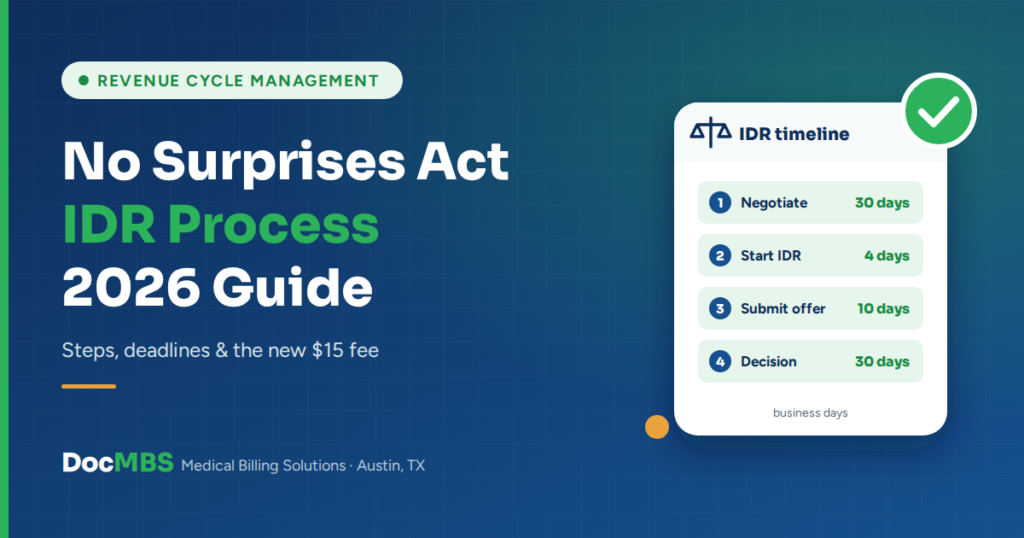
The No Surprises Act IDR process lets out-of-network providers dispute low payments on protected claims. You negotiate with the plan for 30 business days, then have 4 business days to start IDR. Each side submits an offer and a certified IDR entity picks one. Since June 11, 2026, the administrative fee is $15 per party.
Table of Contents
- What Is the No Surprises Act IDR Process?
- Which Claims Are Eligible?
- What Changed in 2026
- No Surprises Act IDR Process: Steps and Deadlines
- IDR Fees in 2026
- Batching Rules and the 50-Item Cap
- Worked Example: Is a Dispute Worth Filing?
- Common Mistakes and How to Fix Them
- Behavioral Health and Facility Claims
- Texas Note: State Arbitration vs Federal IDR
- Key Takeaways
- FAQs
- Sources
What Is the No Surprises Act IDR Process?
The No Surprises Act stops out-of-network providers from balance billing patients in certain situations. In return, it gives providers and health plans a way to settle the payment amount between themselves. That is Independent Dispute Resolution, or IDR.
IDR works like baseball arbitration. Each side submits one payment offer. A certified IDR entity reviews both and picks one of the two. It cannot split the difference. The decision is binding.
The process is heavily used. CMS reported on October 2, 2026 that it has received and closed more than 7 million disputes since April 2022.
Which Claims Are Eligible?
| Eligible for federal IDR | Not eligible |
|---|---|
| Out-of-network emergency services, including post-stabilization care | Medicare, Medicare Advantage, Medicaid and TRICARE claims |
| Non-emergency services by an out-of-network provider at an in-network facility | Claims covered by a state surprise billing law or all-payer model |
| Out-of-network air ambulance services | Routine out-of-network office visits the patient chose |
| Patient is covered by a group health plan or individual health insurance | Services where the patient gave valid notice and consent to out-of-network billing |
Watch Out: Ineligible disputes are the biggest waste in this process. The final rule notes that from April 2022 through December 2024, 355,804 disputes were found ineligible. You still owe the administrative fee on an ineligible dispute. Confirm eligibility before you file.
What Changed in 2026
The Departments of HHS, Labor and the Treasury issued the Federal IDR Operations final rule (CMS-9897-F) on May 28, 2026. It was published in the Federal Register on June 4, 2026 and took effect August 3, 2026. Several parts phase in later.
| Change | New rule | When it applies |
|---|---|---|
| Administrative fee | $15 per party per dispute (was $115) | Disputes initiated on or after June 11, 2026 |
| Batching cap | Up to 50 line items per batched dispute | Phased in after the effective date |
| Eligibility decision | IDR entity must decide within 5 business days of final selection | 90 days after CMS announces the portal function is ready |
| Open negotiation notice | Sent through the federal IDR portal; plan must respond by business day 15 | 90 days after CMS announces the portal function is ready |
| Remittance codes | Plans must use specific CARCs and RARCs showing whether a claim is subject to the Act and IDR | Per CMS guidance (issued July 2026) |
| IDR registry | Plans must register and show an IDR registration number on payment notices | 90 business days after CMS announces the registry is ready |
| Unpaid fees | If you don’t pay fees by the offer deadline, your offer is not considered | August 3, 2026 |
CMS is also moving the process to a new platform, the IDR Gateway. Sign-ups opened on September 15, 2026, and CMS says the process will move from single-use web forms to the Gateway in late 2026. If your practice or billing company files disputes, register now.
No Surprises Act IDR Process: Steps and Deadlines
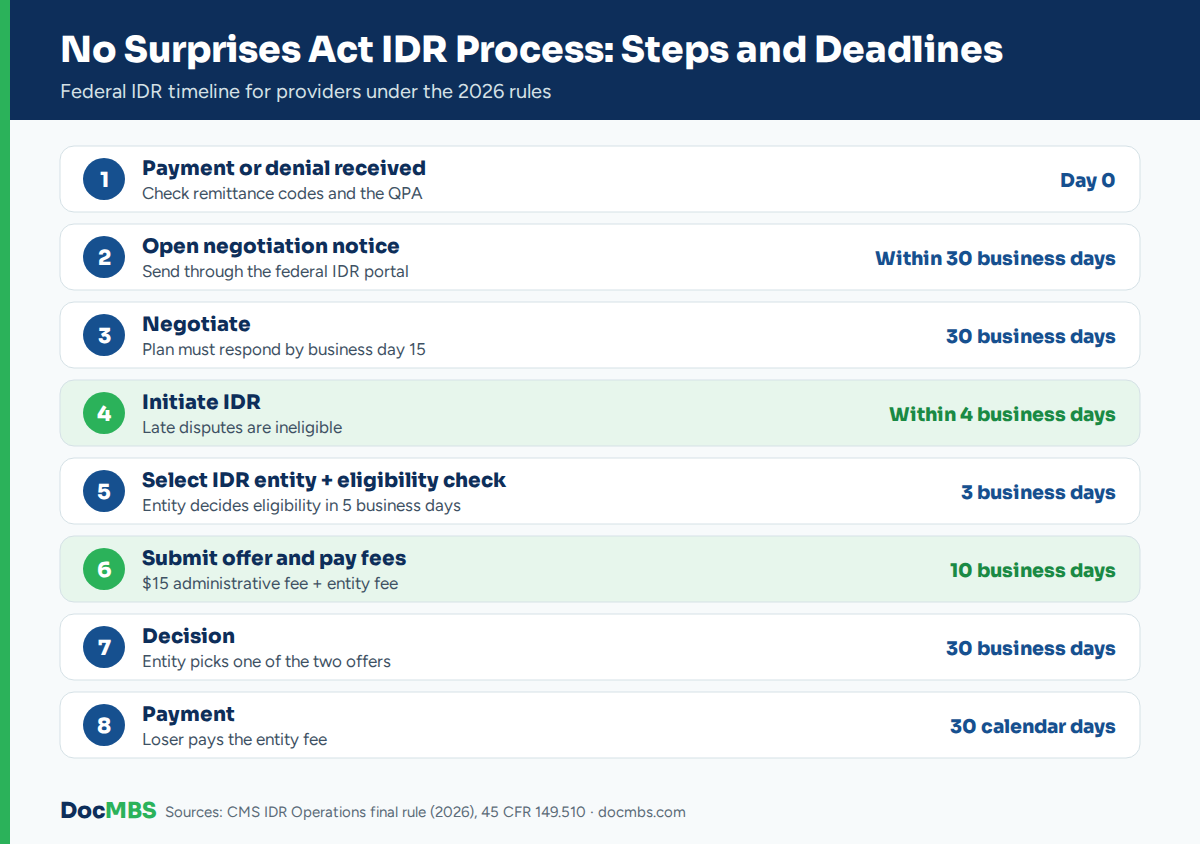
The clock starts when you receive the plan’s initial payment or denial. Most deadlines are counted in business days.
- Receive the initial payment or denial. Check the remittance for the codes that show the claim falls under the No Surprises Act, and note the plan’s qualifying payment amount (QPA).
- Start open negotiation within 30 business days. Send the open negotiation notice. Under the 2026 rule, this goes through the federal IDR portal.
- Negotiate for 30 business days. The plan must respond by business day 15. Many disputes settle here, so make a real offer.
- Initiate IDR within 4 business days after open negotiation ends. A dispute started later than that is ineligible.
- Select a certified IDR entity within 3 business days. If the parties can’t agree, the Departments pick one at random.
- Eligibility check. The IDR entity decides whether the dispute qualifies within 5 business days of final selection. If it asks you for information, answer within 5 business days.
- Submit your offer and pay your fees within 10 business days of entity selection. Include your evidence.
- Decision within 30 business days of entity selection. The entity picks one offer.
- Payment within 30 calendar days of the decision.
After a decision, there is a 90-calendar-day cooling-off period. During it, the same party cannot start a new dispute with the same other party over the same item or service.
Writing off underpaid out-of-network claims?
DocMBS finds your IDR-eligible claims, tracks every open negotiation and 4-day deadline, and prepares the offers. Find out how much your practice could recover.
IDR Fees in 2026
There are two separate fees. Know both before you file.
| Fee | 2026 amount | Who pays | Refundable? |
|---|---|---|---|
| Administrative fee | $15 per party per dispute (was $115 before June 11, 2026) | Both parties | No, even if the dispute is ineligible |
| IDR entity fee, single dispute | $200–$840, set by each entity | Both pay up front | Yes, to the winning party |
| IDR entity fee, batched dispute | $268–$1,173, plus $75–$250 for each additional 25 line items after the first 25 | Both pay up front | Yes, to the winning party |
Entity fee ranges are the ones the Departments kept in place for 2026. Each certified IDR entity publishes its own fee inside the range.
The key point: the loser pays the IDR entity fee. If you win, your entity fee comes back and your only cost is the $15. If you lose, you are out both fees.
Batching Rules and the 50-Item Cap
Batching lets you combine similar claims into one dispute and pay one set of fees. Under the 2026 rule, items can be batched if they are:
- Furnished to one patient on the same or consecutive dates of service and billed on the same claim form, or
- Billed under the same service code (or a comparable code in another code system), or
- Anesthesiology, radiology, pathology or laboratory services with codes in the same Category I CPT section.
The claims must also involve the same provider or group and the same plan. A batched dispute is limited to 50 line items.
Pro Tip: Batching is what makes small claims worth disputing. One $300 underpayment may not justify the risk of losing the entity fee. Twenty of them with the same code and the same plan usually do.
Worked Example: Is a Dispute Worth Filing?
Example only. The practice, amounts and entity fees are illustrative.
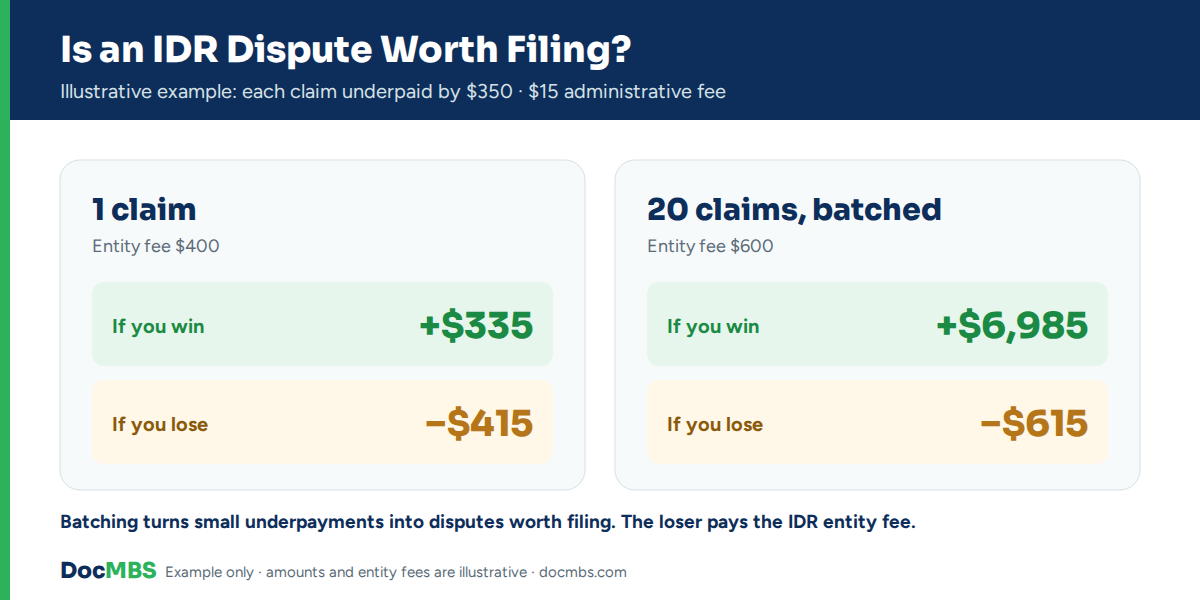
An out-of-network emergency physician group bills $1,200 for a visit. The plan pays its QPA of $250. After open negotiation fails, the group offers $600 and the plan offers $250. The IDR entity charges $400 for a single dispute.
| Outcome | Extra payment | Administrative fee | IDR entity fee | Net result |
|---|---|---|---|---|
| Provider wins | +$350 | −$15 | $0 (refunded) | +$335 |
| Provider loses | $0 | −$15 | −$400 | −$415 |
On a single claim, the downside is larger than the upside. Now batch 20 claims with the same code and plan, each underpaid by $350, with a batched entity fee of $600:
| Outcome | Extra payment | Administrative fee | IDR entity fee | Net result |
|---|---|---|---|---|
| Provider wins | +$7,000 | −$15 | $0 (refunded) | +$6,985 |
| Provider loses | $0 | −$15 | −$600 | −$615 |
What this shows: the $15 fee is now a small part of the math. What decides whether to file is the entity fee you risk, the amount in dispute, and how reasonable your offer is. An offer far above market rates is more likely to lose.
Common Mistakes and How to Fix Them
| Mistake | What happens | How to fix it |
|---|---|---|
| Filing a claim that isn’t covered by the Act | Dispute closed as ineligible; $15 fee still owed | Check plan type, service type and state law before filing |
| Missing the 4-business-day window | Dispute is ineligible | Calendar the end of open negotiation the day you send the notice |
| Skipping open negotiation or sending the notice the wrong way | Dispute rejected | Send the notice through the federal IDR portal and keep proof |
| Batching claims that don’t belong together | Batch rejected or split | Same provider, same plan, same code (or one patient encounter), 50 items or fewer |
| Not paying fees by the offer deadline | Your offer is not considered, and you still owe the fees | Pay both fees when you submit the offer |
| Ignoring the remittance codes | You miss eligible claims or file ineligible ones | Train posters to read the new IDR-related CARCs and RARCs on out-of-network remits |
| Filing against the wrong plan entity | Delays and eligibility challenges | Use the plan’s legal name and IDR registration number from the payment notice |
On the out-of-network claims we work, the most common problem is not a lost dispute. It is a claim that was never disputed because nobody flagged it as eligible when the payment was posted. Our revenue cycle and denial management services build that check into payment posting.
Behavioral Health and Facility Claims
Behavioral health: Most outpatient therapy by an out-of-network therapist is not covered by the No Surprises Act, because the patient chose the provider. IDR applies when behavioral health care is an emergency service, such as a psychiatric emergency, or when an out-of-network clinician sees the patient at an in-network hospital or facility.
Facilities and emergency groups: Emergency departments, hospital-based physicians, anesthesia, radiology and pathology groups have the most eligible claims. For them, a steady batching process matters more than any single dispute.
Texas Note: State Arbitration vs Federal IDR
Texas has its own surprise billing law, Senate Bill 1264, run by the Texas Department of Insurance (TDI). Which process you use depends on the patient’s plan:
| Patient’s plan | Process |
|---|---|
| State-regulated plans (TDI-regulated HMO, PPO and EPO plans), and state employee (ERS) and teacher (TRS) plans | Texas process through TDI: arbitration for physicians and other providers, mediation for facilities |
| Self-funded employer plans and other federally regulated plans | Federal IDR |
State-regulated plan ID cards in Texas are marked “TDI” or “DOI.” Check the card before you choose a path. Filing a Texas-regulated claim in federal IDR will get it closed as ineligible. The Texas process has its own deadlines and fees, so confirm them with TDI.
Key Takeaways
- The federal administrative fee is $15 per party for disputes initiated on or after June 11, 2026, down from $115.
- Deadlines: 30 business days of open negotiation, then 4 business days to start IDR.
- The IDR entity picks one offer, and the loser pays the entity fee ($200–$840 single, $268–$1,173 batched).
- You can batch up to 50 line items that meet the batching rules.
- Check eligibility and plan type first. In Texas, state-regulated plans go through TDI, not federal IDR.
- Register for the IDR Gateway, which replaces the current web forms in late 2026.
FAQs
What is the No Surprises Act IDR process?
It is the federal process for settling payment disputes between out-of-network providers and health plans on claims protected by the No Surprises Act. After a 30-business-day negotiation, each side submits a payment offer, and a certified IDR entity picks one. The decision is binding on both.
How much does IDR cost in 2026?
Each party pays a $15 administrative fee per dispute, for disputes initiated on or after June 11, 2026. Each party also pays the certified IDR entity fee up front: $200 to $840 for a single dispute, or $268 to $1,173 for a batched one. The winner gets the entity fee back.
How long do I have to start IDR?
You must first open negotiation within 30 business days of the initial payment or denial, then negotiate for 30 business days. If that fails, you have 4 business days after negotiation ends to initiate IDR. Disputes started after that window are ineligible.
Which claims qualify for federal IDR?
Out-of-network emergency services, non-emergency services by out-of-network providers at in-network facilities, and out-of-network air ambulance services qualify, when the patient has a group health plan or individual coverage. Medicare, Medicaid and claims covered by a state surprise billing law do not.
How many claims can be batched in one IDR dispute?
Under the 2026 final rule, a batched dispute can include up to 50 line items. The items must meet the batching rules, such as the same service code, or one patient’s services on the same claim, and must involve the same provider or group and the same plan.
Who pays the IDR fees if I win?
The losing party pays the certified IDR entity fee, so your entity fee is refunded if your offer is chosen. The $15 administrative fee is not refundable for either party, and it is owed even if the dispute turns out to be ineligible.
Does federal IDR apply in Texas?
Only for some plans. Texas-regulated plans, plus state employee and teacher plans, use the Texas arbitration and mediation process run by the Texas Department of Insurance. Self-funded employer plans and other federally regulated plans use federal IDR. Look for “TDI” or “DOI” on the member’s ID card.
Stop Leaving Out-of-Network Money on the Table
With a $15 filing fee and a 50-item batching cap, the No Surprises Act IDR process now makes sense for far more claims than before. The practices that benefit are the ones that flag eligible claims early and never miss the 4-day window.
DocMBS can review your out-of-network payments and show you which ones are worth disputing. Book a free billing review to get started.
Sources
- CMS: Federal IDR Operations Final Rule fact sheet, May 28, 2026
- Federal Register: Federal Independent Dispute Resolution Operations (91 FR 33900), June 4, 2026
- CMS: About Independent Dispute Resolution
- CMS: CMS convenes certified IDR entity leaders, October 2, 2026
- Texas Department of Insurance: Senate Bill 1264 implementation
Last updated: October 2026. This article is for education only and is not legal advice. IDR rules are phasing in during 2026, so confirm current deadlines and fees with CMS, your certified IDR entity or TDI before filing.
Talk to our billing team
Book an appointment and discuss your practice's billing with a DocMBS specialist.