By DocMBS Billing Team · Last updated: October 2026
CPT code 90837 is the most-billed psychotherapy code, and also the one payers question most. Bill it for a 50-minute session and you risk a downcode or a refund request. Bill 90834 for a true 55-minute session and you give away money on every visit.
This guide covers the time rule, the 2026 Medicare rate, a worked payment example, telehealth and E/M rules, and the denials we see most on 90837 claims, with a fix for each.
Quick Answer
CPT code 90837 is individual psychotherapy lasting 53 minutes or more with the patient. It is billed as one unit per session. The 2026 Medicare national rate is about $167.00 in an office setting, before locality adjustment. Document exact start and stop times, because payers audit this code heavily.
Table of Contents
- What Is CPT Code 90837?
- The 53-Minute Rule: 90832 vs 90834 vs 90837
- CPT Code 90837 Reimbursement Rate for 2026
- Worked Example: One 60-Minute Session
- Who Can Bill 90837?
- 90837 and E/M Visits: Use the Add-On Codes
- Telehealth Rules for 90837
- Step-by-Step: Audit-Proof Documentation
- Common 90837 Denials and How to Fix Them
- Texas Medicaid Note
- Key Takeaways
- FAQs
- Sources
What Is CPT Code 90837?
CPT code 90837 reports individual psychotherapy of 53 minutes or longer, face-to-face with the patient. Family members may join for part of the session, but the patient must be present for most of it. It is the “60-minute session” code.
- Units: one unit per session, no matter how far past 53 minutes it runs.
- What counts: time spent in psychotherapy with the patient. Scheduling, note writing and phone calls afterward do not count.
- Common diagnoses: depression, anxiety disorders, PTSD and other conditions where longer sessions are clinically needed.
The 53-Minute Rule: 90832 vs 90834 vs 90837
Psychotherapy codes are picked by actual minutes, using the CPT midpoint rule. You may bill a code once you pass the halfway point of its stated time.
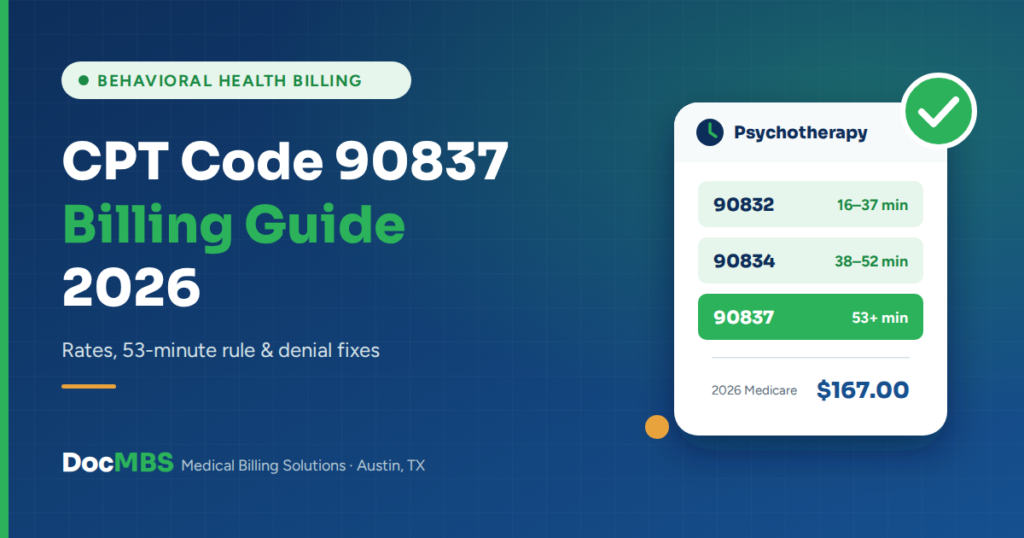
| Code | Session name | Actual psychotherapy time |
|---|---|---|
| Not billable as psychotherapy | — | Under 16 minutes |
| 90832 | 30-minute session | 16–37 minutes |
| 90834 | 45-minute session | 38–52 minutes |
| 90837 | 60-minute session | 53 minutes or more |
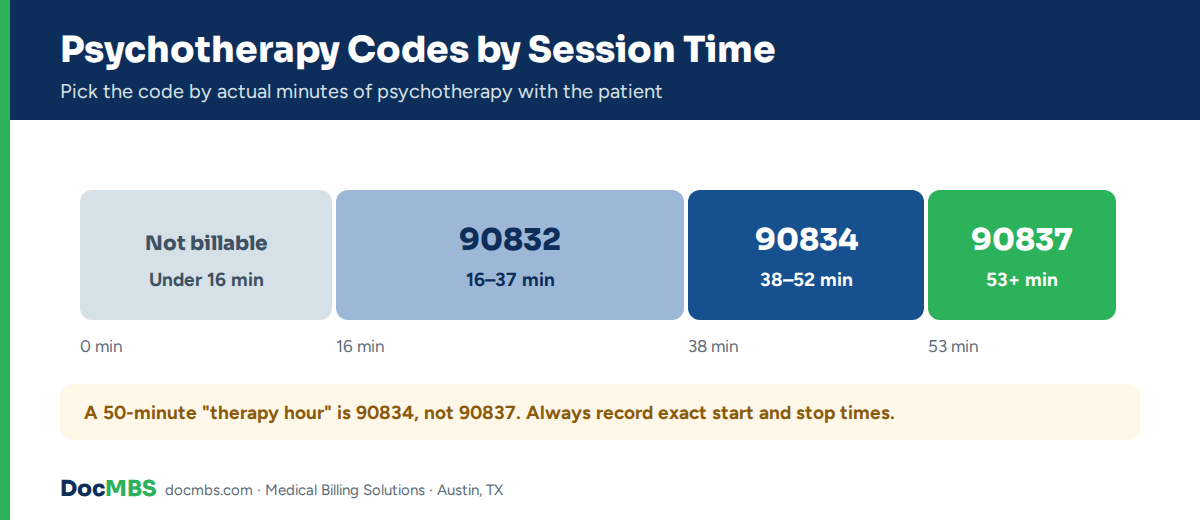
Watch Out: A “therapy hour” of 50 minutes is 90834, not 90837. If your schedule runs 50-minute sessions and your claims are mostly 90837, an auditor will spot it fast. Bill the minutes you actually delivered.
What if the session runs 90 minutes?
You still bill one unit of 90837. Do not bill two units or add 90834. Whether extra time can be billed depends on the payer, so check its policy. If the patient is in crisis, the crisis codes 90839 (first 60 minutes) and 90840 (each added 30 minutes) may fit better than 90837.
CPT Code 90837 Reimbursement Rate for 2026
Search for the 90837 rate and you will find anything from $154 to $172. Most of those numbers are last year’s rate, a projection, or one locality. Here is how the 2026 Medicare figure is built.
CMS set the 2026 conversion factor at $33.40 for most clinicians ($33.57 for those in a qualifying alternative payment model). Medicare multiplies that by the code’s total relative value units (RVUs).
| Setting | Total RVUs | 2026 national rate (CF $33.4009) | 75% rate (LCSW, LMFT, LMHC) |
|---|---|---|---|
| Non-facility (office, or telehealth to the patient’s home) | 5.00 | $167.00 | $125.25 |
| Facility (hospital outpatient and similar) | 4.05 | $135.27 | $101.45 |
National amounts before geographic adjustment. Your Medicare locality rate will be higher or lower. Look up your exact rate in the CMS Physician Fee Schedule Look-Up Tool.
What changes the amount you are paid
- Locality. Medicare adjusts each RVU for your area’s costs.
- Provider type. Psychiatrists and clinical psychologists are paid at 100% of the fee schedule. Clinical social workers, marriage and family therapists and mental health counselors are paid at 75%.
- Commercial contracts. Private payers set their own rates, often as a percentage of Medicare. Your contract decides.
- The 2027 update. The CY 2027 Physician Fee Schedule final rule is expected in November 2026 and will change these rates from January 1, 2027.
Getting 90837 claims downcoded or denied?
DocMBS reviews your therapy claims, checks your notes against payer time rules and appeals unfair downcodes. Find out how much revenue your practice is losing on psychotherapy codes.
Worked Example: One 60-Minute Session
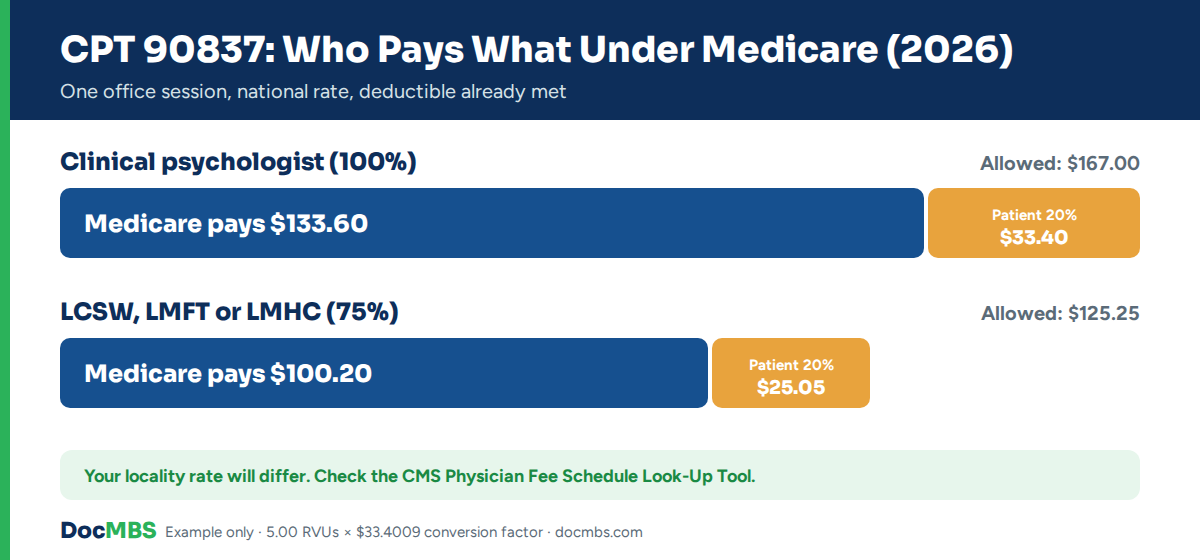
Example only, using the national Medicare rate. The patient has met the Part B deductible.
A therapist sees a Medicare patient in the office from 2:02 PM to 2:58 PM. That is 56 minutes of psychotherapy, so the code is 90837.
| Step | Clinical psychologist (100%) | LCSW, LMFT or LMHC (75%) |
|---|---|---|
| Medicare allowed amount | $167.00 | $125.25 |
| Patient coinsurance (20%) | $33.40 | $25.05 |
| Medicare pays (80%) | $133.60 | $100.20 |
Medicare payments are also reduced by the 2% sequestration cut, so the check will be slightly lower than the 80% shown.
Why the minutes matter: if the same session had ended at 2:52 PM, it would be 50 minutes and the correct code would be 90834, which pays less. Three more minutes changes the code. That is why exact times, not rounded ones, belong in the note.
Who Can Bill 90837?
Any clinician licensed to provide psychotherapy and enrolled with the payer can bill it. Under Medicare that includes:
- Psychiatrists and other physicians
- Clinical psychologists
- Clinical social workers (LCSW)
- Marriage and family therapists (LMFT) and mental health counselors (LMHC, LPC), who have been able to bill Medicare since January 1, 2024
- Nurse practitioners, clinical nurse specialists and physician assistants, when it is within their state scope of practice
Commercial plans and Medicaid have their own lists, and many require each therapist to be credentialed before the first claim.
90837 and E/M Visits: Use the Add-On Codes
A psychiatrist or nurse practitioner who does medication management and psychotherapy in the same visit should not bill 90837 with an E/M code. CPT has add-on codes for that:
| Psychotherapy time with an E/M visit | Add-on code | Stand-alone equivalent |
|---|---|---|
| 16–37 minutes | 90833 | 90832 |
| 38–52 minutes | 90836 | 90834 |
| 53 minutes or more | 90838 | 90837 |
The E/M level must be supported by its own work, and the psychotherapy minutes must be separate from the E/M time. Document both clearly. For complicated sessions, such as those needing an interpreter or play equipment, the add-on 90785 (interactive complexity) may be billed with 90837 if the payer covers it.
Telehealth Rules for 90837
90837 is widely covered by telehealth. Under Medicare:
- The patient’s home is a permanent allowed location for behavioral health telehealth.
- Place of service 10 means telehealth in the patient’s home. Place of service 02 means telehealth somewhere other than home.
- Claims with POS 10 are paid at the non-facility rate.
- The rule requiring an in-person visit before mental health telehealth does not apply until after December 31, 2027, per CMS’s telehealth FAQ.
- Audio-only sessions are allowed for behavioral health in certain cases. Report them with modifier 93.
Commercial payers differ. Many want modifier 95 for video visits, and some want a specific place of service. Check each payer’s telehealth policy, because a wrong POS or modifier is one of the easiest denials to avoid.
Step-by-Step: Audit-Proof Documentation
Payers use data to flag clinicians who bill 90837 far more often than their peers. A high share of 90837 is not wrong if your patients need it. It just means your notes must prove it.
- Record exact start and stop times. Write “2:02 PM–2:58 PM,” not “60 min.”
- State the diagnosis and link the session to it.
- Explain why a longer session was needed. Examples: trauma processing, exposure work, severe symptoms, a recent crisis.
- Name the therapy method used and what you did in the session.
- Note the patient’s response and progress toward treatment plan goals.
- Keep the treatment plan current, with the planned session length and frequency.
- Sign and date the note with your credentials.
- Check your own code mix every quarter. If 90837 is most of your claims, sample your notes to confirm they support it.
Pro Tip: On the therapy claims we review, the most common audit failure is not a short session. It is a note with no times at all. A good session with no start and stop time is treated as unsupported.
Common 90837 Denials and How to Fix Them
| Denial | What it means | How to fix it |
|---|---|---|
| CO-150 | Payer says the information does not support this level of service | Appeal with the note showing start and stop times and the reason for a 53+ minute session |
| CO-50 | Not medically necessary | Send the treatment plan, diagnosis and progress notes that show why this length of session is needed |
| CO-16 | Claim is missing information | Check the rendering provider, credential modifier, POS, telehealth modifier and authorization number, then resubmit |
| CO-97 | Service is bundled with another service | Do not bill 90837 with an E/M by the same clinician on the same day; use 90833, 90836 or 90838 |
| CO-151 | Payer says the frequency of services is not supported | Check visit limits and authorizations; appeal with the treatment plan if more frequent sessions are needed |
| CO-197 | No prior authorization | Some plans require authorization for 90837; verify benefits before the first session |
Some payers also downcode 90837 to 90834 automatically. If your documentation supports 53 minutes or more, appeal. If the downcodes keep coming, our behavioral health billing and denial management services can take that work off your desk.
Texas Medicaid Note
Texas Medicaid covers 90837, and the rate depends on the provider type. TMHP publishes it in the Outpatient Behavioral Health fee schedule. Most Texas Medicaid members are in managed care (STAR, STAR Kids, STAR+PLUS), so your contract with each health plan sets the final rate and any authorization rules.
Remember the short filing window too. Texas Medicaid claims are generally due within 95 days of the date of service.
Key Takeaways
- CPT code 90837 requires 53 minutes or more of psychotherapy. A 50-minute session is 90834.
- The 2026 Medicare national rate is about $167.00 non-facility and $135.27 facility, before locality adjustment.
- LCSWs, LMFTs and LMHCs are paid 75% of the fee schedule under Medicare.
- With an E/M visit, use add-on 90838 instead of 90837.
- Exact start and stop times are your best defense against CO-150 denials and downcodes.
FAQs
What is CPT code 90837?
CPT code 90837 is individual psychotherapy lasting 53 minutes or more with the patient. It is often called the 60-minute session code. It is billed as one unit per session by a licensed clinician such as a psychologist, clinical social worker, counselor, marriage and family therapist or psychiatrist.
How many minutes do you need to bill 90837?
You need at least 53 minutes of actual psychotherapy time. Sessions of 38 to 52 minutes are billed as 90834, and sessions of 16 to 37 minutes as 90832. Record the exact start and stop times in the note, because payers use them to check the code.
How much does Medicare pay for 90837 in 2026?
The 2026 national Medicare rate is about $167.00 in a non-facility setting and $135.27 in a facility, based on the $33.40 conversion factor. Your locality rate will differ. Medicare pays 80% after the deductible, and the patient owes 20%. Social workers and counselors are paid at 75%.
What is the difference between 90834 and 90837?
The difference is time. 90834 covers 38 to 52 minutes of psychotherapy, and 90837 covers 53 minutes or more. 90837 pays more, so payers review it more closely. A standard 45 or 50-minute session should be billed as 90834.
Can you bill 90837 with an E/M code?
No, not by the same clinician on the same day. When a prescriber provides both an E/M service and psychotherapy in one visit, they bill the E/M code plus a psychotherapy add-on: 90833, 90836 or 90838, depending on the psychotherapy minutes.
Can 90837 be billed for telehealth?
Yes. Medicare covers 90837 by telehealth, including when the patient is at home. Use place of service 10 for home and 02 for other locations, and modifier 93 for audio-only sessions. Commercial payers often require modifier 95, so check each payer’s policy.
Why do payers deny or downcode 90837?
The usual reasons are missing start and stop times, notes that do not explain why a longer session was needed, missing authorization, and billing patterns where nearly every session is 90837. Clear documentation and a current treatment plan prevent most of these denials.
Bill 90837 With Confidence
CPT code 90837 is fair payment for longer sessions, as long as the minutes and the medical need are in the note. Know the 53-minute rule, check your 2026 rate, and fix the small errors that cause most denials.
DocMBS handles billing for therapists and behavioral health practices every day. Book a free billing review and we’ll check your psychotherapy claims for downcodes, denials and missed revenue.
Sources
- CMS: CY 2026 Medicare Physician Fee Schedule Final Rule fact sheet (CMS-1832-F)
- CMS: Physician Fee Schedule Look-Up Tool
- CMS: Telehealth FAQ (updated February 26, 2026)
- TMHP: Texas Medicaid fee schedules
Last updated: October 2026. CPT® is a registered trademark of the American Medical Association. Code descriptions are paraphrased. This article is for education only. Confirm rates, coverage and documentation rules with each payer before billing.
Talk to our billing team
Book an appointment and discuss your practice's billing with a DocMBS specialist.