
By DocMBS Billing Team · Last updated: September 2026
The new Medicare daily rate for skilled nursing facility 2027 payments starts on October 1, 2026. If your billing system, your expected-payment tables or your Medicare Advantage contracts still use FY 2026 numbers, every October claim will look like an underpayment or an overpayment, and you won’t know which.
This guide gives you the final FY 2027 PDPM rates from the CMS final rule (CMS-1843-F), shows exactly how a resident’s per diem is built, walks through a full 30-day payment example, and lists the claim mistakes we see most often when a new fiscal year starts.
Quick Answer
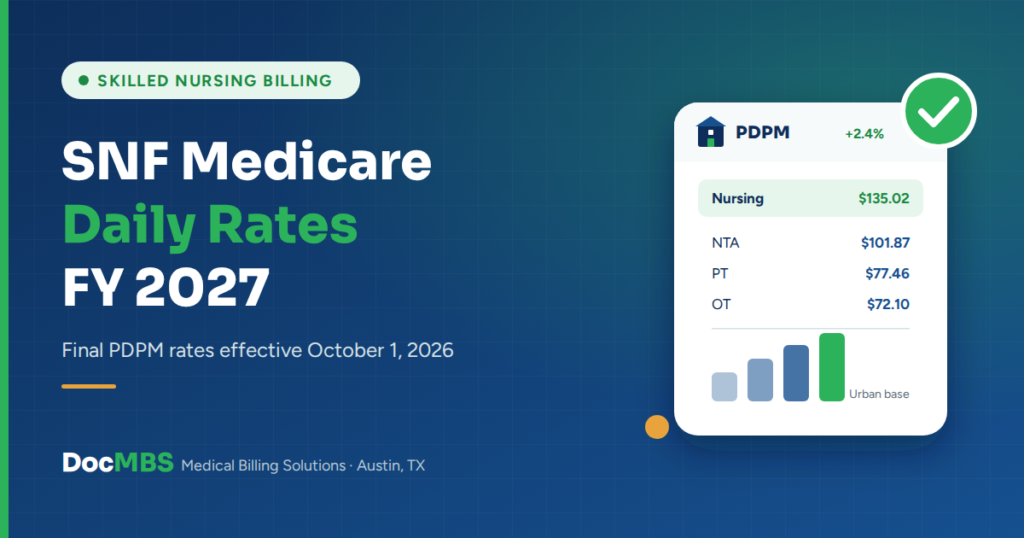
There is no single Medicare daily rate for a SNF in 2027. CMS pays a per diem built from six PDPM components. For FY 2027 (Oct 1, 2026 – Sep 30, 2027), rates rose 2.4%. The unadjusted urban base totals $536.29 and rural $555.32 before case-mix, wage index and variable per diem adjustments.
Table of Contents
- FY 2027 SNF Payment Update at a Glance
- FY 2027 Medicare Daily Rate for Skilled Nursing Facility Care: Unadjusted PDPM Rates
- Case-Mix Adjusted Component Rates (Selected Groups)
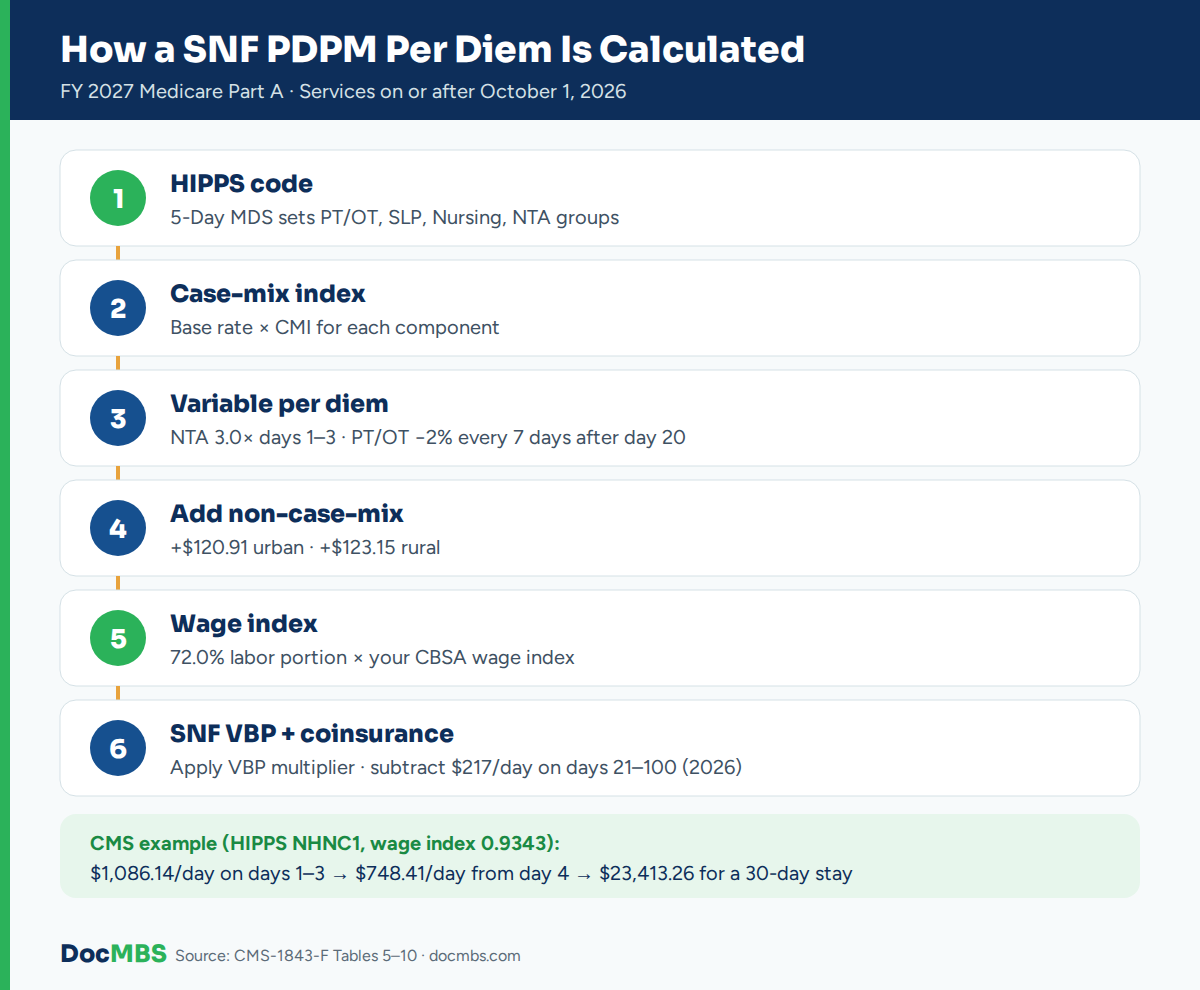
- How the SNF Medicare Daily Rate Is Calculated in 2027
- Worked Example: One Resident, 30 Days
- Texas Note: How Your Wage Index Changes the Net Rate
- Patient Side: SNF Coinsurance for Days 21–100
- What Else Changed in the FY 2027 Final Rule
- Step-by-Step: Getting Your Billing Ready for October 1
- Common Mistakes and Denials (and How to Fix Them)
- Key Takeaways
- FAQs
- Sources
FY 2027 SNF Payment Update at a Glance
CMS issued the FY 2027 Skilled Nursing Facility Prospective Payment System (SNF PPS) final rule on July 29, 2026. It was published in the Federal Register on July 31, 2026, and it takes effect for services on or after October 1, 2026.
| Item | FY 2027 Final | What it means for you |
|---|---|---|
| SNF market basket increase | 3.3% | Estimated input-price inflation for SNFs |
| Productivity adjustment | −0.9 percentage point | Required by law; reduces the update |
| Forecast error adjustment | None | FY 2025 miss was 0.2 point, under the 0.5 threshold |
| Net payment update | 2.4% | Applied to all six PDPM base rates |
| Wage index budget neutrality factor | 0.9989 | Already built into the rate tables below |
| Labor-related share | 72.0% (up from 71.9%) | Portion of the rate adjusted by your wage index |
| Wage index decrease cap | 5% per year (permanent) | Your wage index can’t drop more than 5% from last year |
| Estimated aggregate impact | +$882.74 million | Nationwide increase in SNF payments |
| SNF VBP impact | −$203.60 million | Net reduction for some SNFs under Value-Based Purchasing |
The proposed rule in April had a 3.2% market basket and a 0.8-point productivity cut. Both moved up by 0.1 point in the final rule, so the net 2.4% update did not change. The individual rates did shift by a few cents, which is why you should load the final tables, not the proposed ones.
FY 2027 Medicare Daily Rate for Skilled Nursing Facility Care: Unadjusted PDPM Rates
Under the Patient Driven Payment Model (PDPM), the Medicare daily rate is split into six components. Five are case-mix adjusted: physical therapy (PT), occupational therapy (OT), speech-language pathology (SLP), nursing and non-therapy ancillaries (NTA). The sixth, the non-case-mix component, is a flat amount that covers room, board and overhead.
Urban SNFs: FY 2027 vs FY 2026
| Component | FY 2026 | FY 2027 Final | Change |
|---|---|---|---|
| Physical Therapy (PT) | $75.73 | $77.46 | +$1.73 |
| Occupational Therapy (OT) | $70.49 | $72.10 | +$1.61 |
| Speech-Language Pathology (SLP) | $28.28 | $28.93 | +$0.65 |
| Nursing | $132.00 | $135.02 | +$3.02 |
| Non-Therapy Ancillaries (NTA) | $99.59 | $101.87 | +$2.28 |
| Non-Case-Mix | $118.21 | $120.91 | +$2.70 |
| Sum of base rates | $524.30 | $536.29 | +$11.99 |
Rural SNFs: FY 2027 vs FY 2026
| Component | FY 2026 | FY 2027 Final | Change |
|---|---|---|---|
| Physical Therapy (PT) | $86.33 | $88.30 | +$1.97 |
| Occupational Therapy (OT) | $79.29 | $81.10 | +$1.81 |
| Speech-Language Pathology (SLP) | $35.63 | $36.44 | +$0.81 |
| Nursing | $126.12 | $129.00 | +$2.88 |
| Non-Therapy Ancillaries (NTA) | $95.15 | $97.33 | +$2.18 |
| Non-Case-Mix | $120.40 | $123.15 | +$2.75 |
| Sum of base rates | $542.92 | $555.32 | +$12.40 |
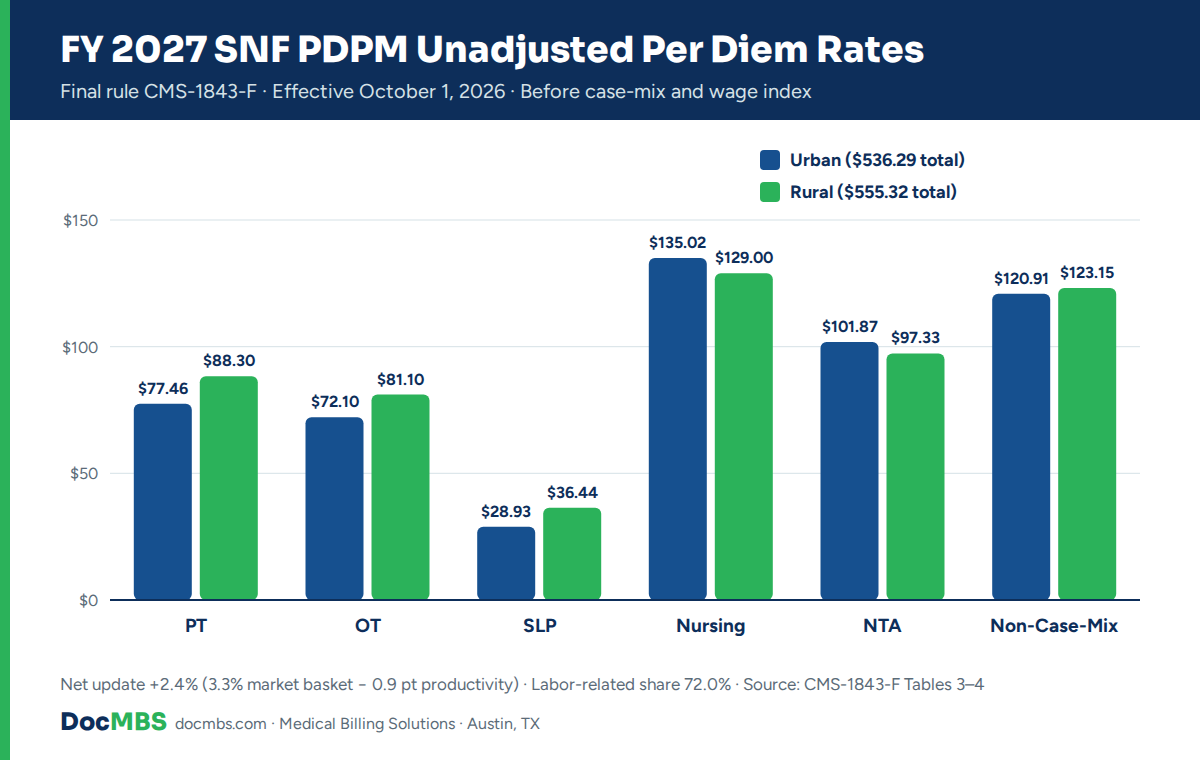
Source: CMS-1843-F, Tables 3 and 4. Rates reflect the 2.4% update and the 0.9989 wage index budget neutrality factor.
Watch Out: The “sum of base rates” is not what Medicare pays for a resident. Nobody is billed at a 1.00 case-mix index in every component. Use it only to compare years. The real per diem depends on the resident’s HIPPS code, your wage index and the day of the stay.
Why rural nursing is lower than urban: Rural SNFs get higher therapy, SLP and non-case-mix base rates, but a lower nursing base rate ($129.00 vs $135.02). Commenters asked CMS to fix this gap. CMS said it will consider it in future rulemaking but kept the rates as proposed for FY 2027.
Case-Mix Adjusted Component Rates (Selected Groups)
Each resident’s MDS assessment places them in one group per component. The group’s case-mix index (CMI) multiplies the base rate. CMS publishes the full grid in Tables 5 (urban) and 6 (rural) of the final rule. Here are common groups for quick reference.
| HIPPS character / group | Component | CMI | Urban rate | Rural rate |
|---|---|---|---|---|
| A (TA) | PT | 1.45 | $112.32 | $128.04 |
| N (TN) | PT | 1.40 | $108.44 | $123.62 |
| N (TN) | OT | 1.42 | $102.38 | $115.16 |
| A (SA) | SLP | 0.64 | $18.52 | $23.32 |
| H (SH) | SLP | 2.70 | $78.11 | $98.39 |
| ES3 | Nursing | 3.84 | $518.48 | $495.36 |
| HDE2 | Nursing | 2.27 | $306.50 | $292.83 |
| CBC2 (HIPPS 3rd character N) | Nursing | 1.47 | $198.48 | $189.63 |
| PA1 | Nursing | 0.62 | $83.71 | $79.98 |
| A (NA, 12+ points) | NTA | 3.06 | $311.72 | $297.83 |
| C (NC) | NTA | 1.74 | $177.25 | $169.35 |
| F (NF, 0 points) | NTA | 0.68 | $69.27 | $66.18 |
Source: CMS-1843-F, Tables 5 and 6. These amounts are before wage index, VPD and SNF VBP adjustments.
Pro Tip: Nursing and NTA drive most of the dollars. A resident who moves from NTA group F to group A on day 1 adds about $242 per day to the urban NTA component before the 3.0 VPD multiplier. That is why accurate Section I and Section O coding on the 5-Day MDS matters more than any other single step.
How the SNF Medicare Daily Rate Is Calculated in 2027
Every covered day follows the same math. Once you know the steps, you can check any remittance line in a few minutes.
- Find the HIPPS code. The 5-Day MDS (or an Interim Payment Assessment) sets the five-character HIPPS code. Characters 1–4 are the PT/OT, SLP, nursing and NTA groups. Character 5 is the assessment indicator.
- Apply the case-mix index. Multiply each component’s base rate by its CMI (or read the rate straight from Tables 5 and 6).
- Apply the variable per diem (VPD) adjustment.
- NTA: 3.0× on days 1–3, then 1.0× from day 4.
- PT and OT: 1.00 on days 1–20, then drops 2% every 7 days (0.98 on days 21–27, 0.96 on days 28–34, and so on).
- SLP, nursing and non-case-mix: no VPD adjustment.
- Add the non-case-mix component to get the total case-mix adjusted per diem.
- Split labor and non-labor. 72.0% of the total is labor-related for FY 2027. The other 28.0% is non-labor.
- Apply your wage index to the labor portion only, then add the non-labor portion back.
- Apply SNF VBP. Your MAC applies your facility’s value-based incentive payment multiplier to the adjusted rate.
- Subtract beneficiary coinsurance on days 21–100 to get Medicare’s share.
Not sure your October PDPM claims will pay right?
DocMBS reviews your HIPPS codes, MDS timing and expected-payment tables against the FY 2027 final rates before you submit. We catch the rate and coding gaps that turn into short payments and denials.
Worked Example: One Resident, 30 Days
CMS includes a hypothetical example in the final rule. We use it here because every number can be checked against the source. The facility is an urban SNF in Frederick, MD (CBSA 23224) with an FY 2027 wage index of 0.9343. The resident’s HIPPS code is NHNC1.
Step 1: Build the day 1–3 per diem
| Component | Group | Rate | VPD factor | Adjusted |
|---|---|---|---|---|
| PT | N | $108.44 | 1.00 | $108.44 |
| OT | N | $102.38 | 1.00 | $102.38 |
| SLP | H | $78.11 | 1.00 | $78.11 |
| Nursing | N (CBC2) | $198.48 | 1.00 | $198.48 |
| NTA | C | $177.25 | 3.00 | $531.75 |
| Non-case-mix | — | $120.91 | — | $120.91 |
| Total case-mix adjusted per diem | $1,140.07 | |||
Step 2: Apply the wage index
- Labor portion: $1,140.07 × 72.0% = $820.85
- Wage-adjusted labor: $820.85 × 0.9343 = $766.92
- Non-labor portion: $1,140.07 − $820.85 = $319.22
- Day 1–3 per diem: $766.92 + $319.22 = $1,086.14
Step 3: Follow the rate through the stay
| Days | NTA VPD | PT/OT VPD | Per diem | Subtotal |
|---|---|---|---|---|
| 1–3 | 3.00 | 1.00 | $1,086.14 | $3,258.42 |
| 4–20 | 1.00 | 1.00 | $748.41 | $12,722.97 |
| 21–27 | 1.00 | 0.98 | $744.39 | $5,210.73 |
| 28–30 | 1.00 | 0.96 | $740.38 | $2,221.14 |
| Total 30-day PPS payment | $23,413.26 | |||
Notice the drop on day 4: the per diem falls by $337.73 because the NTA multiplier goes from 3.0 to 1.0. If your team sees a lower payment starting day 4, that is expected, not an error.
Example: what Medicare actually sends. The $23,413.26 is the total PPS amount. Days 21–30 carry beneficiary coinsurance (10 days × $217 = $2,170 for 2026 dates of service). So the MAC’s payment on that stay would be about $21,243.26, before any SNF VBP adjustment or sequestration. The $2,170 becomes the patient’s, Medigap’s or Medicaid’s responsibility and posts as PR-2.
Texas Note: How Your Wage Index Changes the Net Rate
Texas has many urban CBSAs (Austin, Houston, Dallas, San Antonio, El Paso and more) plus rural Texas, and each one has its own wage index. Because 72% of the rate moves with the wage index, two Texas SNFs with the same resident mix can be paid very differently.
Here is the same NHNC1 resident using an illustrative wage index of 0.95. This is not the real value for any Texas area; it is only there to show the math.
| Scenario | Day 1–3 per diem | Day 4–20 per diem |
|---|---|---|
| CMS example (wage index 0.9343) | $1,086.14 | $748.41 |
| Illustrative wage index 0.95 | $1,099.03 | $757.29 |
A wage index just 0.016 higher adds about $9 per day from day 4. Over a 30-day stay and a full census, that difference adds up fast.
What Texas SNFs should do:
- Look up your CBSA (for example, Austin-Round Rock is CBSA 12420) in the FY 2027 final wage index tables on the CMS SNF Wage Index page.
- If your CBSA’s wage index fell more than 5% from FY 2026, the permanent 5% cap limits the drop. Confirm your MAC applied it.
- Rural Texas facilities use the rural rate table (Table 4 and Table 6), not the urban one.
- Keep Medicare and Texas Medicaid separate. Texas Medicaid nursing facility rates are set by the state (HHSC) and paid through STAR+PLUS managed care, not through Medicare PDPM. For dual-eligible residents, Texas Medicaid may pay the days 21–100 coinsurance as a crossover claim.
Novitas Solutions is the Part A MAC for Texas (Jurisdiction H). Check its site for the FY 2027 SNF Pricer update and any local billing notes.
Patient Side: SNF Coinsurance for Days 21–100
Many families search for the Medicare daily rate for skilled nursing facility care because they want to know what they will owe. Here is how Original Medicare Part A covers a qualifying SNF stay in each benefit period:
| Days in benefit period | Resident pays (2026) | Medicare pays |
|---|---|---|
| 1–20 | $0 | Full PPS rate |
| 21–100 | $217 per day | PPS rate minus $217 |
| 101 and after | All costs | Nothing |
Two points billers often miss:
- Coinsurance follows the calendar year, not the fiscal year. The $217 amount applies to SNF days in calendar year 2026, including October to December 2026. CMS announces the calendar year 2027 amount separately, usually in the fall.
- Coinsurance is tied to the inpatient deductible. It equals one-eighth of the Part A inpatient deductible ($1,736 ÷ 8 = $217 in 2026).
Coverage still requires a qualifying 3-day inpatient hospital stay (unless a waiver applies) and a daily need for skilled care.
What Else Changed in the FY 2027 Final Rule
Quality Reporting Program (QRP)
- Two COVID-19 vaccine measures removed starting with the FY 2028 SNF QRP (the healthcare personnel vaccination measure and the patient/resident up-to-date measure).
- Shorter data deadlines. Starting with the FY 2029 SNF QRP, quarterly QRP data is due by the 15th day of the second month after the quarter ends. That is about 45 days instead of 4.5 months.
- All-payer MDS reporting. Starting with the FY 2031 SNF QRP, SNFs must submit MDS data for every resident receiving covered skilled care, regardless of payer. That includes Medicare Advantage, Medicaid and commercial residents.
- The penalty still stands. A SNF that does not meet QRP reporting requirements loses 2.0 percentage points from its annual update. For FY 2027, that turns a 2.4% increase into 0.4%.
Value-Based Purchasing (VBP)
- CMS finalized performance standards for the FY 2029 and FY 2030 program years.
- The MDS “snapshot date” for two VBP measures moves to match the new QRP deadlines, starting with FY 2027 data.
- The 2% VBP withhold continues; each SNF earns back part, all or more of it based on its performance score.
PDPM coding and case-mix
- No substantive changes to PDPM ICD-10 mappings for FY 2027. Only non-substantive updates were posted on the CMS PDPM page.
- Codes such as R62.7 (adult failure to thrive) and M62.81 (generalized muscle weakness) stay in “Return to Provider.” They cannot be your primary diagnosis on a Part A claim.
- CMS ran a request for information on “case-mix creep.” It pointed to sharp rises in coded malnutrition (5% of stays before PDPM to 47% in FY 2024), swallowing disorders and depression. No cut was finalized for FY 2027, but CMS signaled a possible future adjustment.
Pro Tip: The case-mix creep RFI is a warning sign. On the SNF claims we work, the diagnoses and MDS items CMS named (malnutrition, dysphagia, depression) are exactly where documentation gaps show up in audits. Make sure every coded condition is supported in the physician and dietitian notes, not just on the MDS.
Step-by-Step: Getting Your Billing Ready for October 1
- Load the final FY 2027 rates. Update your billing system and expected-reimbursement tables with Tables 3–6 from CMS-1843-F. Delete any proposed-rule values you loaded in the spring.
- Confirm your wage index. Pull your CBSA’s FY 2027 value from the CMS wage index tables and check whether the 5% cap applies.
- Split claims by date of service. Bill September days and October days on separate monthly claims, as you normally do. FY 2027 rates apply to days on or after October 1, 2026.
- Check HIPPS codes on revenue code 0022. Each line needs the correct five-character HIPPS code and the right number of units (days).
- Audit 5-Day MDS timing. Late assessments mean default billing (HIPPS ZZZZZ) at the lowest rate for the late days.
- Review Medicare Advantage contracts. Many MA contracts pay a percentage of Medicare PDPM. Check whether your contracts update automatically on October 1 or need a new rate sheet.
- Update coinsurance logic. Keep $217 for 2026 dates and set a reminder to update January 1 when CMS releases the 2027 amount.
- Reconcile the first October remits. Compare paid amounts line by line against your own calculation. Flag any variance over a few dollars per day.
Common Mistakes and Denials (and How to Fix Them)
| Problem | What you’ll see | How to fix it |
|---|---|---|
| Missing or invalid HIPPS code, or HIPPS doesn’t match the MDS | Return to provider (RTP) or CO-16 (claim lacks information) | Match the HIPPS code to the accepted MDS in iQIES, correct the claim and resubmit |
| Late or missing 5-Day MDS | Payment at default rate (HIPPS ZZZZZ) | Track ARD windows daily; bill ZZZZZ only for the out-of-compliance days |
| Primary diagnosis maps to “Return to Provider” | Claim returned; can’t classify | Code the actual reason for the skilled stay (e.g. the condition treated, aftercare code) instead of symptom codes like R62.7 or M62.81 |
| Coinsurance not reported on days 21+ | Payment reduced; patient balance posted as PR-2 you didn’t expect | Report coinsurance days correctly and bill the secondary (Medigap or Medicaid crossover) |
| Skilled need not documented | CO-50 (not medically necessary) on review | Document daily skilled services; appeal with MDS, therapy and nursing notes |
| Outside provider bills Part B during a Part A stay | Consolidated billing rejection for the outside supplier (often CARC 109) | SNF bills the service on its Part A claim and pays the vendor under arrangement. |
| MA plan paid FY 2026 percentage | Underpayment with CO-45 | Appeal with your contract terms and the FY 2027 rate tables |
| Expected-payment table still on FY 2026 | Every October claim flags as a variance | Load the FY 2027 final rates before posting October payments |
SNF billing has little room for error. A single wrong HIPPS character can shift the per diem by hundreds of dollars. If you’d rather hand this work to a team that bills SNF claims every day, see our medical billing and RCM services.
Key Takeaways
- FY 2027 SNF PPS rates rise 2.4% for services from October 1, 2026 through September 30, 2027.
- Urban unadjusted base rates total $536.29; rural total $555.32. Nursing is the largest component ($135.02 urban).
- The labor-related share is 72.0%, so your wage index moves most of the rate.
- Missing QRP reporting cuts the update by 2 points, to 0.4%.
- Resident coinsurance for days 21–100 is $217/day in 2026; the 2027 amount comes later.
- CMS is studying case-mix creep, so tighten MDS and diagnosis documentation now.
FAQs
What is the Medicare daily rate for a skilled nursing facility in 2027?
There is no single flat rate. Medicare pays each SNF a per diem built from six PDPM components, adjusted for the resident’s case mix, the facility’s wage index and the day of the stay. For FY 2027, unadjusted urban base rates total $536.29 and rural rates total $555.32. Actual per diems commonly run from a few hundred dollars to over $1,000 a day.
When do the FY 2027 SNF PDPM rates take effect?
The FY 2027 rates apply to covered SNF days from October 1, 2026 through September 30, 2027. CMS issued the final rule (CMS-1843-F) on July 29, 2026, and it was published in the Federal Register on July 31, 2026. Days of service on or before September 30, 2026 are still paid at FY 2026 rates.
How much did Medicare SNF payments increase for FY 2027?
CMS finalized a 2.4% increase. That is a 3.3% SNF market basket update minus a 0.9 percentage point productivity adjustment. No forecast error adjustment applied. CMS estimates the update adds about $882.74 million to SNF payments nationally, though the SNF VBP program reduces payments to some facilities by an estimated $203.60 million.
What is the SNF coinsurance for days 21 to 100?
For 2026, the Medicare Part A coinsurance is $217 per day for SNF days 21 through 100 in a benefit period. Days 1–20 have no coinsurance, and after day 100 the resident pays all costs. Coinsurance follows the calendar year, so the 2027 amount will apply to days from January 1, 2027, once CMS announces it.
What happens if a SNF doesn’t meet QRP reporting requirements?
The SNF’s annual payment update is reduced by 2.0 percentage points for that fiscal year. For FY 2027, that means a 0.4% update instead of 2.4%. The cut is not cumulative, so it doesn’t carry into the next year’s base, but it applies to every Medicare Part A day billed during the penalty year.
Did the FY 2027 rule change PDPM ICD-10 code mappings?
No. CMS made no substantive changes to the PDPM ICD-10 mappings for FY 2027, only non-substantive updates posted on its PDPM website. Codes such as R62.7 and M62.81 remain in the “Return to Provider” category and cannot be the primary diagnosis on a Part A SNF claim.
Do Medicare Advantage plans have to pay the new PDPM rates?
No. Medicare Advantage plans pay SNFs based on their contracts. Many contracts are written as a percentage of Medicare PDPM, a per diem level system or a flat rate. Check whether your MA contracts update automatically on October 1. If a plan keeps paying FY 2026 amounts under a PDPM-linked contract, appeal the underpayment.
What is the labor-related share for SNFs in FY 2027?
The FY 2027 labor-related share is 72.0%, up slightly from 71.9% in FY 2026. Medicare multiplies 72.0% of a resident’s total case-mix adjusted per diem by the facility’s wage index, then adds back the remaining 28.0% non-labor portion. Facilities in high-wage areas gain the most from this split.
Get Your FY 2027 SNF Claims Paid Right the First Time
The Medicare daily rate for skilled nursing facility 2027 claims is higher, but only if your system, your MDS timing and your contracts all reflect the final rule. Load the final tables, confirm your wage index, and check your first October remits line by line.
DocMBS bills SNF claims every day, from HIPPS validation and consolidated billing to coinsurance crossovers and MA underpayment appeals. Book a free SNF billing review and we’ll check your FY 2027 setup before the first claim goes out.
Sources
- CMS Fact Sheet: Fiscal Year 2027 SNF PPS Final Rule (CMS-1843-F), July 29, 2026
- Federal Register: Medicare Program; Prospective Payment System and Consolidated Billing for Skilled Nursing Facilities; FY 2027 (CMS-1843-F), Tables 3–10, published July 31, 2026
- CMS: SNF PPS Wage Index (FY 2027 final wage index tables)
- Medicare.gov: Skilled nursing facility care coverage and costs
- CMS: Skilled Nursing Facility (SNF) PPS
Last updated: September 2026. This article is for education only and is not legal or reimbursement advice. Final payment depends on your MAC, your wage index, SNF VBP, sequestration and your payer contracts. Confirm rates with your MAC and the official CMS files before billing.
Talk to our billing team
Book an appointment and discuss your practice's billing with a DocMBS specialist.